 ROS Index
Repository Summary
| Checkout URI | https://github.com/ajtudela/rqt_lifecycle_manager.git |
| VCS Type | git |
| VCS Version | jazzy |
| Last Updated | 2026-09-30 |
| Dev Status | MAINTAINED |
| Released | RELEASED |
| Contributing |
Help Wanted (-)
Good First Issues (-) Pull Requests to Review (-) |
Packages
| Name | Version |
|---|---|
| rqt_lifecycle_manager | 0.2.0 |
README
rqt_lifecycle_manager




Overview
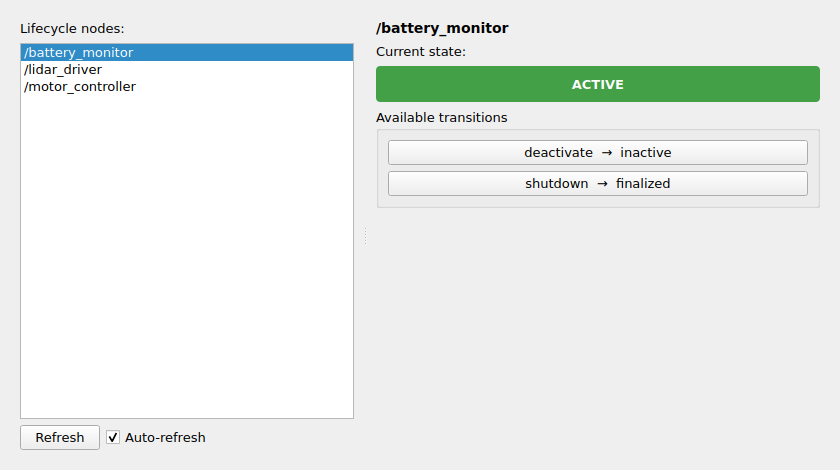
rqt_lifecycle_manager is an [rqt] plugin to inspect and control ROS 2 lifecycle nodes from a graphical interface. It lets you:
- List all lifecycle nodes currently present on the graph (auto-discovered).
- See the current state of the selected node, color-coded.
- Change to any available state through dynamically generated buttons (only valid transitions for the current state are shown).
The interface never blocks: every ROS 2 service call is issued asynchronously and its result is delivered back to the Qt GUI thread through signals, so the window stays responsive even if a node is slow to transition or does not answer at all.
Keywords: ROS2, rqt, lifecycle, lifecycle_msgs, state machine, GUI
Author: Alberto Tudela
The package has been tested under [ROS2] Jazzy on [Ubuntu] 24.04. This is research code, expect that it changes often and any fitness for a particular purpose is disclaimed.
How it works
ROS 2 lifecycle nodes expose their [managed state machine][lifecycle] through three services: ~/get_state, ~/get_available_transitions and ~/change_state. This plugin:
-
Discovers lifecycle nodes with a fast, local graph query (
get_service_names_and_types), filtering for nodes that offer a~/get_stateservice of typelifecycle_msgs/srv/GetState. - Queries the selected node’s state and available transitions.
- Requests a transition when you press a button.
All service calls use call_async. The plugin reuses the ROS 2 node that rqt_gui_py already spins in a background executor thread, so responses are processed off the GUI thread and marshaled back with Qt signals. The result is a non-blocking UI by design.
Installation
Binaries
On Ubuntu 24.04 you can install the latest version of this package using the following command
sudo apt-get update
sudo apt-get install ros-jazzy-rqt-lifecycle-manager
Building from Source
Dependencies
- Robot Operating System (ROS) 2 (middleware for robotics)
-
rqt_gui,rqt_gui_py,python_qt_binding(rqt framework) -
lifecycle_msgs(lifecycle service and message types)
Building
To build from source, clone the latest version from this repository into your colcon workspace and compile the package using:
cd colcon_workspace/src
git clone https://github.com/ajtudela/rqt_lifecycle_manager.git
cd ../
rosdep install -i --from-path src --rosdistro jazzy -y
colcon build --symlink-install
Usage
Source your workspace, then launch it in one of two ways.
Inside the generic rqt container (Plugins → Lifecycle → Lifecycle Manager):
rqt
Or as a standalone window:
ros2 run rqt_lifecycle_manager rqt_lifecycle_manager
Trying it out
Bring up any lifecycle node, for example the demo talker:
ros2 run lifecycle_py lifecycle_talker # or any of your lifecycle nodes
It will appear in the node list. Select it, and use the transition buttons (configure, activate, deactivate, cleanup, shutdown, …) to move it through its states. The state label updates automatically, even when the node is transitioned from another tool.
Nodes
This package does not provide a runtime node; it provides an rqt plugin. The plugin acts as a client of the standard lifecycle services of every managed node:
Services called (per managed node)
-
<node>/get_state(lifecycle_msgs/srv/GetState) Reads the current lifecycle state.
File truncated at 100 lines see the full file
CONTRIBUTING
Contributing
Contributions are welcome! Please open an issue to discuss substantial changes before submitting a pull request, keep the code passing the ament linters, and add tests for new behavior.
Any contribution that you make to this repository will be under the Apache 2 License, as dictated by that license:
5. Submission of Contributions. Unless You explicitly state otherwise,
   any Contribution intentionally submitted for inclusion in the Work
   by You to the Licensor shall be under the terms and conditions of
   this License, without any additional terms or conditions.
   Notwithstanding the above, nothing herein shall supersede or modify
   the terms of any separate license agreement you may have executed
   with Licensor regarding such Contributions.
Repository Summary
| Checkout URI | https://github.com/ajtudela/rqt_lifecycle_manager.git |
| VCS Type | git |
| VCS Version | jazzy |
| Last Updated | 2026-09-30 |
| Dev Status | MAINTAINED |
| Released | RELEASED |
| Contributing |
Help Wanted (-)
Good First Issues (-) Pull Requests to Review (-) |
Packages
| Name | Version |
|---|---|
| rqt_lifecycle_manager | 0.2.0 |
README
rqt_lifecycle_manager
Overview
rqt_lifecycle_manager is an [rqt] plugin to inspect and control ROS 2 lifecycle nodes from a graphical interface. It lets you:
- List all lifecycle nodes currently present on the graph (auto-discovered).
- See the current state of the selected node, color-coded.
- Change to any available state through dynamically generated buttons (only valid transitions for the current state are shown).
The interface never blocks: every ROS 2 service call is issued asynchronously and its result is delivered back to the Qt GUI thread through signals, so the window stays responsive even if a node is slow to transition or does not answer at all.
Keywords: ROS2, rqt, lifecycle, lifecycle_msgs, state machine, GUI
Author: Alberto Tudela
The package has been tested under [ROS2] Jazzy on [Ubuntu] 24.04. This is research code, expect that it changes often and any fitness for a particular purpose is disclaimed.
How it works
ROS 2 lifecycle nodes expose their [managed state machine][lifecycle] through three services: ~/get_state, ~/get_available_transitions and ~/change_state. This plugin:
-
Discovers lifecycle nodes with a fast, local graph query (
get_service_names_and_types), filtering for nodes that offer a~/get_stateservice of typelifecycle_msgs/srv/GetState. - Queries the selected node’s state and available transitions.
- Requests a transition when you press a button.
All service calls use call_async. The plugin reuses the ROS 2 node that rqt_gui_py already spins in a background executor thread, so responses are processed off the GUI thread and marshaled back with Qt signals. The result is a non-blocking UI by design.
Installation
Binaries
On Ubuntu 24.04 you can install the latest version of this package using the following command
sudo apt-get update
sudo apt-get install ros-jazzy-rqt-lifecycle-manager
Building from Source
Dependencies
- Robot Operating System (ROS) 2 (middleware for robotics)
-
rqt_gui,rqt_gui_py,python_qt_binding(rqt framework) -
lifecycle_msgs(lifecycle service and message types)
Building
To build from source, clone the latest version from this repository into your colcon workspace and compile the package using:
cd colcon_workspace/src
git clone https://github.com/ajtudela/rqt_lifecycle_manager.git
cd ../
rosdep install -i --from-path src --rosdistro jazzy -y
colcon build --symlink-install
Usage
Source your workspace, then launch it in one of two ways.
Inside the generic rqt container (Plugins → Lifecycle → Lifecycle Manager):
rqt
Or as a standalone window:
ros2 run rqt_lifecycle_manager rqt_lifecycle_manager
Trying it out
Bring up any lifecycle node, for example the demo talker:
ros2 run lifecycle_py lifecycle_talker # or any of your lifecycle nodes
It will appear in the node list. Select it, and use the transition buttons (configure, activate, deactivate, cleanup, shutdown, …) to move it through its states. The state label updates automatically, even when the node is transitioned from another tool.
Nodes
This package does not provide a runtime node; it provides an rqt plugin. The plugin acts as a client of the standard lifecycle services of every managed node:
Services called (per managed node)
-
<node>/get_state(lifecycle_msgs/srv/GetState) Reads the current lifecycle state.
File truncated at 100 lines see the full file
CONTRIBUTING
Contributing
Contributions are welcome! Please open an issue to discuss substantial changes before submitting a pull request, keep the code passing the ament linters, and add tests for new behavior.
Any contribution that you make to this repository will be under the Apache 2 License, as dictated by that license:
5. Submission of Contributions. Unless You explicitly state otherwise,
   any Contribution intentionally submitted for inclusion in the Work
   by You to the Licensor shall be under the terms and conditions of
   this License, without any additional terms or conditions.
   Notwithstanding the above, nothing herein shall supersede or modify
   the terms of any separate license agreement you may have executed
   with Licensor regarding such Contributions.
Repository Summary
| Checkout URI | https://github.com/ajtudela/rqt_lifecycle_manager.git |
| VCS Type | git |
| VCS Version | jazzy |
| Last Updated | 2026-09-30 |
| Dev Status | MAINTAINED |
| Released | RELEASED |
| Contributing |
Help Wanted (-)
Good First Issues (-) Pull Requests to Review (-) |
Packages
| Name | Version |
|---|---|
| rqt_lifecycle_manager | 0.2.0 |
README
rqt_lifecycle_manager
Overview
rqt_lifecycle_manager is an [rqt] plugin to inspect and control ROS 2 lifecycle nodes from a graphical interface. It lets you:
- List all lifecycle nodes currently present on the graph (auto-discovered).
- See the current state of the selected node, color-coded.
- Change to any available state through dynamically generated buttons (only valid transitions for the current state are shown).
The interface never blocks: every ROS 2 service call is issued asynchronously and its result is delivered back to the Qt GUI thread through signals, so the window stays responsive even if a node is slow to transition or does not answer at all.
Keywords: ROS2, rqt, lifecycle, lifecycle_msgs, state machine, GUI
Author: Alberto Tudela
The package has been tested under [ROS2] Jazzy on [Ubuntu] 24.04. This is research code, expect that it changes often and any fitness for a particular purpose is disclaimed.
How it works
ROS 2 lifecycle nodes expose their [managed state machine][lifecycle] through three services: ~/get_state, ~/get_available_transitions and ~/change_state. This plugin:
-
Discovers lifecycle nodes with a fast, local graph query (
get_service_names_and_types), filtering for nodes that offer a~/get_stateservice of typelifecycle_msgs/srv/GetState. - Queries the selected node’s state and available transitions.
- Requests a transition when you press a button.
All service calls use call_async. The plugin reuses the ROS 2 node that rqt_gui_py already spins in a background executor thread, so responses are processed off the GUI thread and marshaled back with Qt signals. The result is a non-blocking UI by design.
Installation
Binaries
On Ubuntu 24.04 you can install the latest version of this package using the following command
sudo apt-get update
sudo apt-get install ros-jazzy-rqt-lifecycle-manager
Building from Source
Dependencies
- Robot Operating System (ROS) 2 (middleware for robotics)
-
rqt_gui,rqt_gui_py,python_qt_binding(rqt framework) -
lifecycle_msgs(lifecycle service and message types)
Building
To build from source, clone the latest version from this repository into your colcon workspace and compile the package using:
cd colcon_workspace/src
git clone https://github.com/ajtudela/rqt_lifecycle_manager.git
cd ../
rosdep install -i --from-path src --rosdistro jazzy -y
colcon build --symlink-install
Usage
Source your workspace, then launch it in one of two ways.
Inside the generic rqt container (Plugins → Lifecycle → Lifecycle Manager):
rqt
Or as a standalone window:
ros2 run rqt_lifecycle_manager rqt_lifecycle_manager
Trying it out
Bring up any lifecycle node, for example the demo talker:
ros2 run lifecycle_py lifecycle_talker # or any of your lifecycle nodes
It will appear in the node list. Select it, and use the transition buttons (configure, activate, deactivate, cleanup, shutdown, …) to move it through its states. The state label updates automatically, even when the node is transitioned from another tool.
Nodes
This package does not provide a runtime node; it provides an rqt plugin. The plugin acts as a client of the standard lifecycle services of every managed node:
Services called (per managed node)
-
<node>/get_state(lifecycle_msgs/srv/GetState) Reads the current lifecycle state.
File truncated at 100 lines see the full file
CONTRIBUTING
Contributing
Contributions are welcome! Please open an issue to discuss substantial changes before submitting a pull request, keep the code passing the ament linters, and add tests for new behavior.
Any contribution that you make to this repository will be under the Apache 2 License, as dictated by that license:
5. Submission of Contributions. Unless You explicitly state otherwise,
   any Contribution intentionally submitted for inclusion in the Work
   by You to the Licensor shall be under the terms and conditions of
   this License, without any additional terms or conditions.
   Notwithstanding the above, nothing herein shall supersede or modify
   the terms of any separate license agreement you may have executed
   with Licensor regarding such Contributions.
Repository Summary
| Checkout URI | https://github.com/ajtudela/rqt_lifecycle_manager.git |
| VCS Type | git |
| VCS Version | jazzy |
| Last Updated | 2026-09-30 |
| Dev Status | MAINTAINED |
| Released | RELEASED |
| Contributing |
Help Wanted (-)
Good First Issues (-) Pull Requests to Review (-) |
Packages
| Name | Version |
|---|---|
| rqt_lifecycle_manager | 0.2.0 |
README
rqt_lifecycle_manager
Overview
rqt_lifecycle_manager is an [rqt] plugin to inspect and control ROS 2 lifecycle nodes from a graphical interface. It lets you:
- List all lifecycle nodes currently present on the graph (auto-discovered).
- See the current state of the selected node, color-coded.
- Change to any available state through dynamically generated buttons (only valid transitions for the current state are shown).
The interface never blocks: every ROS 2 service call is issued asynchronously and its result is delivered back to the Qt GUI thread through signals, so the window stays responsive even if a node is slow to transition or does not answer at all.
Keywords: ROS2, rqt, lifecycle, lifecycle_msgs, state machine, GUI
Author: Alberto Tudela
The package has been tested under [ROS2] Jazzy on [Ubuntu] 24.04. This is research code, expect that it changes often and any fitness for a particular purpose is disclaimed.
How it works
ROS 2 lifecycle nodes expose their [managed state machine][lifecycle] through three services: ~/get_state, ~/get_available_transitions and ~/change_state. This plugin:
-
Discovers lifecycle nodes with a fast, local graph query (
get_service_names_and_types), filtering for nodes that offer a~/get_stateservice of typelifecycle_msgs/srv/GetState. - Queries the selected node’s state and available transitions.
- Requests a transition when you press a button.
All service calls use call_async. The plugin reuses the ROS 2 node that rqt_gui_py already spins in a background executor thread, so responses are processed off the GUI thread and marshaled back with Qt signals. The result is a non-blocking UI by design.
Installation
Binaries
On Ubuntu 24.04 you can install the latest version of this package using the following command
sudo apt-get update
sudo apt-get install ros-jazzy-rqt-lifecycle-manager
Building from Source
Dependencies
- Robot Operating System (ROS) 2 (middleware for robotics)
-
rqt_gui,rqt_gui_py,python_qt_binding(rqt framework) -
lifecycle_msgs(lifecycle service and message types)
Building
To build from source, clone the latest version from this repository into your colcon workspace and compile the package using:
cd colcon_workspace/src
git clone https://github.com/ajtudela/rqt_lifecycle_manager.git
cd ../
rosdep install -i --from-path src --rosdistro jazzy -y
colcon build --symlink-install
Usage
Source your workspace, then launch it in one of two ways.
Inside the generic rqt container (Plugins → Lifecycle → Lifecycle Manager):
rqt
Or as a standalone window:
ros2 run rqt_lifecycle_manager rqt_lifecycle_manager
Trying it out
Bring up any lifecycle node, for example the demo talker:
ros2 run lifecycle_py lifecycle_talker # or any of your lifecycle nodes
It will appear in the node list. Select it, and use the transition buttons (configure, activate, deactivate, cleanup, shutdown, …) to move it through its states. The state label updates automatically, even when the node is transitioned from another tool.
Nodes
This package does not provide a runtime node; it provides an rqt plugin. The plugin acts as a client of the standard lifecycle services of every managed node:
Services called (per managed node)
-
<node>/get_state(lifecycle_msgs/srv/GetState) Reads the current lifecycle state.
File truncated at 100 lines see the full file
CONTRIBUTING
Contributing
Contributions are welcome! Please open an issue to discuss substantial changes before submitting a pull request, keep the code passing the ament linters, and add tests for new behavior.
Any contribution that you make to this repository will be under the Apache 2 License, as dictated by that license:
5. Submission of Contributions. Unless You explicitly state otherwise,
   any Contribution intentionally submitted for inclusion in the Work
   by You to the Licensor shall be under the terms and conditions of
   this License, without any additional terms or conditions.
   Notwithstanding the above, nothing herein shall supersede or modify
   the terms of any separate license agreement you may have executed
   with Licensor regarding such Contributions.
Repository Summary
| Checkout URI | https://github.com/ajtudela/rqt_lifecycle_manager.git |
| VCS Type | git |
| VCS Version | rolling |
| Last Updated | 2026-09-07 |
| Dev Status | MAINTAINED |
| Released | RELEASED |
| Contributing |
Help Wanted (-)
Good First Issues (-) Pull Requests to Review (-) |
Packages
| Name | Version |
|---|---|
| rqt_lifecycle_manager | 0.2.0 |
README
rqt_lifecycle_manager


Overview
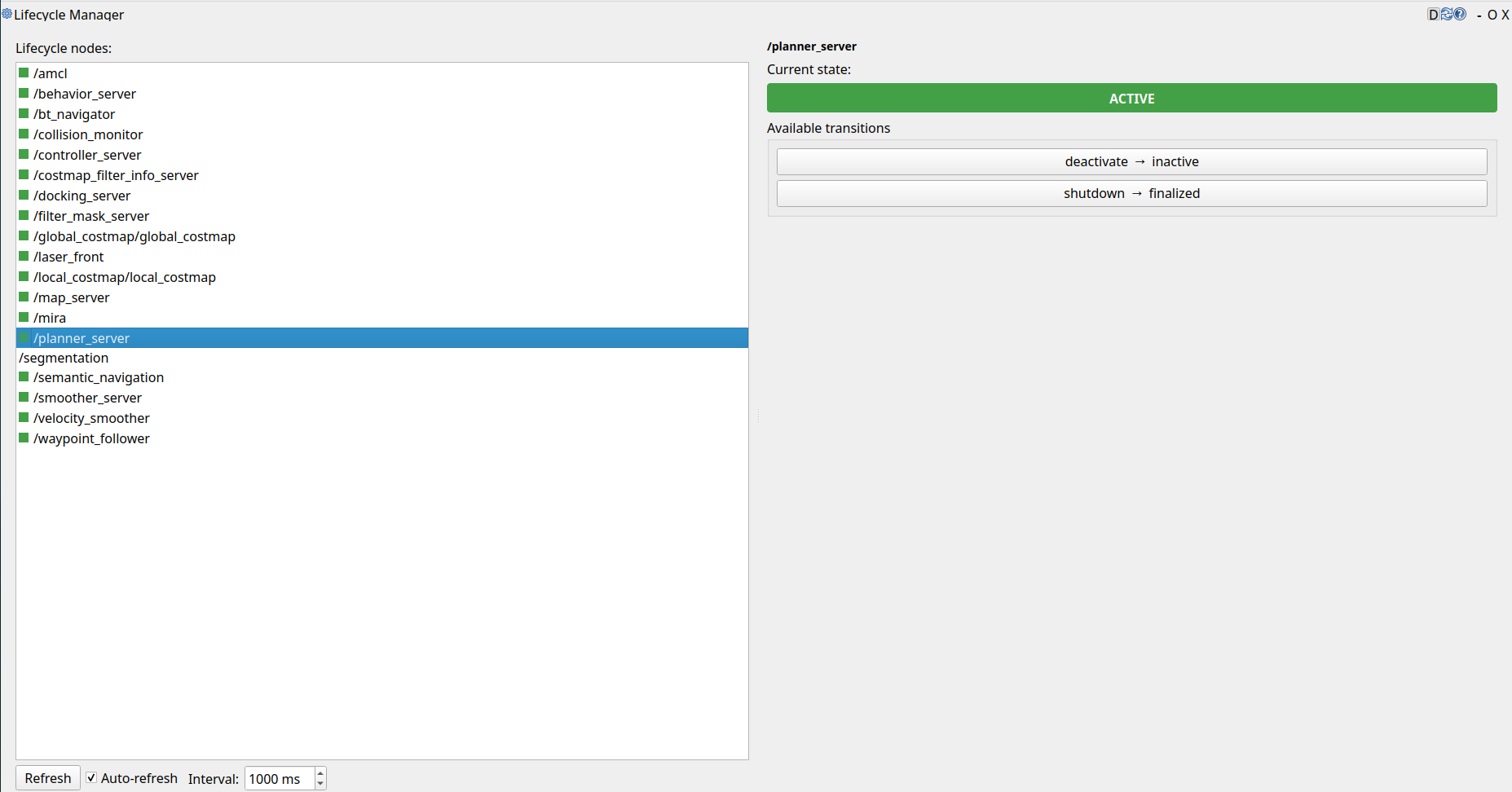
rqt_lifecycle_manager is an [rqt] plugin to inspect and control ROS 2 lifecycle nodes from a graphical interface. It lets you:
- List all lifecycle nodes currently present on the graph (auto-discovered).
- See the current state of the selected node, color-coded.
- Change to any available state through dynamically generated buttons (only valid transitions for the current state are shown).
The interface never blocks: every ROS 2 service call is issued asynchronously and its result is delivered back to the Qt GUI thread through signals, so the window stays responsive even if a node is slow to transition or does not answer at all.
Keywords: ROS2, rqt, lifecycle, lifecycle_msgs, state machine, GUI
Author: Alberto Tudela
The package has been tested under ROS2 Rolling on Ubuntu 24.04. This is research code, expect that it changes often and any fitness for a particular purpose is disclaimed.
How it works
ROS 2 lifecycle nodes expose their [managed state machine][lifecycle] through three services: ~/get_state, ~/get_available_transitions and ~/change_state. This plugin:
-
Discovers lifecycle nodes with a fast, local graph query (
get_service_names_and_types), filtering for nodes that offer a~/get_stateservice of typelifecycle_msgs/srv/GetState. - Queries the selected node’s state and available transitions.
- Requests a transition when you press a button.
All service calls use call_async. The plugin reuses the ROS 2 node that rqt_gui_py already spins in a background executor thread, so responses are processed off the GUI thread and marshaled back with Qt signals. The result is a non-blocking UI by design.
Installation
Building from Source
Dependencies
- Robot Operating System (ROS) 2 (middleware for robotics)
-
rqt_gui,rqt_gui_py,python_qt_binding(rqt framework) -
lifecycle_msgs(lifecycle service and message types)
Building
To build from source, clone the latest version from this repository into your colcon workspace and compile the package using:
cd colcon_workspace/src
git clone https://github.com/ajtudela/rqt_lifecycle_manager.git
cd ../
rosdep install -i --from-path src --rosdistro rolling -y
colcon build --symlink-install
Usage
Source your workspace, then launch it in one of two ways.
Inside the generic rqt container (Plugins → Lifecycle → Lifecycle Manager):
rqt
Or as a standalone window:
ros2 run rqt_lifecycle_manager rqt_lifecycle_manager
Trying it out
Bring up any lifecycle node, for example the demo talker:
ros2 run lifecycle_py lifecycle_talker # or any of your lifecycle nodes
It will appear in the node list. Select it, and use the transition buttons (configure, activate, deactivate, cleanup, shutdown, …) to move it through its states. The state label updates automatically, even when the node is transitioned from another tool.
Nodes
This package does not provide a runtime node; it provides an rqt plugin. The plugin acts as a client of the standard lifecycle services of every managed node:
Services called (per managed node)
-
<node>/get_state(lifecycle_msgs/srv/GetState) Reads the current lifecycle state. -
<node>/get_available_transitions(lifecycle_msgs/srv/GetAvailableTransitions) Lists the transitions valid from the current state. -
<node>/change_state(lifecycle_msgs/srv/ChangeState) Triggers a lifecycle transition.
File truncated at 100 lines see the full file
CONTRIBUTING
Contributing
Contributions are welcome! Please open an issue to discuss substantial changes before submitting a pull request, keep the code passing the ament linters, and add tests for new behavior.
Any contribution that you make to this repository will be under the Apache 2 License, as dictated by that license:
5. Submission of Contributions. Unless You explicitly state otherwise,
   any Contribution intentionally submitted for inclusion in the Work
   by You to the Licensor shall be under the terms and conditions of
   this License, without any additional terms or conditions.
   Notwithstanding the above, nothing herein shall supersede or modify
   the terms of any separate license agreement you may have executed
   with Licensor regarding such Contributions.
Repository Summary
| Checkout URI | https://github.com/ajtudela/rqt_lifecycle_manager.git |
| VCS Type | git |
| VCS Version | jazzy |
| Last Updated | 2026-09-30 |
| Dev Status | MAINTAINED |
| Released | RELEASED |
| Contributing |
Help Wanted (-)
Good First Issues (-) Pull Requests to Review (-) |
Packages
| Name | Version |
|---|---|
| rqt_lifecycle_manager | 0.2.0 |
README
rqt_lifecycle_manager
Overview
rqt_lifecycle_manager is an [rqt] plugin to inspect and control ROS 2 lifecycle nodes from a graphical interface. It lets you:
- List all lifecycle nodes currently present on the graph (auto-discovered).
- See the current state of the selected node, color-coded.
- Change to any available state through dynamically generated buttons (only valid transitions for the current state are shown).
The interface never blocks: every ROS 2 service call is issued asynchronously and its result is delivered back to the Qt GUI thread through signals, so the window stays responsive even if a node is slow to transition or does not answer at all.
Keywords: ROS2, rqt, lifecycle, lifecycle_msgs, state machine, GUI
Author: Alberto Tudela
The package has been tested under [ROS2] Jazzy on [Ubuntu] 24.04. This is research code, expect that it changes often and any fitness for a particular purpose is disclaimed.
How it works
ROS 2 lifecycle nodes expose their [managed state machine][lifecycle] through three services: ~/get_state, ~/get_available_transitions and ~/change_state. This plugin:
-
Discovers lifecycle nodes with a fast, local graph query (
get_service_names_and_types), filtering for nodes that offer a~/get_stateservice of typelifecycle_msgs/srv/GetState. - Queries the selected node’s state and available transitions.
- Requests a transition when you press a button.
All service calls use call_async. The plugin reuses the ROS 2 node that rqt_gui_py already spins in a background executor thread, so responses are processed off the GUI thread and marshaled back with Qt signals. The result is a non-blocking UI by design.
Installation
Binaries
On Ubuntu 24.04 you can install the latest version of this package using the following command
sudo apt-get update
sudo apt-get install ros-jazzy-rqt-lifecycle-manager
Building from Source
Dependencies
- Robot Operating System (ROS) 2 (middleware for robotics)
-
rqt_gui,rqt_gui_py,python_qt_binding(rqt framework) -
lifecycle_msgs(lifecycle service and message types)
Building
To build from source, clone the latest version from this repository into your colcon workspace and compile the package using:
cd colcon_workspace/src
git clone https://github.com/ajtudela/rqt_lifecycle_manager.git
cd ../
rosdep install -i --from-path src --rosdistro jazzy -y
colcon build --symlink-install
Usage
Source your workspace, then launch it in one of two ways.
Inside the generic rqt container (Plugins → Lifecycle → Lifecycle Manager):
rqt
Or as a standalone window:
ros2 run rqt_lifecycle_manager rqt_lifecycle_manager
Trying it out
Bring up any lifecycle node, for example the demo talker:
ros2 run lifecycle_py lifecycle_talker # or any of your lifecycle nodes
It will appear in the node list. Select it, and use the transition buttons (configure, activate, deactivate, cleanup, shutdown, …) to move it through its states. The state label updates automatically, even when the node is transitioned from another tool.
Nodes
This package does not provide a runtime node; it provides an rqt plugin. The plugin acts as a client of the standard lifecycle services of every managed node:
Services called (per managed node)
-
<node>/get_state(lifecycle_msgs/srv/GetState) Reads the current lifecycle state.
File truncated at 100 lines see the full file
CONTRIBUTING
Contributing
Contributions are welcome! Please open an issue to discuss substantial changes before submitting a pull request, keep the code passing the ament linters, and add tests for new behavior.
Any contribution that you make to this repository will be under the Apache 2 License, as dictated by that license:
5. Submission of Contributions. Unless You explicitly state otherwise,
   any Contribution intentionally submitted for inclusion in the Work
   by You to the Licensor shall be under the terms and conditions of
   this License, without any additional terms or conditions.
   Notwithstanding the above, nothing herein shall supersede or modify
   the terms of any separate license agreement you may have executed
   with Licensor regarding such Contributions.
Repository Summary
| Checkout URI | https://github.com/ajtudela/rqt_lifecycle_manager.git |
| VCS Type | git |
| VCS Version | jazzy |
| Last Updated | 2026-09-30 |
| Dev Status | MAINTAINED |
| Released | RELEASED |
| Contributing |
Help Wanted (-)
Good First Issues (-) Pull Requests to Review (-) |
Packages
| Name | Version |
|---|---|
| rqt_lifecycle_manager | 0.2.0 |
README
rqt_lifecycle_manager
Overview
rqt_lifecycle_manager is an [rqt] plugin to inspect and control ROS 2 lifecycle nodes from a graphical interface. It lets you:
- List all lifecycle nodes currently present on the graph (auto-discovered).
- See the current state of the selected node, color-coded.
- Change to any available state through dynamically generated buttons (only valid transitions for the current state are shown).
The interface never blocks: every ROS 2 service call is issued asynchronously and its result is delivered back to the Qt GUI thread through signals, so the window stays responsive even if a node is slow to transition or does not answer at all.
Keywords: ROS2, rqt, lifecycle, lifecycle_msgs, state machine, GUI
Author: Alberto Tudela
The package has been tested under [ROS2] Jazzy on [Ubuntu] 24.04. This is research code, expect that it changes often and any fitness for a particular purpose is disclaimed.
How it works
ROS 2 lifecycle nodes expose their [managed state machine][lifecycle] through three services: ~/get_state, ~/get_available_transitions and ~/change_state. This plugin:
-
Discovers lifecycle nodes with a fast, local graph query (
get_service_names_and_types), filtering for nodes that offer a~/get_stateservice of typelifecycle_msgs/srv/GetState. - Queries the selected node’s state and available transitions.
- Requests a transition when you press a button.
All service calls use call_async. The plugin reuses the ROS 2 node that rqt_gui_py already spins in a background executor thread, so responses are processed off the GUI thread and marshaled back with Qt signals. The result is a non-blocking UI by design.
Installation
Binaries
On Ubuntu 24.04 you can install the latest version of this package using the following command
sudo apt-get update
sudo apt-get install ros-jazzy-rqt-lifecycle-manager
Building from Source
Dependencies
- Robot Operating System (ROS) 2 (middleware for robotics)
-
rqt_gui,rqt_gui_py,python_qt_binding(rqt framework) -
lifecycle_msgs(lifecycle service and message types)
Building
To build from source, clone the latest version from this repository into your colcon workspace and compile the package using:
cd colcon_workspace/src
git clone https://github.com/ajtudela/rqt_lifecycle_manager.git
cd ../
rosdep install -i --from-path src --rosdistro jazzy -y
colcon build --symlink-install
Usage
Source your workspace, then launch it in one of two ways.
Inside the generic rqt container (Plugins → Lifecycle → Lifecycle Manager):
rqt
Or as a standalone window:
ros2 run rqt_lifecycle_manager rqt_lifecycle_manager
Trying it out
Bring up any lifecycle node, for example the demo talker:
ros2 run lifecycle_py lifecycle_talker # or any of your lifecycle nodes
It will appear in the node list. Select it, and use the transition buttons (configure, activate, deactivate, cleanup, shutdown, …) to move it through its states. The state label updates automatically, even when the node is transitioned from another tool.
Nodes
This package does not provide a runtime node; it provides an rqt plugin. The plugin acts as a client of the standard lifecycle services of every managed node:
Services called (per managed node)
-
<node>/get_state(lifecycle_msgs/srv/GetState) Reads the current lifecycle state.
File truncated at 100 lines see the full file
CONTRIBUTING
Contributing
Contributions are welcome! Please open an issue to discuss substantial changes before submitting a pull request, keep the code passing the ament linters, and add tests for new behavior.
Any contribution that you make to this repository will be under the Apache 2 License, as dictated by that license:
5. Submission of Contributions. Unless You explicitly state otherwise,
   any Contribution intentionally submitted for inclusion in the Work
   by You to the Licensor shall be under the terms and conditions of
   this License, without any additional terms or conditions.
   Notwithstanding the above, nothing herein shall supersede or modify
   the terms of any separate license agreement you may have executed
   with Licensor regarding such Contributions.
Repository Summary
| Checkout URI | https://github.com/ajtudela/rqt_lifecycle_manager.git |
| VCS Type | git |
| VCS Version | jazzy |
| Last Updated | 2026-09-30 |
| Dev Status | MAINTAINED |
| Released | RELEASED |
| Contributing |
Help Wanted (-)
Good First Issues (-) Pull Requests to Review (-) |
Packages
| Name | Version |
|---|---|
| rqt_lifecycle_manager | 0.2.0 |
README
rqt_lifecycle_manager
Overview
rqt_lifecycle_manager is an [rqt] plugin to inspect and control ROS 2 lifecycle nodes from a graphical interface. It lets you:
- List all lifecycle nodes currently present on the graph (auto-discovered).
- See the current state of the selected node, color-coded.
- Change to any available state through dynamically generated buttons (only valid transitions for the current state are shown).
The interface never blocks: every ROS 2 service call is issued asynchronously and its result is delivered back to the Qt GUI thread through signals, so the window stays responsive even if a node is slow to transition or does not answer at all.
Keywords: ROS2, rqt, lifecycle, lifecycle_msgs, state machine, GUI
Author: Alberto Tudela
The package has been tested under [ROS2] Jazzy on [Ubuntu] 24.04. This is research code, expect that it changes often and any fitness for a particular purpose is disclaimed.
How it works
ROS 2 lifecycle nodes expose their [managed state machine][lifecycle] through three services: ~/get_state, ~/get_available_transitions and ~/change_state. This plugin:
-
Discovers lifecycle nodes with a fast, local graph query (
get_service_names_and_types), filtering for nodes that offer a~/get_stateservice of typelifecycle_msgs/srv/GetState. - Queries the selected node’s state and available transitions.
- Requests a transition when you press a button.
All service calls use call_async. The plugin reuses the ROS 2 node that rqt_gui_py already spins in a background executor thread, so responses are processed off the GUI thread and marshaled back with Qt signals. The result is a non-blocking UI by design.
Installation
Binaries
On Ubuntu 24.04 you can install the latest version of this package using the following command
sudo apt-get update
sudo apt-get install ros-jazzy-rqt-lifecycle-manager
Building from Source
Dependencies
- Robot Operating System (ROS) 2 (middleware for robotics)
-
rqt_gui,rqt_gui_py,python_qt_binding(rqt framework) -
lifecycle_msgs(lifecycle service and message types)
Building
To build from source, clone the latest version from this repository into your colcon workspace and compile the package using:
cd colcon_workspace/src
git clone https://github.com/ajtudela/rqt_lifecycle_manager.git
cd ../
rosdep install -i --from-path src --rosdistro jazzy -y
colcon build --symlink-install
Usage
Source your workspace, then launch it in one of two ways.
Inside the generic rqt container (Plugins → Lifecycle → Lifecycle Manager):
rqt
Or as a standalone window:
ros2 run rqt_lifecycle_manager rqt_lifecycle_manager
Trying it out
Bring up any lifecycle node, for example the demo talker:
ros2 run lifecycle_py lifecycle_talker # or any of your lifecycle nodes
It will appear in the node list. Select it, and use the transition buttons (configure, activate, deactivate, cleanup, shutdown, …) to move it through its states. The state label updates automatically, even when the node is transitioned from another tool.
Nodes
This package does not provide a runtime node; it provides an rqt plugin. The plugin acts as a client of the standard lifecycle services of every managed node:
Services called (per managed node)
-
<node>/get_state(lifecycle_msgs/srv/GetState) Reads the current lifecycle state.
File truncated at 100 lines see the full file
CONTRIBUTING
Contributing
Contributions are welcome! Please open an issue to discuss substantial changes before submitting a pull request, keep the code passing the ament linters, and add tests for new behavior.
Any contribution that you make to this repository will be under the Apache 2 License, as dictated by that license:
5. Submission of Contributions. Unless You explicitly state otherwise,
   any Contribution intentionally submitted for inclusion in the Work
   by You to the Licensor shall be under the terms and conditions of
   this License, without any additional terms or conditions.
   Notwithstanding the above, nothing herein shall supersede or modify
   the terms of any separate license agreement you may have executed
   with Licensor regarding such Contributions.
Repository Summary
| Checkout URI | https://github.com/ajtudela/rqt_lifecycle_manager.git |
| VCS Type | git |
| VCS Version | jazzy |
| Last Updated | 2026-09-30 |
| Dev Status | MAINTAINED |
| Released | RELEASED |
| Contributing |
Help Wanted (-)
Good First Issues (-) Pull Requests to Review (-) |
Packages
| Name | Version |
|---|---|
| rqt_lifecycle_manager | 0.2.0 |
README
rqt_lifecycle_manager
Overview
rqt_lifecycle_manager is an [rqt] plugin to inspect and control ROS 2 lifecycle nodes from a graphical interface. It lets you:
- List all lifecycle nodes currently present on the graph (auto-discovered).
- See the current state of the selected node, color-coded.
- Change to any available state through dynamically generated buttons (only valid transitions for the current state are shown).
The interface never blocks: every ROS 2 service call is issued asynchronously and its result is delivered back to the Qt GUI thread through signals, so the window stays responsive even if a node is slow to transition or does not answer at all.
Keywords: ROS2, rqt, lifecycle, lifecycle_msgs, state machine, GUI
Author: Alberto Tudela
The package has been tested under [ROS2] Jazzy on [Ubuntu] 24.04. This is research code, expect that it changes often and any fitness for a particular purpose is disclaimed.
How it works
ROS 2 lifecycle nodes expose their [managed state machine][lifecycle] through three services: ~/get_state, ~/get_available_transitions and ~/change_state. This plugin:
-
Discovers lifecycle nodes with a fast, local graph query (
get_service_names_and_types), filtering for nodes that offer a~/get_stateservice of typelifecycle_msgs/srv/GetState. - Queries the selected node’s state and available transitions.
- Requests a transition when you press a button.
All service calls use call_async. The plugin reuses the ROS 2 node that rqt_gui_py already spins in a background executor thread, so responses are processed off the GUI thread and marshaled back with Qt signals. The result is a non-blocking UI by design.
Installation
Binaries
On Ubuntu 24.04 you can install the latest version of this package using the following command
sudo apt-get update
sudo apt-get install ros-jazzy-rqt-lifecycle-manager
Building from Source
Dependencies
- Robot Operating System (ROS) 2 (middleware for robotics)
-
rqt_gui,rqt_gui_py,python_qt_binding(rqt framework) -
lifecycle_msgs(lifecycle service and message types)
Building
To build from source, clone the latest version from this repository into your colcon workspace and compile the package using:
cd colcon_workspace/src
git clone https://github.com/ajtudela/rqt_lifecycle_manager.git
cd ../
rosdep install -i --from-path src --rosdistro jazzy -y
colcon build --symlink-install
Usage
Source your workspace, then launch it in one of two ways.
Inside the generic rqt container (Plugins → Lifecycle → Lifecycle Manager):
rqt
Or as a standalone window:
ros2 run rqt_lifecycle_manager rqt_lifecycle_manager
Trying it out
Bring up any lifecycle node, for example the demo talker:
ros2 run lifecycle_py lifecycle_talker # or any of your lifecycle nodes
It will appear in the node list. Select it, and use the transition buttons (configure, activate, deactivate, cleanup, shutdown, …) to move it through its states. The state label updates automatically, even when the node is transitioned from another tool.
Nodes
This package does not provide a runtime node; it provides an rqt plugin. The plugin acts as a client of the standard lifecycle services of every managed node:
Services called (per managed node)
-
<node>/get_state(lifecycle_msgs/srv/GetState) Reads the current lifecycle state.
File truncated at 100 lines see the full file
CONTRIBUTING
Contributing
Contributions are welcome! Please open an issue to discuss substantial changes before submitting a pull request, keep the code passing the ament linters, and add tests for new behavior.
Any contribution that you make to this repository will be under the Apache 2 License, as dictated by that license:
5. Submission of Contributions. Unless You explicitly state otherwise,
   any Contribution intentionally submitted for inclusion in the Work
   by You to the Licensor shall be under the terms and conditions of
   this License, without any additional terms or conditions.
   Notwithstanding the above, nothing herein shall supersede or modify
   the terms of any separate license agreement you may have executed
   with Licensor regarding such Contributions.
Repository Summary
| Checkout URI | https://github.com/ajtudela/rqt_lifecycle_manager.git |
| VCS Type | git |
| VCS Version | jazzy |
| Last Updated | 2026-09-30 |
| Dev Status | MAINTAINED |
| Released | RELEASED |
| Contributing |
Help Wanted (-)
Good First Issues (-) Pull Requests to Review (-) |
Packages
| Name | Version |
|---|---|
| rqt_lifecycle_manager | 0.2.0 |
README
rqt_lifecycle_manager
Overview
rqt_lifecycle_manager is an [rqt] plugin to inspect and control ROS 2 lifecycle nodes from a graphical interface. It lets you:
- List all lifecycle nodes currently present on the graph (auto-discovered).
- See the current state of the selected node, color-coded.
- Change to any available state through dynamically generated buttons (only valid transitions for the current state are shown).
The interface never blocks: every ROS 2 service call is issued asynchronously and its result is delivered back to the Qt GUI thread through signals, so the window stays responsive even if a node is slow to transition or does not answer at all.
Keywords: ROS2, rqt, lifecycle, lifecycle_msgs, state machine, GUI
Author: Alberto Tudela
The package has been tested under [ROS2] Jazzy on [Ubuntu] 24.04. This is research code, expect that it changes often and any fitness for a particular purpose is disclaimed.
How it works
ROS 2 lifecycle nodes expose their [managed state machine][lifecycle] through three services: ~/get_state, ~/get_available_transitions and ~/change_state. This plugin:
-
Discovers lifecycle nodes with a fast, local graph query (
get_service_names_and_types), filtering for nodes that offer a~/get_stateservice of typelifecycle_msgs/srv/GetState. - Queries the selected node’s state and available transitions.
- Requests a transition when you press a button.
All service calls use call_async. The plugin reuses the ROS 2 node that rqt_gui_py already spins in a background executor thread, so responses are processed off the GUI thread and marshaled back with Qt signals. The result is a non-blocking UI by design.
Installation
Binaries
On Ubuntu 24.04 you can install the latest version of this package using the following command
sudo apt-get update
sudo apt-get install ros-jazzy-rqt-lifecycle-manager
Building from Source
Dependencies
- Robot Operating System (ROS) 2 (middleware for robotics)
-
rqt_gui,rqt_gui_py,python_qt_binding(rqt framework) -
lifecycle_msgs(lifecycle service and message types)
Building
To build from source, clone the latest version from this repository into your colcon workspace and compile the package using:
cd colcon_workspace/src
git clone https://github.com/ajtudela/rqt_lifecycle_manager.git
cd ../
rosdep install -i --from-path src --rosdistro jazzy -y
colcon build --symlink-install
Usage
Source your workspace, then launch it in one of two ways.
Inside the generic rqt container (Plugins → Lifecycle → Lifecycle Manager):
rqt
Or as a standalone window:
ros2 run rqt_lifecycle_manager rqt_lifecycle_manager
Trying it out
Bring up any lifecycle node, for example the demo talker:
ros2 run lifecycle_py lifecycle_talker # or any of your lifecycle nodes
It will appear in the node list. Select it, and use the transition buttons (configure, activate, deactivate, cleanup, shutdown, …) to move it through its states. The state label updates automatically, even when the node is transitioned from another tool.
Nodes
This package does not provide a runtime node; it provides an rqt plugin. The plugin acts as a client of the standard lifecycle services of every managed node:
Services called (per managed node)
-
<node>/get_state(lifecycle_msgs/srv/GetState) Reads the current lifecycle state.
File truncated at 100 lines see the full file
CONTRIBUTING
Contributing
Contributions are welcome! Please open an issue to discuss substantial changes before submitting a pull request, keep the code passing the ament linters, and add tests for new behavior.
Any contribution that you make to this repository will be under the Apache 2 License, as dictated by that license:
5. Submission of Contributions. Unless You explicitly state otherwise,
   any Contribution intentionally submitted for inclusion in the Work
   by You to the Licensor shall be under the terms and conditions of
   this License, without any additional terms or conditions.
   Notwithstanding the above, nothing herein shall supersede or modify
   the terms of any separate license agreement you may have executed
   with Licensor regarding such Contributions.
Repository Summary
| Checkout URI | https://github.com/ajtudela/rqt_lifecycle_manager.git |
| VCS Type | git |
| VCS Version | jazzy |
| Last Updated | 2026-09-30 |
| Dev Status | MAINTAINED |
| Released | RELEASED |
| Contributing |
Help Wanted (-)
Good First Issues (-) Pull Requests to Review (-) |
Packages
| Name | Version |
|---|---|
| rqt_lifecycle_manager | 0.2.0 |
README
rqt_lifecycle_manager
Overview
rqt_lifecycle_manager is an [rqt] plugin to inspect and control ROS 2 lifecycle nodes from a graphical interface. It lets you:
- List all lifecycle nodes currently present on the graph (auto-discovered).
- See the current state of the selected node, color-coded.
- Change to any available state through dynamically generated buttons (only valid transitions for the current state are shown).
The interface never blocks: every ROS 2 service call is issued asynchronously and its result is delivered back to the Qt GUI thread through signals, so the window stays responsive even if a node is slow to transition or does not answer at all.
Keywords: ROS2, rqt, lifecycle, lifecycle_msgs, state machine, GUI
Author: Alberto Tudela
The package has been tested under [ROS2] Jazzy on [Ubuntu] 24.04. This is research code, expect that it changes often and any fitness for a particular purpose is disclaimed.
How it works
ROS 2 lifecycle nodes expose their [managed state machine][lifecycle] through three services: ~/get_state, ~/get_available_transitions and ~/change_state. This plugin:
-
Discovers lifecycle nodes with a fast, local graph query (
get_service_names_and_types), filtering for nodes that offer a~/get_stateservice of typelifecycle_msgs/srv/GetState. - Queries the selected node’s state and available transitions.
- Requests a transition when you press a button.
All service calls use call_async. The plugin reuses the ROS 2 node that rqt_gui_py already spins in a background executor thread, so responses are processed off the GUI thread and marshaled back with Qt signals. The result is a non-blocking UI by design.
Installation
Binaries
On Ubuntu 24.04 you can install the latest version of this package using the following command
sudo apt-get update
sudo apt-get install ros-jazzy-rqt-lifecycle-manager
Building from Source
Dependencies
- Robot Operating System (ROS) 2 (middleware for robotics)
-
rqt_gui,rqt_gui_py,python_qt_binding(rqt framework) -
lifecycle_msgs(lifecycle service and message types)
Building
To build from source, clone the latest version from this repository into your colcon workspace and compile the package using:
cd colcon_workspace/src
git clone https://github.com/ajtudela/rqt_lifecycle_manager.git
cd ../
rosdep install -i --from-path src --rosdistro jazzy -y
colcon build --symlink-install
Usage
Source your workspace, then launch it in one of two ways.
Inside the generic rqt container (Plugins → Lifecycle → Lifecycle Manager):
rqt
Or as a standalone window:
ros2 run rqt_lifecycle_manager rqt_lifecycle_manager
Trying it out
Bring up any lifecycle node, for example the demo talker:
ros2 run lifecycle_py lifecycle_talker # or any of your lifecycle nodes
It will appear in the node list. Select it, and use the transition buttons (configure, activate, deactivate, cleanup, shutdown, …) to move it through its states. The state label updates automatically, even when the node is transitioned from another tool.
Nodes
This package does not provide a runtime node; it provides an rqt plugin. The plugin acts as a client of the standard lifecycle services of every managed node:
Services called (per managed node)
-
<node>/get_state(lifecycle_msgs/srv/GetState) Reads the current lifecycle state.
File truncated at 100 lines see the full file
CONTRIBUTING
Contributing
Contributions are welcome! Please open an issue to discuss substantial changes before submitting a pull request, keep the code passing the ament linters, and add tests for new behavior.
Any contribution that you make to this repository will be under the Apache 2 License, as dictated by that license:
5. Submission of Contributions. Unless You explicitly state otherwise,
   any Contribution intentionally submitted for inclusion in the Work
   by You to the Licensor shall be under the terms and conditions of
   this License, without any additional terms or conditions.
   Notwithstanding the above, nothing herein shall supersede or modify
   the terms of any separate license agreement you may have executed
   with Licensor regarding such Contributions.
Repository Summary
| Checkout URI | https://github.com/ajtudela/rqt_lifecycle_manager.git |
| VCS Type | git |
| VCS Version | jazzy |
| Last Updated | 2026-09-30 |
| Dev Status | MAINTAINED |
| Released | RELEASED |
| Contributing |
Help Wanted (-)
Good First Issues (-) Pull Requests to Review (-) |
Packages
| Name | Version |
|---|---|
| rqt_lifecycle_manager | 0.2.0 |
README
rqt_lifecycle_manager
Overview
rqt_lifecycle_manager is an [rqt] plugin to inspect and control ROS 2 lifecycle nodes from a graphical interface. It lets you:
- List all lifecycle nodes currently present on the graph (auto-discovered).
- See the current state of the selected node, color-coded.
- Change to any available state through dynamically generated buttons (only valid transitions for the current state are shown).
The interface never blocks: every ROS 2 service call is issued asynchronously and its result is delivered back to the Qt GUI thread through signals, so the window stays responsive even if a node is slow to transition or does not answer at all.
Keywords: ROS2, rqt, lifecycle, lifecycle_msgs, state machine, GUI
Author: Alberto Tudela
The package has been tested under [ROS2] Jazzy on [Ubuntu] 24.04. This is research code, expect that it changes often and any fitness for a particular purpose is disclaimed.
How it works
ROS 2 lifecycle nodes expose their [managed state machine][lifecycle] through three services: ~/get_state, ~/get_available_transitions and ~/change_state. This plugin:
-
Discovers lifecycle nodes with a fast, local graph query (
get_service_names_and_types), filtering for nodes that offer a~/get_stateservice of typelifecycle_msgs/srv/GetState. - Queries the selected node’s state and available transitions.
- Requests a transition when you press a button.
All service calls use call_async. The plugin reuses the ROS 2 node that rqt_gui_py already spins in a background executor thread, so responses are processed off the GUI thread and marshaled back with Qt signals. The result is a non-blocking UI by design.
Installation
Binaries
On Ubuntu 24.04 you can install the latest version of this package using the following command
sudo apt-get update
sudo apt-get install ros-jazzy-rqt-lifecycle-manager
Building from Source
Dependencies
- Robot Operating System (ROS) 2 (middleware for robotics)
-
rqt_gui,rqt_gui_py,python_qt_binding(rqt framework) -
lifecycle_msgs(lifecycle service and message types)
Building
To build from source, clone the latest version from this repository into your colcon workspace and compile the package using:
cd colcon_workspace/src
git clone https://github.com/ajtudela/rqt_lifecycle_manager.git
cd ../
rosdep install -i --from-path src --rosdistro jazzy -y
colcon build --symlink-install
Usage
Source your workspace, then launch it in one of two ways.
Inside the generic rqt container (Plugins → Lifecycle → Lifecycle Manager):
rqt
Or as a standalone window:
ros2 run rqt_lifecycle_manager rqt_lifecycle_manager
Trying it out
Bring up any lifecycle node, for example the demo talker:
ros2 run lifecycle_py lifecycle_talker # or any of your lifecycle nodes
It will appear in the node list. Select it, and use the transition buttons (configure, activate, deactivate, cleanup, shutdown, …) to move it through its states. The state label updates automatically, even when the node is transitioned from another tool.
Nodes
This package does not provide a runtime node; it provides an rqt plugin. The plugin acts as a client of the standard lifecycle services of every managed node:
Services called (per managed node)
-
<node>/get_state(lifecycle_msgs/srv/GetState) Reads the current lifecycle state.
File truncated at 100 lines see the full file
CONTRIBUTING
Contributing
Contributions are welcome! Please open an issue to discuss substantial changes before submitting a pull request, keep the code passing the ament linters, and add tests for new behavior.
Any contribution that you make to this repository will be under the Apache 2 License, as dictated by that license:
5. Submission of Contributions. Unless You explicitly state otherwise,
   any Contribution intentionally submitted for inclusion in the Work
   by You to the Licensor shall be under the terms and conditions of
   this License, without any additional terms or conditions.
   Notwithstanding the above, nothing herein shall supersede or modify
   the terms of any separate license agreement you may have executed
   with Licensor regarding such Contributions.
Repository Summary
| Checkout URI | https://github.com/ajtudela/rqt_lifecycle_manager.git |
| VCS Type | git |
| VCS Version | jazzy |
| Last Updated | 2026-09-30 |
| Dev Status | MAINTAINED |
| Released | RELEASED |
| Contributing |
Help Wanted (-)
Good First Issues (-) Pull Requests to Review (-) |
Packages
| Name | Version |
|---|---|
| rqt_lifecycle_manager | 0.2.0 |
README
rqt_lifecycle_manager
Overview
rqt_lifecycle_manager is an [rqt] plugin to inspect and control ROS 2 lifecycle nodes from a graphical interface. It lets you:
- List all lifecycle nodes currently present on the graph (auto-discovered).
- See the current state of the selected node, color-coded.
- Change to any available state through dynamically generated buttons (only valid transitions for the current state are shown).
The interface never blocks: every ROS 2 service call is issued asynchronously and its result is delivered back to the Qt GUI thread through signals, so the window stays responsive even if a node is slow to transition or does not answer at all.
Keywords: ROS2, rqt, lifecycle, lifecycle_msgs, state machine, GUI
Author: Alberto Tudela
The package has been tested under [ROS2] Jazzy on [Ubuntu] 24.04. This is research code, expect that it changes often and any fitness for a particular purpose is disclaimed.
How it works
ROS 2 lifecycle nodes expose their [managed state machine][lifecycle] through three services: ~/get_state, ~/get_available_transitions and ~/change_state. This plugin:
-
Discovers lifecycle nodes with a fast, local graph query (
get_service_names_and_types), filtering for nodes that offer a~/get_stateservice of typelifecycle_msgs/srv/GetState. - Queries the selected node’s state and available transitions.
- Requests a transition when you press a button.
All service calls use call_async. The plugin reuses the ROS 2 node that rqt_gui_py already spins in a background executor thread, so responses are processed off the GUI thread and marshaled back with Qt signals. The result is a non-blocking UI by design.
Installation
Binaries
On Ubuntu 24.04 you can install the latest version of this package using the following command
sudo apt-get update
sudo apt-get install ros-jazzy-rqt-lifecycle-manager
Building from Source
Dependencies
- Robot Operating System (ROS) 2 (middleware for robotics)
-
rqt_gui,rqt_gui_py,python_qt_binding(rqt framework) -
lifecycle_msgs(lifecycle service and message types)
Building
To build from source, clone the latest version from this repository into your colcon workspace and compile the package using:
cd colcon_workspace/src
git clone https://github.com/ajtudela/rqt_lifecycle_manager.git
cd ../
rosdep install -i --from-path src --rosdistro jazzy -y
colcon build --symlink-install
Usage
Source your workspace, then launch it in one of two ways.
Inside the generic rqt container (Plugins → Lifecycle → Lifecycle Manager):
rqt
Or as a standalone window:
ros2 run rqt_lifecycle_manager rqt_lifecycle_manager
Trying it out
Bring up any lifecycle node, for example the demo talker:
ros2 run lifecycle_py lifecycle_talker # or any of your lifecycle nodes
It will appear in the node list. Select it, and use the transition buttons (configure, activate, deactivate, cleanup, shutdown, …) to move it through its states. The state label updates automatically, even when the node is transitioned from another tool.
Nodes
This package does not provide a runtime node; it provides an rqt plugin. The plugin acts as a client of the standard lifecycle services of every managed node:
Services called (per managed node)
-
<node>/get_state(lifecycle_msgs/srv/GetState) Reads the current lifecycle state.
File truncated at 100 lines see the full file
CONTRIBUTING
Contributing
Contributions are welcome! Please open an issue to discuss substantial changes before submitting a pull request, keep the code passing the ament linters, and add tests for new behavior.
Any contribution that you make to this repository will be under the Apache 2 License, as dictated by that license:
5. Submission of Contributions. Unless You explicitly state otherwise,
   any Contribution intentionally submitted for inclusion in the Work
   by You to the Licensor shall be under the terms and conditions of
   this License, without any additional terms or conditions.
   Notwithstanding the above, nothing herein shall supersede or modify
   the terms of any separate license agreement you may have executed
   with Licensor regarding such Contributions.
Repository Summary
| Checkout URI | https://github.com/ajtudela/rqt_lifecycle_manager.git |
| VCS Type | git |
| VCS Version | jazzy |
| Last Updated | 2026-09-30 |
| Dev Status | MAINTAINED |
| Released | RELEASED |
| Contributing |
Help Wanted (-)
Good First Issues (-) Pull Requests to Review (-) |
Packages
| Name | Version |
|---|---|
| rqt_lifecycle_manager | 0.2.0 |
README
rqt_lifecycle_manager
Overview
rqt_lifecycle_manager is an [rqt] plugin to inspect and control ROS 2 lifecycle nodes from a graphical interface. It lets you:
- List all lifecycle nodes currently present on the graph (auto-discovered).
- See the current state of the selected node, color-coded.
- Change to any available state through dynamically generated buttons (only valid transitions for the current state are shown).
The interface never blocks: every ROS 2 service call is issued asynchronously and its result is delivered back to the Qt GUI thread through signals, so the window stays responsive even if a node is slow to transition or does not answer at all.
Keywords: ROS2, rqt, lifecycle, lifecycle_msgs, state machine, GUI
Author: Alberto Tudela
The package has been tested under [ROS2] Jazzy on [Ubuntu] 24.04. This is research code, expect that it changes often and any fitness for a particular purpose is disclaimed.
How it works
ROS 2 lifecycle nodes expose their [managed state machine][lifecycle] through three services: ~/get_state, ~/get_available_transitions and ~/change_state. This plugin:
-
Discovers lifecycle nodes with a fast, local graph query (
get_service_names_and_types), filtering for nodes that offer a~/get_stateservice of typelifecycle_msgs/srv/GetState. - Queries the selected node’s state and available transitions.
- Requests a transition when you press a button.
All service calls use call_async. The plugin reuses the ROS 2 node that rqt_gui_py already spins in a background executor thread, so responses are processed off the GUI thread and marshaled back with Qt signals. The result is a non-blocking UI by design.
Installation
Binaries
On Ubuntu 24.04 you can install the latest version of this package using the following command
sudo apt-get update
sudo apt-get install ros-jazzy-rqt-lifecycle-manager
Building from Source
Dependencies
- Robot Operating System (ROS) 2 (middleware for robotics)
-
rqt_gui,rqt_gui_py,python_qt_binding(rqt framework) -
lifecycle_msgs(lifecycle service and message types)
Building
To build from source, clone the latest version from this repository into your colcon workspace and compile the package using:
cd colcon_workspace/src
git clone https://github.com/ajtudela/rqt_lifecycle_manager.git
cd ../
rosdep install -i --from-path src --rosdistro jazzy -y
colcon build --symlink-install
Usage
Source your workspace, then launch it in one of two ways.
Inside the generic rqt container (Plugins → Lifecycle → Lifecycle Manager):
rqt
Or as a standalone window:
ros2 run rqt_lifecycle_manager rqt_lifecycle_manager
Trying it out
Bring up any lifecycle node, for example the demo talker:
ros2 run lifecycle_py lifecycle_talker # or any of your lifecycle nodes
It will appear in the node list. Select it, and use the transition buttons (configure, activate, deactivate, cleanup, shutdown, …) to move it through its states. The state label updates automatically, even when the node is transitioned from another tool.
Nodes
This package does not provide a runtime node; it provides an rqt plugin. The plugin acts as a client of the standard lifecycle services of every managed node:
Services called (per managed node)
-
<node>/get_state(lifecycle_msgs/srv/GetState) Reads the current lifecycle state.
File truncated at 100 lines see the full file
CONTRIBUTING
Contributing
Contributions are welcome! Please open an issue to discuss substantial changes before submitting a pull request, keep the code passing the ament linters, and add tests for new behavior.
Any contribution that you make to this repository will be under the Apache 2 License, as dictated by that license:
5. Submission of Contributions. Unless You explicitly state otherwise,
   any Contribution intentionally submitted for inclusion in the Work
   by You to the Licensor shall be under the terms and conditions of
   this License, without any additional terms or conditions.
   Notwithstanding the above, nothing herein shall supersede or modify
   the terms of any separate license agreement you may have executed
   with Licensor regarding such Contributions.
Repository Summary
| Checkout URI | https://github.com/ajtudela/rqt_lifecycle_manager.git |
| VCS Type | git |
| VCS Version | jazzy |
| Last Updated | 2026-09-30 |
| Dev Status | MAINTAINED |
| Released | RELEASED |
| Contributing |
Help Wanted (-)
Good First Issues (-) Pull Requests to Review (-) |
Packages
| Name | Version |
|---|---|
| rqt_lifecycle_manager | 0.2.0 |
README
rqt_lifecycle_manager
Overview
rqt_lifecycle_manager is an [rqt] plugin to inspect and control ROS 2 lifecycle nodes from a graphical interface. It lets you:
- List all lifecycle nodes currently present on the graph (auto-discovered).
- See the current state of the selected node, color-coded.
- Change to any available state through dynamically generated buttons (only valid transitions for the current state are shown).
The interface never blocks: every ROS 2 service call is issued asynchronously and its result is delivered back to the Qt GUI thread through signals, so the window stays responsive even if a node is slow to transition or does not answer at all.
Keywords: ROS2, rqt, lifecycle, lifecycle_msgs, state machine, GUI
Author: Alberto Tudela
The package has been tested under [ROS2] Jazzy on [Ubuntu] 24.04. This is research code, expect that it changes often and any fitness for a particular purpose is disclaimed.
How it works
ROS 2 lifecycle nodes expose their [managed state machine][lifecycle] through three services: ~/get_state, ~/get_available_transitions and ~/change_state. This plugin:
-
Discovers lifecycle nodes with a fast, local graph query (
get_service_names_and_types), filtering for nodes that offer a~/get_stateservice of typelifecycle_msgs/srv/GetState. - Queries the selected node’s state and available transitions.
- Requests a transition when you press a button.
All service calls use call_async. The plugin reuses the ROS 2 node that rqt_gui_py already spins in a background executor thread, so responses are processed off the GUI thread and marshaled back with Qt signals. The result is a non-blocking UI by design.
Installation
Binaries
On Ubuntu 24.04 you can install the latest version of this package using the following command
sudo apt-get update
sudo apt-get install ros-jazzy-rqt-lifecycle-manager
Building from Source
Dependencies
- Robot Operating System (ROS) 2 (middleware for robotics)
-
rqt_gui,rqt_gui_py,python_qt_binding(rqt framework) -
lifecycle_msgs(lifecycle service and message types)
Building
To build from source, clone the latest version from this repository into your colcon workspace and compile the package using:
cd colcon_workspace/src
git clone https://github.com/ajtudela/rqt_lifecycle_manager.git
cd ../
rosdep install -i --from-path src --rosdistro jazzy -y
colcon build --symlink-install
Usage
Source your workspace, then launch it in one of two ways.
Inside the generic rqt container (Plugins → Lifecycle → Lifecycle Manager):
rqt
Or as a standalone window:
ros2 run rqt_lifecycle_manager rqt_lifecycle_manager
Trying it out
Bring up any lifecycle node, for example the demo talker:
ros2 run lifecycle_py lifecycle_talker # or any of your lifecycle nodes
It will appear in the node list. Select it, and use the transition buttons (configure, activate, deactivate, cleanup, shutdown, …) to move it through its states. The state label updates automatically, even when the node is transitioned from another tool.
Nodes
This package does not provide a runtime node; it provides an rqt plugin. The plugin acts as a client of the standard lifecycle services of every managed node:
Services called (per managed node)
-
<node>/get_state(lifecycle_msgs/srv/GetState) Reads the current lifecycle state.
File truncated at 100 lines see the full file
CONTRIBUTING
Contributing
Contributions are welcome! Please open an issue to discuss substantial changes before submitting a pull request, keep the code passing the ament linters, and add tests for new behavior.
Any contribution that you make to this repository will be under the Apache 2 License, as dictated by that license:
5. Submission of Contributions. Unless You explicitly state otherwise,
   any Contribution intentionally submitted for inclusion in the Work
   by You to the Licensor shall be under the terms and conditions of
   this License, without any additional terms or conditions.
   Notwithstanding the above, nothing herein shall supersede or modify
   the terms of any separate license agreement you may have executed
   with Licensor regarding such Contributions.
Repository Summary
| Checkout URI | https://github.com/ajtudela/rqt_lifecycle_manager.git |
| VCS Type | git |
| VCS Version | jazzy |
| Last Updated | 2026-09-30 |
| Dev Status | MAINTAINED |
| Released | RELEASED |
| Contributing |
Help Wanted (-)
Good First Issues (-) Pull Requests to Review (-) |
Packages
| Name | Version |
|---|---|
| rqt_lifecycle_manager | 0.2.0 |
README
rqt_lifecycle_manager
Overview
rqt_lifecycle_manager is an [rqt] plugin to inspect and control ROS 2 lifecycle nodes from a graphical interface. It lets you:
- List all lifecycle nodes currently present on the graph (auto-discovered).
- See the current state of the selected node, color-coded.
- Change to any available state through dynamically generated buttons (only valid transitions for the current state are shown).
The interface never blocks: every ROS 2 service call is issued asynchronously and its result is delivered back to the Qt GUI thread through signals, so the window stays responsive even if a node is slow to transition or does not answer at all.
Keywords: ROS2, rqt, lifecycle, lifecycle_msgs, state machine, GUI
Author: Alberto Tudela
The package has been tested under [ROS2] Jazzy on [Ubuntu] 24.04. This is research code, expect that it changes often and any fitness for a particular purpose is disclaimed.
How it works
ROS 2 lifecycle nodes expose their [managed state machine][lifecycle] through three services: ~/get_state, ~/get_available_transitions and ~/change_state. This plugin:
-
Discovers lifecycle nodes with a fast, local graph query (
get_service_names_and_types), filtering for nodes that offer a~/get_stateservice of typelifecycle_msgs/srv/GetState. - Queries the selected node’s state and available transitions.
- Requests a transition when you press a button.
All service calls use call_async. The plugin reuses the ROS 2 node that rqt_gui_py already spins in a background executor thread, so responses are processed off the GUI thread and marshaled back with Qt signals. The result is a non-blocking UI by design.
Installation
Binaries
On Ubuntu 24.04 you can install the latest version of this package using the following command
sudo apt-get update
sudo apt-get install ros-jazzy-rqt-lifecycle-manager
Building from Source
Dependencies
- Robot Operating System (ROS) 2 (middleware for robotics)
-
rqt_gui,rqt_gui_py,python_qt_binding(rqt framework) -
lifecycle_msgs(lifecycle service and message types)
Building
To build from source, clone the latest version from this repository into your colcon workspace and compile the package using:
cd colcon_workspace/src
git clone https://github.com/ajtudela/rqt_lifecycle_manager.git
cd ../
rosdep install -i --from-path src --rosdistro jazzy -y
colcon build --symlink-install
Usage
Source your workspace, then launch it in one of two ways.
Inside the generic rqt container (Plugins → Lifecycle → Lifecycle Manager):
rqt
Or as a standalone window:
ros2 run rqt_lifecycle_manager rqt_lifecycle_manager
Trying it out
Bring up any lifecycle node, for example the demo talker:
ros2 run lifecycle_py lifecycle_talker # or any of your lifecycle nodes
It will appear in the node list. Select it, and use the transition buttons (configure, activate, deactivate, cleanup, shutdown, …) to move it through its states. The state label updates automatically, even when the node is transitioned from another tool.
Nodes
This package does not provide a runtime node; it provides an rqt plugin. The plugin acts as a client of the standard lifecycle services of every managed node:
Services called (per managed node)
-
<node>/get_state(lifecycle_msgs/srv/GetState) Reads the current lifecycle state.
File truncated at 100 lines see the full file
CONTRIBUTING
Contributing
Contributions are welcome! Please open an issue to discuss substantial changes before submitting a pull request, keep the code passing the ament linters, and add tests for new behavior.
Any contribution that you make to this repository will be under the Apache 2 License, as dictated by that license:
5. Submission of Contributions. Unless You explicitly state otherwise,
   any Contribution intentionally submitted for inclusion in the Work
   by You to the Licensor shall be under the terms and conditions of
   this License, without any additional terms or conditions.
   Notwithstanding the above, nothing herein shall supersede or modify
   the terms of any separate license agreement you may have executed
   with Licensor regarding such Contributions.
Repository Summary
| Checkout URI | https://github.com/ajtudela/rqt_lifecycle_manager.git |
| VCS Type | git |
| VCS Version | jazzy |
| Last Updated | 2026-09-30 |
| Dev Status | MAINTAINED |
| Released | RELEASED |
| Contributing |
Help Wanted (-)
Good First Issues (-) Pull Requests to Review (-) |
Packages
| Name | Version |
|---|---|
| rqt_lifecycle_manager | 0.2.0 |
README
rqt_lifecycle_manager
Overview
rqt_lifecycle_manager is an [rqt] plugin to inspect and control ROS 2 lifecycle nodes from a graphical interface. It lets you:
- List all lifecycle nodes currently present on the graph (auto-discovered).
- See the current state of the selected node, color-coded.
- Change to any available state through dynamically generated buttons (only valid transitions for the current state are shown).
The interface never blocks: every ROS 2 service call is issued asynchronously and its result is delivered back to the Qt GUI thread through signals, so the window stays responsive even if a node is slow to transition or does not answer at all.
Keywords: ROS2, rqt, lifecycle, lifecycle_msgs, state machine, GUI
Author: Alberto Tudela
The package has been tested under [ROS2] Jazzy on [Ubuntu] 24.04. This is research code, expect that it changes often and any fitness for a particular purpose is disclaimed.
How it works
ROS 2 lifecycle nodes expose their [managed state machine][lifecycle] through three services: ~/get_state, ~/get_available_transitions and ~/change_state. This plugin:
-
Discovers lifecycle nodes with a fast, local graph query (
get_service_names_and_types), filtering for nodes that offer a~/get_stateservice of typelifecycle_msgs/srv/GetState. - Queries the selected node’s state and available transitions.
- Requests a transition when you press a button.
All service calls use call_async. The plugin reuses the ROS 2 node that rqt_gui_py already spins in a background executor thread, so responses are processed off the GUI thread and marshaled back with Qt signals. The result is a non-blocking UI by design.
Installation
Binaries
On Ubuntu 24.04 you can install the latest version of this package using the following command
sudo apt-get update
sudo apt-get install ros-jazzy-rqt-lifecycle-manager
Building from Source
Dependencies
- Robot Operating System (ROS) 2 (middleware for robotics)
-
rqt_gui,rqt_gui_py,python_qt_binding(rqt framework) -
lifecycle_msgs(lifecycle service and message types)
Building
To build from source, clone the latest version from this repository into your colcon workspace and compile the package using:
cd colcon_workspace/src
git clone https://github.com/ajtudela/rqt_lifecycle_manager.git
cd ../
rosdep install -i --from-path src --rosdistro jazzy -y
colcon build --symlink-install
Usage
Source your workspace, then launch it in one of two ways.
Inside the generic rqt container (Plugins → Lifecycle → Lifecycle Manager):
rqt
Or as a standalone window:
ros2 run rqt_lifecycle_manager rqt_lifecycle_manager
Trying it out
Bring up any lifecycle node, for example the demo talker:
ros2 run lifecycle_py lifecycle_talker # or any of your lifecycle nodes
It will appear in the node list. Select it, and use the transition buttons (configure, activate, deactivate, cleanup, shutdown, …) to move it through its states. The state label updates automatically, even when the node is transitioned from another tool.
Nodes
This package does not provide a runtime node; it provides an rqt plugin. The plugin acts as a client of the standard lifecycle services of every managed node:
Services called (per managed node)
-
<node>/get_state(lifecycle_msgs/srv/GetState) Reads the current lifecycle state.
File truncated at 100 lines see the full file
CONTRIBUTING
Contributing
Contributions are welcome! Please open an issue to discuss substantial changes before submitting a pull request, keep the code passing the ament linters, and add tests for new behavior.
Any contribution that you make to this repository will be under the Apache 2 License, as dictated by that license:
5. Submission of Contributions. Unless You explicitly state otherwise,
   any Contribution intentionally submitted for inclusion in the Work
   by You to the Licensor shall be under the terms and conditions of
   this License, without any additional terms or conditions.
   Notwithstanding the above, nothing herein shall supersede or modify
   the terms of any separate license agreement you may have executed
   with Licensor regarding such Contributions.
Repository Summary
| Checkout URI | https://github.com/ajtudela/rqt_lifecycle_manager.git |
| VCS Type | git |
| VCS Version | jazzy |
| Last Updated | 2026-09-30 |
| Dev Status | MAINTAINED |
| Released | RELEASED |
| Contributing |
Help Wanted (-)
Good First Issues (-) Pull Requests to Review (-) |
Packages
| Name | Version |
|---|---|
| rqt_lifecycle_manager | 0.2.0 |
README
rqt_lifecycle_manager
Overview
rqt_lifecycle_manager is an [rqt] plugin to inspect and control ROS 2 lifecycle nodes from a graphical interface. It lets you:
- List all lifecycle nodes currently present on the graph (auto-discovered).
- See the current state of the selected node, color-coded.
- Change to any available state through dynamically generated buttons (only valid transitions for the current state are shown).
The interface never blocks: every ROS 2 service call is issued asynchronously and its result is delivered back to the Qt GUI thread through signals, so the window stays responsive even if a node is slow to transition or does not answer at all.
Keywords: ROS2, rqt, lifecycle, lifecycle_msgs, state machine, GUI
Author: Alberto Tudela
The package has been tested under [ROS2] Jazzy on [Ubuntu] 24.04. This is research code, expect that it changes often and any fitness for a particular purpose is disclaimed.
How it works
ROS 2 lifecycle nodes expose their [managed state machine][lifecycle] through three services: ~/get_state, ~/get_available_transitions and ~/change_state. This plugin:
-
Discovers lifecycle nodes with a fast, local graph query (
get_service_names_and_types), filtering for nodes that offer a~/get_stateservice of typelifecycle_msgs/srv/GetState. - Queries the selected node’s state and available transitions.
- Requests a transition when you press a button.
All service calls use call_async. The plugin reuses the ROS 2 node that rqt_gui_py already spins in a background executor thread, so responses are processed off the GUI thread and marshaled back with Qt signals. The result is a non-blocking UI by design.
Installation
Binaries
On Ubuntu 24.04 you can install the latest version of this package using the following command
sudo apt-get update
sudo apt-get install ros-jazzy-rqt-lifecycle-manager
Building from Source
Dependencies
- Robot Operating System (ROS) 2 (middleware for robotics)
-
rqt_gui,rqt_gui_py,python_qt_binding(rqt framework) -
lifecycle_msgs(lifecycle service and message types)
Building
To build from source, clone the latest version from this repository into your colcon workspace and compile the package using:
cd colcon_workspace/src
git clone https://github.com/ajtudela/rqt_lifecycle_manager.git
cd ../
rosdep install -i --from-path src --rosdistro jazzy -y
colcon build --symlink-install
Usage
Source your workspace, then launch it in one of two ways.
Inside the generic rqt container (Plugins → Lifecycle → Lifecycle Manager):
rqt
Or as a standalone window:
ros2 run rqt_lifecycle_manager rqt_lifecycle_manager
Trying it out
Bring up any lifecycle node, for example the demo talker:
ros2 run lifecycle_py lifecycle_talker # or any of your lifecycle nodes
It will appear in the node list. Select it, and use the transition buttons (configure, activate, deactivate, cleanup, shutdown, …) to move it through its states. The state label updates automatically, even when the node is transitioned from another tool.
Nodes
This package does not provide a runtime node; it provides an rqt plugin. The plugin acts as a client of the standard lifecycle services of every managed node:
Services called (per managed node)
-
<node>/get_state(lifecycle_msgs/srv/GetState) Reads the current lifecycle state.
File truncated at 100 lines see the full file
CONTRIBUTING
Contributing
Contributions are welcome! Please open an issue to discuss substantial changes before submitting a pull request, keep the code passing the ament linters, and add tests for new behavior.
Any contribution that you make to this repository will be under the Apache 2 License, as dictated by that license:
5. Submission of Contributions. Unless You explicitly state otherwise,
   any Contribution intentionally submitted for inclusion in the Work
   by You to the Licensor shall be under the terms and conditions of
   this License, without any additional terms or conditions.
   Notwithstanding the above, nothing herein shall supersede or modify
   the terms of any separate license agreement you may have executed
   with Licensor regarding such Contributions.
Repository Summary
| Checkout URI | https://github.com/ajtudela/rqt_lifecycle_manager.git |
| VCS Type | git |
| VCS Version | jazzy |
| Last Updated | 2026-09-30 |
| Dev Status | MAINTAINED |
| Released | RELEASED |
| Contributing |
Help Wanted (-)
Good First Issues (-) Pull Requests to Review (-) |
Packages
| Name | Version |
|---|---|
| rqt_lifecycle_manager | 0.2.0 |
README
rqt_lifecycle_manager
Overview
rqt_lifecycle_manager is an [rqt] plugin to inspect and control ROS 2 lifecycle nodes from a graphical interface. It lets you:
- List all lifecycle nodes currently present on the graph (auto-discovered).
- See the current state of the selected node, color-coded.
- Change to any available state through dynamically generated buttons (only valid transitions for the current state are shown).
The interface never blocks: every ROS 2 service call is issued asynchronously and its result is delivered back to the Qt GUI thread through signals, so the window stays responsive even if a node is slow to transition or does not answer at all.
Keywords: ROS2, rqt, lifecycle, lifecycle_msgs, state machine, GUI
Author: Alberto Tudela
The package has been tested under [ROS2] Jazzy on [Ubuntu] 24.04. This is research code, expect that it changes often and any fitness for a particular purpose is disclaimed.
How it works
ROS 2 lifecycle nodes expose their [managed state machine][lifecycle] through three services: ~/get_state, ~/get_available_transitions and ~/change_state. This plugin:
-
Discovers lifecycle nodes with a fast, local graph query (
get_service_names_and_types), filtering for nodes that offer a~/get_stateservice of typelifecycle_msgs/srv/GetState. - Queries the selected node’s state and available transitions.
- Requests a transition when you press a button.
All service calls use call_async. The plugin reuses the ROS 2 node that rqt_gui_py already spins in a background executor thread, so responses are processed off the GUI thread and marshaled back with Qt signals. The result is a non-blocking UI by design.
Installation
Binaries
On Ubuntu 24.04 you can install the latest version of this package using the following command
sudo apt-get update
sudo apt-get install ros-jazzy-rqt-lifecycle-manager
Building from Source
Dependencies
- Robot Operating System (ROS) 2 (middleware for robotics)
-
rqt_gui,rqt_gui_py,python_qt_binding(rqt framework) -
lifecycle_msgs(lifecycle service and message types)
Building
To build from source, clone the latest version from this repository into your colcon workspace and compile the package using:
cd colcon_workspace/src
git clone https://github.com/ajtudela/rqt_lifecycle_manager.git
cd ../
rosdep install -i --from-path src --rosdistro jazzy -y
colcon build --symlink-install
Usage
Source your workspace, then launch it in one of two ways.
Inside the generic rqt container (Plugins → Lifecycle → Lifecycle Manager):
rqt
Or as a standalone window:
ros2 run rqt_lifecycle_manager rqt_lifecycle_manager
Trying it out
Bring up any lifecycle node, for example the demo talker:
ros2 run lifecycle_py lifecycle_talker # or any of your lifecycle nodes
It will appear in the node list. Select it, and use the transition buttons (configure, activate, deactivate, cleanup, shutdown, …) to move it through its states. The state label updates automatically, even when the node is transitioned from another tool.
Nodes
This package does not provide a runtime node; it provides an rqt plugin. The plugin acts as a client of the standard lifecycle services of every managed node:
Services called (per managed node)
-
<node>/get_state(lifecycle_msgs/srv/GetState) Reads the current lifecycle state.
File truncated at 100 lines see the full file
CONTRIBUTING
Contributing
Contributions are welcome! Please open an issue to discuss substantial changes before submitting a pull request, keep the code passing the ament linters, and add tests for new behavior.
Any contribution that you make to this repository will be under the Apache 2 License, as dictated by that license:
5. Submission of Contributions. Unless You explicitly state otherwise,
   any Contribution intentionally submitted for inclusion in the Work
   by You to the Licensor shall be under the terms and conditions of
   this License, without any additional terms or conditions.
   Notwithstanding the above, nothing herein shall supersede or modify
   the terms of any separate license agreement you may have executed
   with Licensor regarding such Contributions.
Repository Summary
| Checkout URI | https://github.com/ajtudela/rqt_lifecycle_manager.git |
| VCS Type | git |
| VCS Version | jazzy |
| Last Updated | 2026-09-30 |
| Dev Status | MAINTAINED |
| Released | RELEASED |
| Contributing |
Help Wanted (-)
Good First Issues (-) Pull Requests to Review (-) |
Packages
| Name | Version |
|---|---|
| rqt_lifecycle_manager | 0.2.0 |
README
rqt_lifecycle_manager
Overview
rqt_lifecycle_manager is an [rqt] plugin to inspect and control ROS 2 lifecycle nodes from a graphical interface. It lets you:
- List all lifecycle nodes currently present on the graph (auto-discovered).
- See the current state of the selected node, color-coded.
- Change to any available state through dynamically generated buttons (only valid transitions for the current state are shown).
The interface never blocks: every ROS 2 service call is issued asynchronously and its result is delivered back to the Qt GUI thread through signals, so the window stays responsive even if a node is slow to transition or does not answer at all.
Keywords: ROS2, rqt, lifecycle, lifecycle_msgs, state machine, GUI
Author: Alberto Tudela
The package has been tested under [ROS2] Jazzy on [Ubuntu] 24.04. This is research code, expect that it changes often and any fitness for a particular purpose is disclaimed.
How it works
ROS 2 lifecycle nodes expose their [managed state machine][lifecycle] through three services: ~/get_state, ~/get_available_transitions and ~/change_state. This plugin:
-
Discovers lifecycle nodes with a fast, local graph query (
get_service_names_and_types), filtering for nodes that offer a~/get_stateservice of typelifecycle_msgs/srv/GetState. - Queries the selected node’s state and available transitions.
- Requests a transition when you press a button.
All service calls use call_async. The plugin reuses the ROS 2 node that rqt_gui_py already spins in a background executor thread, so responses are processed off the GUI thread and marshaled back with Qt signals. The result is a non-blocking UI by design.
Installation
Binaries
On Ubuntu 24.04 you can install the latest version of this package using the following command
sudo apt-get update
sudo apt-get install ros-jazzy-rqt-lifecycle-manager
Building from Source
Dependencies
- Robot Operating System (ROS) 2 (middleware for robotics)
-
rqt_gui,rqt_gui_py,python_qt_binding(rqt framework) -
lifecycle_msgs(lifecycle service and message types)
Building
To build from source, clone the latest version from this repository into your colcon workspace and compile the package using:
cd colcon_workspace/src
git clone https://github.com/ajtudela/rqt_lifecycle_manager.git
cd ../
rosdep install -i --from-path src --rosdistro jazzy -y
colcon build --symlink-install
Usage
Source your workspace, then launch it in one of two ways.
Inside the generic rqt container (Plugins → Lifecycle → Lifecycle Manager):
rqt
Or as a standalone window:
ros2 run rqt_lifecycle_manager rqt_lifecycle_manager
Trying it out
Bring up any lifecycle node, for example the demo talker:
ros2 run lifecycle_py lifecycle_talker # or any of your lifecycle nodes
It will appear in the node list. Select it, and use the transition buttons (configure, activate, deactivate, cleanup, shutdown, …) to move it through its states. The state label updates automatically, even when the node is transitioned from another tool.
Nodes
This package does not provide a runtime node; it provides an rqt plugin. The plugin acts as a client of the standard lifecycle services of every managed node:
Services called (per managed node)
-
<node>/get_state(lifecycle_msgs/srv/GetState) Reads the current lifecycle state.
File truncated at 100 lines see the full file
CONTRIBUTING
Contributing
Contributions are welcome! Please open an issue to discuss substantial changes before submitting a pull request, keep the code passing the ament linters, and add tests for new behavior.
Any contribution that you make to this repository will be under the Apache 2 License, as dictated by that license:
5. Submission of Contributions. Unless You explicitly state otherwise,
   any Contribution intentionally submitted for inclusion in the Work
   by You to the Licensor shall be under the terms and conditions of
   this License, without any additional terms or conditions.
   Notwithstanding the above, nothing herein shall supersede or modify
   the terms of any separate license agreement you may have executed
   with Licensor regarding such Contributions.