 ROS Index
Repository Summary
| Checkout URI | https://github.com/PRBonn/rko_lio.git |
| VCS Type | git |
| VCS Version | master |
| Last Updated | 2026-10-18 |
| Dev Status | DEVELOPED |
| Released | RELEASED |
| Contributing |
Help Wanted (-)
Good First Issues (-) Pull Requests to Review (-) |
Packages
| Name | Version |
|---|---|
| rko_lio | 0.4.2 |
README
RKO-LIO
Robust LiDAR-Inertial Odometry Without Sensor-Specific Modelling
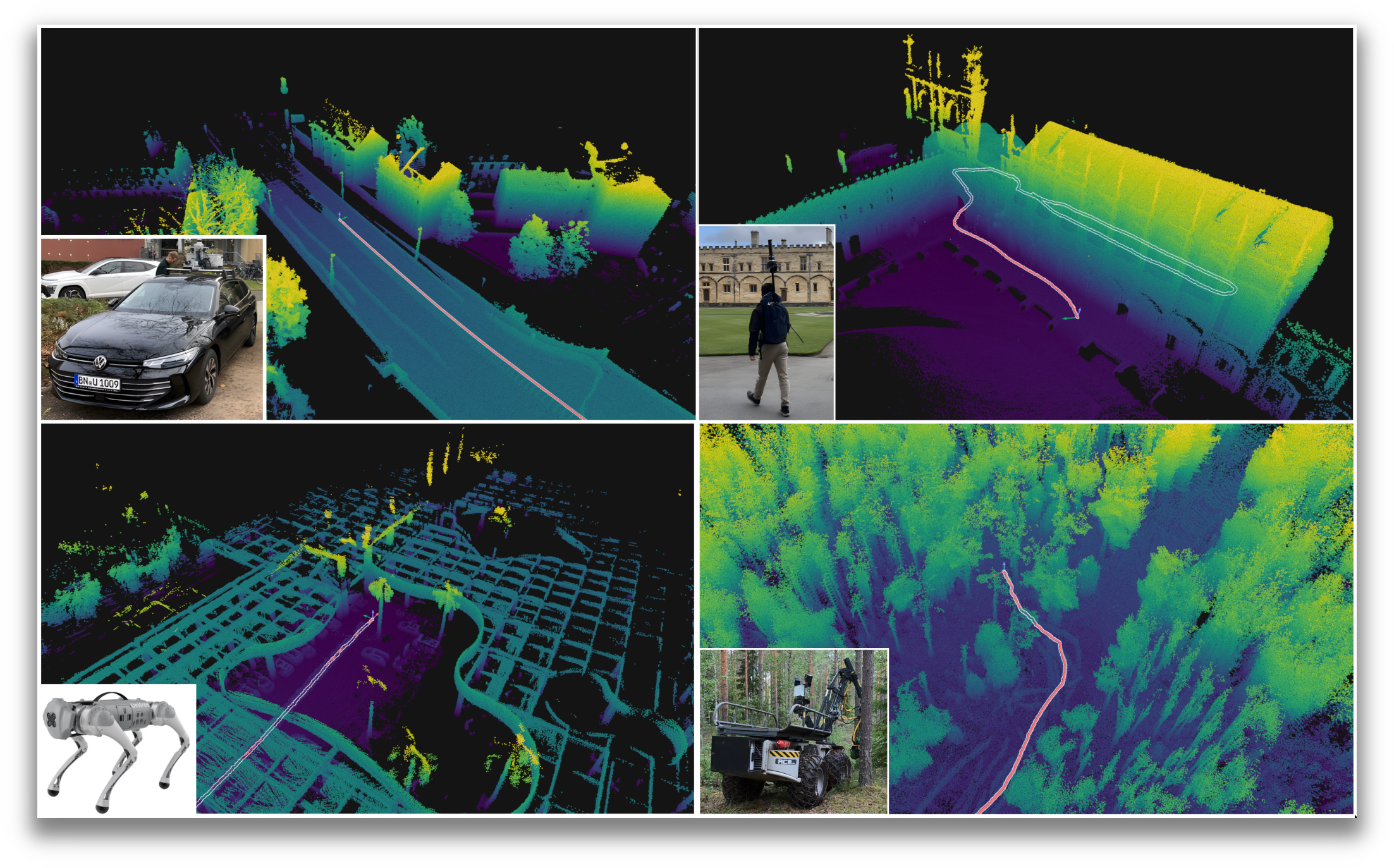
Four different platforms, four different environments, one odometry system
Still early days, but if you want a SLAM system (loop closures, pose graph back-end, drift correction), have a look at rko_slam.
Quick Start
Following is for the python version, see ROS for that.
Assuming you have a rosbag (ros1/ros2) which contains a TF tree, you can run RKO-LIO through
pip install "rko_lio[all]"
# or
pip install rko_lio rosbags "rerun-sdk>=0.31"
# data path should be a directory with *.bag files (ROS1) or a metadata.yaml (ROS2)
rko_lio -v /path/to/data
Why pip install those three packages?
-
rko_lio-> the odometry package -
rosbags-> required for the rosbag dataloader. Both ros1 and ros2 bags are supported! -
rerun-sdk-> required for the optional visualizer (-vflag)
pip install "rko_lio[all]" fetches the other optional dependencies as well.
Check further options for the CLI through rko_lio --help.
To dump a default config you can edit and pass with --config, run rko_lio --dump_config.
More details are available in the Python docs.
Extrinsics and convention
Please note that the system needs the extrinsic to be specified between IMU and LiDAR. Either your data includes this in some format, and then the dataloaders try to automatically read it, or otherwise you can specify it in a config file (required if it’s missing in the data). Pass the config file with
rko_lio --config config_file.yaml
This file needs two keys: extrinsic_imu2base_quat_xyzw_xyz and extrinsic_lidar2base_quat_xyzw_xyz, which must each
be a list. For example: [0,0,0,1,0,0,0] for identity. Both keys are required.
Throughout this package, I refer to transformations using transform_<from-frame>2<to-frame>. By this, I mean a
transformation that converts a vector expressed in the <from-frame> coordinate system to the <to-frame> coordinate
system. Mathematically, this translates to:
The superscript on the vector indicates the frame in which the vector is expressed, and
$^{ \mathrm{to} }\mathbf{T}_{\mathrm{from}}$ corresponds to transform_<from-frame>_to_<to-frame>.
ROS
Supported distros: Humble, Jazzy, Kilted, Lyrical, Rolling.
sudo apt install ros-$ROS_DISTRO-rko-lio
Or if you’d like to build from source, clone the repo into your colcon workspace and
rosdep install --from-paths src --ignore-src -r -y
colcon build --packages-select rko_lio  # --symlink-install --event-handlers console_direct+
File truncated at 100 lines see the full file
CONTRIBUTING
Repository Summary
| Checkout URI | https://github.com/PRBonn/rko_lio.git |
| VCS Type | git |
| VCS Version | master |
| Last Updated | 2026-10-18 |
| Dev Status | DEVELOPED |
| Released | RELEASED |
| Contributing |
Help Wanted (-)
Good First Issues (-) Pull Requests to Review (-) |
Packages
| Name | Version |
|---|---|
| rko_lio | 0.4.2 |
README
RKO-LIO
Robust LiDAR-Inertial Odometry Without Sensor-Specific Modelling
Four different platforms, four different environments, one odometry system
Still early days, but if you want a SLAM system (loop closures, pose graph back-end, drift correction), have a look at rko_slam.
Quick Start
Following is for the python version, see ROS for that.
Assuming you have a rosbag (ros1/ros2) which contains a TF tree, you can run RKO-LIO through
pip install "rko_lio[all]"
# or
pip install rko_lio rosbags "rerun-sdk>=0.31"
# data path should be a directory with *.bag files (ROS1) or a metadata.yaml (ROS2)
rko_lio -v /path/to/data
Why pip install those three packages?
-
rko_lio-> the odometry package -
rosbags-> required for the rosbag dataloader. Both ros1 and ros2 bags are supported! -
rerun-sdk-> required for the optional visualizer (-vflag)
pip install "rko_lio[all]" fetches the other optional dependencies as well.
Check further options for the CLI through rko_lio --help.
To dump a default config you can edit and pass with --config, run rko_lio --dump_config.
More details are available in the Python docs.
Extrinsics and convention
Please note that the system needs the extrinsic to be specified between IMU and LiDAR. Either your data includes this in some format, and then the dataloaders try to automatically read it, or otherwise you can specify it in a config file (required if it’s missing in the data). Pass the config file with
rko_lio --config config_file.yaml
This file needs two keys: extrinsic_imu2base_quat_xyzw_xyz and extrinsic_lidar2base_quat_xyzw_xyz, which must each
be a list. For example: [0,0,0,1,0,0,0] for identity. Both keys are required.
Throughout this package, I refer to transformations using transform_<from-frame>2<to-frame>. By this, I mean a
transformation that converts a vector expressed in the <from-frame> coordinate system to the <to-frame> coordinate
system. Mathematically, this translates to:
The superscript on the vector indicates the frame in which the vector is expressed, and
$^{ \mathrm{to} }\mathbf{T}_{\mathrm{from}}$ corresponds to transform_<from-frame>_to_<to-frame>.
ROS
Supported distros: Humble, Jazzy, Kilted, Lyrical, Rolling.
sudo apt install ros-$ROS_DISTRO-rko-lio
Or if you’d like to build from source, clone the repo into your colcon workspace and
rosdep install --from-paths src --ignore-src -r -y
colcon build --packages-select rko_lio  # --symlink-install --event-handlers console_direct+
File truncated at 100 lines see the full file
CONTRIBUTING
Repository Summary
| Checkout URI | https://github.com/PRBonn/rko_lio.git |
| VCS Type | git |
| VCS Version | master |
| Last Updated | 2026-10-18 |
| Dev Status | DEVELOPED |
| Released | RELEASED |
| Contributing |
Help Wanted (-)
Good First Issues (-) Pull Requests to Review (-) |
Packages
| Name | Version |
|---|---|
| rko_lio | 0.4.2 |
README
RKO-LIO
Robust LiDAR-Inertial Odometry Without Sensor-Specific Modelling
Four different platforms, four different environments, one odometry system
Still early days, but if you want a SLAM system (loop closures, pose graph back-end, drift correction), have a look at rko_slam.
Quick Start
Following is for the python version, see ROS for that.
Assuming you have a rosbag (ros1/ros2) which contains a TF tree, you can run RKO-LIO through
pip install "rko_lio[all]"
# or
pip install rko_lio rosbags "rerun-sdk>=0.31"
# data path should be a directory with *.bag files (ROS1) or a metadata.yaml (ROS2)
rko_lio -v /path/to/data
Why pip install those three packages?
-
rko_lio-> the odometry package -
rosbags-> required for the rosbag dataloader. Both ros1 and ros2 bags are supported! -
rerun-sdk-> required for the optional visualizer (-vflag)
pip install "rko_lio[all]" fetches the other optional dependencies as well.
Check further options for the CLI through rko_lio --help.
To dump a default config you can edit and pass with --config, run rko_lio --dump_config.
More details are available in the Python docs.
Extrinsics and convention
Please note that the system needs the extrinsic to be specified between IMU and LiDAR. Either your data includes this in some format, and then the dataloaders try to automatically read it, or otherwise you can specify it in a config file (required if it’s missing in the data). Pass the config file with
rko_lio --config config_file.yaml
This file needs two keys: extrinsic_imu2base_quat_xyzw_xyz and extrinsic_lidar2base_quat_xyzw_xyz, which must each
be a list. For example: [0,0,0,1,0,0,0] for identity. Both keys are required.
Throughout this package, I refer to transformations using transform_<from-frame>2<to-frame>. By this, I mean a
transformation that converts a vector expressed in the <from-frame> coordinate system to the <to-frame> coordinate
system. Mathematically, this translates to:
The superscript on the vector indicates the frame in which the vector is expressed, and
$^{ \mathrm{to} }\mathbf{T}_{\mathrm{from}}$ corresponds to transform_<from-frame>_to_<to-frame>.
ROS
Supported distros: Humble, Jazzy, Kilted, Lyrical, Rolling.
sudo apt install ros-$ROS_DISTRO-rko-lio
Or if you’d like to build from source, clone the repo into your colcon workspace and
rosdep install --from-paths src --ignore-src -r -y
colcon build --packages-select rko_lio  # --symlink-install --event-handlers console_direct+
File truncated at 100 lines see the full file
CONTRIBUTING
Repository Summary
| Checkout URI | https://github.com/PRBonn/rko_lio.git |
| VCS Type | git |
| VCS Version | master |
| Last Updated | 2026-10-18 |
| Dev Status | DEVELOPED |
| Released | RELEASED |
| Contributing |
Help Wanted (-)
Good First Issues (-) Pull Requests to Review (-) |
Packages
| Name | Version |
|---|---|
| rko_lio | 0.4.2 |
README
RKO-LIO
Robust LiDAR-Inertial Odometry Without Sensor-Specific Modelling
Four different platforms, four different environments, one odometry system
Still early days, but if you want a SLAM system (loop closures, pose graph back-end, drift correction), have a look at rko_slam.
Quick Start
Following is for the python version, see ROS for that.
Assuming you have a rosbag (ros1/ros2) which contains a TF tree, you can run RKO-LIO through
pip install "rko_lio[all]"
# or
pip install rko_lio rosbags "rerun-sdk>=0.31"
# data path should be a directory with *.bag files (ROS1) or a metadata.yaml (ROS2)
rko_lio -v /path/to/data
Why pip install those three packages?
-
rko_lio-> the odometry package -
rosbags-> required for the rosbag dataloader. Both ros1 and ros2 bags are supported! -
rerun-sdk-> required for the optional visualizer (-vflag)
pip install "rko_lio[all]" fetches the other optional dependencies as well.
Check further options for the CLI through rko_lio --help.
To dump a default config you can edit and pass with --config, run rko_lio --dump_config.
More details are available in the Python docs.
Extrinsics and convention
Please note that the system needs the extrinsic to be specified between IMU and LiDAR. Either your data includes this in some format, and then the dataloaders try to automatically read it, or otherwise you can specify it in a config file (required if it’s missing in the data). Pass the config file with
rko_lio --config config_file.yaml
This file needs two keys: extrinsic_imu2base_quat_xyzw_xyz and extrinsic_lidar2base_quat_xyzw_xyz, which must each
be a list. For example: [0,0,0,1,0,0,0] for identity. Both keys are required.
Throughout this package, I refer to transformations using transform_<from-frame>2<to-frame>. By this, I mean a
transformation that converts a vector expressed in the <from-frame> coordinate system to the <to-frame> coordinate
system. Mathematically, this translates to:
The superscript on the vector indicates the frame in which the vector is expressed, and
$^{ \mathrm{to} }\mathbf{T}_{\mathrm{from}}$ corresponds to transform_<from-frame>_to_<to-frame>.
ROS
Supported distros: Humble, Jazzy, Kilted, Lyrical, Rolling.
sudo apt install ros-$ROS_DISTRO-rko-lio
Or if you’d like to build from source, clone the repo into your colcon workspace and
rosdep install --from-paths src --ignore-src -r -y
colcon build --packages-select rko_lio  # --symlink-install --event-handlers console_direct+
File truncated at 100 lines see the full file
CONTRIBUTING
Repository Summary
| Checkout URI | https://github.com/PRBonn/rko_lio.git |
| VCS Type | git |
| VCS Version | master |
| Last Updated | 2026-10-18 |
| Dev Status | DEVELOPED |
| Released | RELEASED |
| Contributing |
Help Wanted (-)
Good First Issues (-) Pull Requests to Review (-) |
Packages
| Name | Version |
|---|---|
| rko_lio | 0.4.2 |
README
RKO-LIO
Robust LiDAR-Inertial Odometry Without Sensor-Specific Modelling
Four different platforms, four different environments, one odometry system
Still early days, but if you want a SLAM system (loop closures, pose graph back-end, drift correction), have a look at rko_slam.
Quick Start
Following is for the python version, see ROS for that.
Assuming you have a rosbag (ros1/ros2) which contains a TF tree, you can run RKO-LIO through
pip install "rko_lio[all]"
# or
pip install rko_lio rosbags "rerun-sdk>=0.31"
# data path should be a directory with *.bag files (ROS1) or a metadata.yaml (ROS2)
rko_lio -v /path/to/data
Why pip install those three packages?
-
rko_lio-> the odometry package -
rosbags-> required for the rosbag dataloader. Both ros1 and ros2 bags are supported! -
rerun-sdk-> required for the optional visualizer (-vflag)
pip install "rko_lio[all]" fetches the other optional dependencies as well.
Check further options for the CLI through rko_lio --help.
To dump a default config you can edit and pass with --config, run rko_lio --dump_config.
More details are available in the Python docs.
Extrinsics and convention
Please note that the system needs the extrinsic to be specified between IMU and LiDAR. Either your data includes this in some format, and then the dataloaders try to automatically read it, or otherwise you can specify it in a config file (required if it’s missing in the data). Pass the config file with
rko_lio --config config_file.yaml
This file needs two keys: extrinsic_imu2base_quat_xyzw_xyz and extrinsic_lidar2base_quat_xyzw_xyz, which must each
be a list. For example: [0,0,0,1,0,0,0] for identity. Both keys are required.
Throughout this package, I refer to transformations using transform_<from-frame>2<to-frame>. By this, I mean a
transformation that converts a vector expressed in the <from-frame> coordinate system to the <to-frame> coordinate
system. Mathematically, this translates to:
The superscript on the vector indicates the frame in which the vector is expressed, and
$^{ \mathrm{to} }\mathbf{T}_{\mathrm{from}}$ corresponds to transform_<from-frame>_to_<to-frame>.
ROS
Supported distros: Humble, Jazzy, Kilted, Lyrical, Rolling.
sudo apt install ros-$ROS_DISTRO-rko-lio
Or if you’d like to build from source, clone the repo into your colcon workspace and
rosdep install --from-paths src --ignore-src -r -y
colcon build --packages-select rko_lio  # --symlink-install --event-handlers console_direct+
File truncated at 100 lines see the full file
CONTRIBUTING
Repository Summary
| Checkout URI | https://github.com/PRBonn/rko_lio.git |
| VCS Type | git |
| VCS Version | master |
| Last Updated | 2026-10-18 |
| Dev Status | DEVELOPED |
| Released | RELEASED |
| Contributing |
Help Wanted (-)
Good First Issues (-) Pull Requests to Review (-) |
Packages
| Name | Version |
|---|---|
| rko_lio | 0.4.2 |
README
RKO-LIO
Robust LiDAR-Inertial Odometry Without Sensor-Specific Modelling
Four different platforms, four different environments, one odometry system
Still early days, but if you want a SLAM system (loop closures, pose graph back-end, drift correction), have a look at rko_slam.
Quick Start
Following is for the python version, see ROS for that.
Assuming you have a rosbag (ros1/ros2) which contains a TF tree, you can run RKO-LIO through
pip install "rko_lio[all]"
# or
pip install rko_lio rosbags "rerun-sdk>=0.31"
# data path should be a directory with *.bag files (ROS1) or a metadata.yaml (ROS2)
rko_lio -v /path/to/data
Why pip install those three packages?
-
rko_lio-> the odometry package -
rosbags-> required for the rosbag dataloader. Both ros1 and ros2 bags are supported! -
rerun-sdk-> required for the optional visualizer (-vflag)
pip install "rko_lio[all]" fetches the other optional dependencies as well.
Check further options for the CLI through rko_lio --help.
To dump a default config you can edit and pass with --config, run rko_lio --dump_config.
More details are available in the Python docs.
Extrinsics and convention
Please note that the system needs the extrinsic to be specified between IMU and LiDAR. Either your data includes this in some format, and then the dataloaders try to automatically read it, or otherwise you can specify it in a config file (required if it’s missing in the data). Pass the config file with
rko_lio --config config_file.yaml
This file needs two keys: extrinsic_imu2base_quat_xyzw_xyz and extrinsic_lidar2base_quat_xyzw_xyz, which must each
be a list. For example: [0,0,0,1,0,0,0] for identity. Both keys are required.
Throughout this package, I refer to transformations using transform_<from-frame>2<to-frame>. By this, I mean a
transformation that converts a vector expressed in the <from-frame> coordinate system to the <to-frame> coordinate
system. Mathematically, this translates to:
The superscript on the vector indicates the frame in which the vector is expressed, and
$^{ \mathrm{to} }\mathbf{T}_{\mathrm{from}}$ corresponds to transform_<from-frame>_to_<to-frame>.
ROS
Supported distros: Humble, Jazzy, Kilted, Lyrical, Rolling.
sudo apt install ros-$ROS_DISTRO-rko-lio
Or if you’d like to build from source, clone the repo into your colcon workspace and
rosdep install --from-paths src --ignore-src -r -y
colcon build --packages-select rko_lio  # --symlink-install --event-handlers console_direct+
File truncated at 100 lines see the full file
CONTRIBUTING
Repository Summary
| Checkout URI | https://github.com/PRBonn/rko_lio.git |
| VCS Type | git |
| VCS Version | master |
| Last Updated | 2026-10-18 |
| Dev Status | DEVELOPED |
| Released | RELEASED |
| Contributing |
Help Wanted (-)
Good First Issues (-) Pull Requests to Review (-) |
Packages
| Name | Version |
|---|---|
| rko_lio | 0.4.2 |
README
RKO-LIO
Robust LiDAR-Inertial Odometry Without Sensor-Specific Modelling
Four different platforms, four different environments, one odometry system
Still early days, but if you want a SLAM system (loop closures, pose graph back-end, drift correction), have a look at rko_slam.
Quick Start
Following is for the python version, see ROS for that.
Assuming you have a rosbag (ros1/ros2) which contains a TF tree, you can run RKO-LIO through
pip install "rko_lio[all]"
# or
pip install rko_lio rosbags "rerun-sdk>=0.31"
# data path should be a directory with *.bag files (ROS1) or a metadata.yaml (ROS2)
rko_lio -v /path/to/data
Why pip install those three packages?
-
rko_lio-> the odometry package -
rosbags-> required for the rosbag dataloader. Both ros1 and ros2 bags are supported! -
rerun-sdk-> required for the optional visualizer (-vflag)
pip install "rko_lio[all]" fetches the other optional dependencies as well.
Check further options for the CLI through rko_lio --help.
To dump a default config you can edit and pass with --config, run rko_lio --dump_config.
More details are available in the Python docs.
Extrinsics and convention
Please note that the system needs the extrinsic to be specified between IMU and LiDAR. Either your data includes this in some format, and then the dataloaders try to automatically read it, or otherwise you can specify it in a config file (required if it’s missing in the data). Pass the config file with
rko_lio --config config_file.yaml
This file needs two keys: extrinsic_imu2base_quat_xyzw_xyz and extrinsic_lidar2base_quat_xyzw_xyz, which must each
be a list. For example: [0,0,0,1,0,0,0] for identity. Both keys are required.
Throughout this package, I refer to transformations using transform_<from-frame>2<to-frame>. By this, I mean a
transformation that converts a vector expressed in the <from-frame> coordinate system to the <to-frame> coordinate
system. Mathematically, this translates to:
The superscript on the vector indicates the frame in which the vector is expressed, and
$^{ \mathrm{to} }\mathbf{T}_{\mathrm{from}}$ corresponds to transform_<from-frame>_to_<to-frame>.
ROS
Supported distros: Humble, Jazzy, Kilted, Lyrical, Rolling.
sudo apt install ros-$ROS_DISTRO-rko-lio
Or if you’d like to build from source, clone the repo into your colcon workspace and
rosdep install --from-paths src --ignore-src -r -y
colcon build --packages-select rko_lio  # --symlink-install --event-handlers console_direct+
File truncated at 100 lines see the full file
CONTRIBUTING
Repository Summary
| Checkout URI | https://github.com/PRBonn/rko_lio.git |
| VCS Type | git |
| VCS Version | master |
| Last Updated | 2026-10-18 |
| Dev Status | DEVELOPED |
| Released | RELEASED |
| Contributing |
Help Wanted (-)
Good First Issues (-) Pull Requests to Review (-) |
Packages
| Name | Version |
|---|---|
| rko_lio | 0.4.2 |
README
RKO-LIO
Robust LiDAR-Inertial Odometry Without Sensor-Specific Modelling
Four different platforms, four different environments, one odometry system
Still early days, but if you want a SLAM system (loop closures, pose graph back-end, drift correction), have a look at rko_slam.
Quick Start
Following is for the python version, see ROS for that.
Assuming you have a rosbag (ros1/ros2) which contains a TF tree, you can run RKO-LIO through
pip install "rko_lio[all]"
# or
pip install rko_lio rosbags "rerun-sdk>=0.31"
# data path should be a directory with *.bag files (ROS1) or a metadata.yaml (ROS2)
rko_lio -v /path/to/data
Why pip install those three packages?
-
rko_lio-> the odometry package -
rosbags-> required for the rosbag dataloader. Both ros1 and ros2 bags are supported! -
rerun-sdk-> required for the optional visualizer (-vflag)
pip install "rko_lio[all]" fetches the other optional dependencies as well.
Check further options for the CLI through rko_lio --help.
To dump a default config you can edit and pass with --config, run rko_lio --dump_config.
More details are available in the Python docs.
Extrinsics and convention
Please note that the system needs the extrinsic to be specified between IMU and LiDAR. Either your data includes this in some format, and then the dataloaders try to automatically read it, or otherwise you can specify it in a config file (required if it’s missing in the data). Pass the config file with
rko_lio --config config_file.yaml
This file needs two keys: extrinsic_imu2base_quat_xyzw_xyz and extrinsic_lidar2base_quat_xyzw_xyz, which must each
be a list. For example: [0,0,0,1,0,0,0] for identity. Both keys are required.
Throughout this package, I refer to transformations using transform_<from-frame>2<to-frame>. By this, I mean a
transformation that converts a vector expressed in the <from-frame> coordinate system to the <to-frame> coordinate
system. Mathematically, this translates to:
The superscript on the vector indicates the frame in which the vector is expressed, and
$^{ \mathrm{to} }\mathbf{T}_{\mathrm{from}}$ corresponds to transform_<from-frame>_to_<to-frame>.
ROS
Supported distros: Humble, Jazzy, Kilted, Lyrical, Rolling.
sudo apt install ros-$ROS_DISTRO-rko-lio
Or if you’d like to build from source, clone the repo into your colcon workspace and
rosdep install --from-paths src --ignore-src -r -y
colcon build --packages-select rko_lio  # --symlink-install --event-handlers console_direct+
File truncated at 100 lines see the full file
CONTRIBUTING
Repository Summary
| Checkout URI | https://github.com/PRBonn/rko_lio.git |
| VCS Type | git |
| VCS Version | master |
| Last Updated | 2026-10-18 |
| Dev Status | DEVELOPED |
| Released | RELEASED |
| Contributing |
Help Wanted (-)
Good First Issues (-) Pull Requests to Review (-) |
Packages
| Name | Version |
|---|---|
| rko_lio | 0.4.2 |
README
RKO-LIO
Robust LiDAR-Inertial Odometry Without Sensor-Specific Modelling
Four different platforms, four different environments, one odometry system
Still early days, but if you want a SLAM system (loop closures, pose graph back-end, drift correction), have a look at rko_slam.
Quick Start
Following is for the python version, see ROS for that.
Assuming you have a rosbag (ros1/ros2) which contains a TF tree, you can run RKO-LIO through
pip install "rko_lio[all]"
# or
pip install rko_lio rosbags "rerun-sdk>=0.31"
# data path should be a directory with *.bag files (ROS1) or a metadata.yaml (ROS2)
rko_lio -v /path/to/data
Why pip install those three packages?
-
rko_lio-> the odometry package -
rosbags-> required for the rosbag dataloader. Both ros1 and ros2 bags are supported! -
rerun-sdk-> required for the optional visualizer (-vflag)
pip install "rko_lio[all]" fetches the other optional dependencies as well.
Check further options for the CLI through rko_lio --help.
To dump a default config you can edit and pass with --config, run rko_lio --dump_config.
More details are available in the Python docs.
Extrinsics and convention
Please note that the system needs the extrinsic to be specified between IMU and LiDAR. Either your data includes this in some format, and then the dataloaders try to automatically read it, or otherwise you can specify it in a config file (required if it’s missing in the data). Pass the config file with
rko_lio --config config_file.yaml
This file needs two keys: extrinsic_imu2base_quat_xyzw_xyz and extrinsic_lidar2base_quat_xyzw_xyz, which must each
be a list. For example: [0,0,0,1,0,0,0] for identity. Both keys are required.
Throughout this package, I refer to transformations using transform_<from-frame>2<to-frame>. By this, I mean a
transformation that converts a vector expressed in the <from-frame> coordinate system to the <to-frame> coordinate
system. Mathematically, this translates to:
The superscript on the vector indicates the frame in which the vector is expressed, and
$^{ \mathrm{to} }\mathbf{T}_{\mathrm{from}}$ corresponds to transform_<from-frame>_to_<to-frame>.
ROS
Supported distros: Humble, Jazzy, Kilted, Lyrical, Rolling.
sudo apt install ros-$ROS_DISTRO-rko-lio
Or if you’d like to build from source, clone the repo into your colcon workspace and
rosdep install --from-paths src --ignore-src -r -y
colcon build --packages-select rko_lio  # --symlink-install --event-handlers console_direct+
File truncated at 100 lines see the full file
CONTRIBUTING
Repository Summary
| Checkout URI | https://github.com/PRBonn/rko_lio.git |
| VCS Type | git |
| VCS Version | master |
| Last Updated | 2026-10-18 |
| Dev Status | DEVELOPED |
| Released | RELEASED |
| Contributing |
Help Wanted (-)
Good First Issues (-) Pull Requests to Review (-) |
Packages
| Name | Version |
|---|---|
| rko_lio | 0.4.2 |
README
RKO-LIO
Robust LiDAR-Inertial Odometry Without Sensor-Specific Modelling
Four different platforms, four different environments, one odometry system
Still early days, but if you want a SLAM system (loop closures, pose graph back-end, drift correction), have a look at rko_slam.
Quick Start
Following is for the python version, see ROS for that.
Assuming you have a rosbag (ros1/ros2) which contains a TF tree, you can run RKO-LIO through
pip install "rko_lio[all]"
# or
pip install rko_lio rosbags "rerun-sdk>=0.31"
# data path should be a directory with *.bag files (ROS1) or a metadata.yaml (ROS2)
rko_lio -v /path/to/data
Why pip install those three packages?
-
rko_lio-> the odometry package -
rosbags-> required for the rosbag dataloader. Both ros1 and ros2 bags are supported! -
rerun-sdk-> required for the optional visualizer (-vflag)
pip install "rko_lio[all]" fetches the other optional dependencies as well.
Check further options for the CLI through rko_lio --help.
To dump a default config you can edit and pass with --config, run rko_lio --dump_config.
More details are available in the Python docs.
Extrinsics and convention
Please note that the system needs the extrinsic to be specified between IMU and LiDAR. Either your data includes this in some format, and then the dataloaders try to automatically read it, or otherwise you can specify it in a config file (required if it’s missing in the data). Pass the config file with
rko_lio --config config_file.yaml
This file needs two keys: extrinsic_imu2base_quat_xyzw_xyz and extrinsic_lidar2base_quat_xyzw_xyz, which must each
be a list. For example: [0,0,0,1,0,0,0] for identity. Both keys are required.
Throughout this package, I refer to transformations using transform_<from-frame>2<to-frame>. By this, I mean a
transformation that converts a vector expressed in the <from-frame> coordinate system to the <to-frame> coordinate
system. Mathematically, this translates to:
The superscript on the vector indicates the frame in which the vector is expressed, and
$^{ \mathrm{to} }\mathbf{T}_{\mathrm{from}}$ corresponds to transform_<from-frame>_to_<to-frame>.
ROS
Supported distros: Humble, Jazzy, Kilted, Lyrical, Rolling.
sudo apt install ros-$ROS_DISTRO-rko-lio
Or if you’d like to build from source, clone the repo into your colcon workspace and
rosdep install --from-paths src --ignore-src -r -y
colcon build --packages-select rko_lio  # --symlink-install --event-handlers console_direct+
File truncated at 100 lines see the full file
CONTRIBUTING
Repository Summary
| Checkout URI | https://github.com/PRBonn/rko_lio.git |
| VCS Type | git |
| VCS Version | master |
| Last Updated | 2026-10-18 |
| Dev Status | DEVELOPED |
| Released | RELEASED |
| Contributing |
Help Wanted (-)
Good First Issues (-) Pull Requests to Review (-) |
Packages
| Name | Version |
|---|---|
| rko_lio | 0.4.2 |
README
RKO-LIO
Robust LiDAR-Inertial Odometry Without Sensor-Specific Modelling
Four different platforms, four different environments, one odometry system
Still early days, but if you want a SLAM system (loop closures, pose graph back-end, drift correction), have a look at rko_slam.
Quick Start
Following is for the python version, see ROS for that.
Assuming you have a rosbag (ros1/ros2) which contains a TF tree, you can run RKO-LIO through
pip install "rko_lio[all]"
# or
pip install rko_lio rosbags "rerun-sdk>=0.31"
# data path should be a directory with *.bag files (ROS1) or a metadata.yaml (ROS2)
rko_lio -v /path/to/data
Why pip install those three packages?
-
rko_lio-> the odometry package -
rosbags-> required for the rosbag dataloader. Both ros1 and ros2 bags are supported! -
rerun-sdk-> required for the optional visualizer (-vflag)
pip install "rko_lio[all]" fetches the other optional dependencies as well.
Check further options for the CLI through rko_lio --help.
To dump a default config you can edit and pass with --config, run rko_lio --dump_config.
More details are available in the Python docs.
Extrinsics and convention
Please note that the system needs the extrinsic to be specified between IMU and LiDAR. Either your data includes this in some format, and then the dataloaders try to automatically read it, or otherwise you can specify it in a config file (required if it’s missing in the data). Pass the config file with
rko_lio --config config_file.yaml
This file needs two keys: extrinsic_imu2base_quat_xyzw_xyz and extrinsic_lidar2base_quat_xyzw_xyz, which must each
be a list. For example: [0,0,0,1,0,0,0] for identity. Both keys are required.
Throughout this package, I refer to transformations using transform_<from-frame>2<to-frame>. By this, I mean a
transformation that converts a vector expressed in the <from-frame> coordinate system to the <to-frame> coordinate
system. Mathematically, this translates to:
The superscript on the vector indicates the frame in which the vector is expressed, and
$^{ \mathrm{to} }\mathbf{T}_{\mathrm{from}}$ corresponds to transform_<from-frame>_to_<to-frame>.
ROS
Supported distros: Humble, Jazzy, Kilted, Lyrical, Rolling.
sudo apt install ros-$ROS_DISTRO-rko-lio
Or if you’d like to build from source, clone the repo into your colcon workspace and
rosdep install --from-paths src --ignore-src -r -y
colcon build --packages-select rko_lio  # --symlink-install --event-handlers console_direct+
File truncated at 100 lines see the full file
CONTRIBUTING
Repository Summary
| Checkout URI | https://github.com/PRBonn/rko_lio.git |
| VCS Type | git |
| VCS Version | master |
| Last Updated | 2026-10-18 |
| Dev Status | DEVELOPED |
| Released | RELEASED |
| Contributing |
Help Wanted (-)
Good First Issues (-) Pull Requests to Review (-) |
Packages
| Name | Version |
|---|---|
| rko_lio | 0.4.2 |
README
RKO-LIO
Robust LiDAR-Inertial Odometry Without Sensor-Specific Modelling
Four different platforms, four different environments, one odometry system
Still early days, but if you want a SLAM system (loop closures, pose graph back-end, drift correction), have a look at rko_slam.
Quick Start
Following is for the python version, see ROS for that.
Assuming you have a rosbag (ros1/ros2) which contains a TF tree, you can run RKO-LIO through
pip install "rko_lio[all]"
# or
pip install rko_lio rosbags "rerun-sdk>=0.31"
# data path should be a directory with *.bag files (ROS1) or a metadata.yaml (ROS2)
rko_lio -v /path/to/data
Why pip install those three packages?
-
rko_lio-> the odometry package -
rosbags-> required for the rosbag dataloader. Both ros1 and ros2 bags are supported! -
rerun-sdk-> required for the optional visualizer (-vflag)
pip install "rko_lio[all]" fetches the other optional dependencies as well.
Check further options for the CLI through rko_lio --help.
To dump a default config you can edit and pass with --config, run rko_lio --dump_config.
More details are available in the Python docs.
Extrinsics and convention
Please note that the system needs the extrinsic to be specified between IMU and LiDAR. Either your data includes this in some format, and then the dataloaders try to automatically read it, or otherwise you can specify it in a config file (required if it’s missing in the data). Pass the config file with
rko_lio --config config_file.yaml
This file needs two keys: extrinsic_imu2base_quat_xyzw_xyz and extrinsic_lidar2base_quat_xyzw_xyz, which must each
be a list. For example: [0,0,0,1,0,0,0] for identity. Both keys are required.
Throughout this package, I refer to transformations using transform_<from-frame>2<to-frame>. By this, I mean a
transformation that converts a vector expressed in the <from-frame> coordinate system to the <to-frame> coordinate
system. Mathematically, this translates to:
The superscript on the vector indicates the frame in which the vector is expressed, and
$^{ \mathrm{to} }\mathbf{T}_{\mathrm{from}}$ corresponds to transform_<from-frame>_to_<to-frame>.
ROS
Supported distros: Humble, Jazzy, Kilted, Lyrical, Rolling.
sudo apt install ros-$ROS_DISTRO-rko-lio
Or if you’d like to build from source, clone the repo into your colcon workspace and
rosdep install --from-paths src --ignore-src -r -y
colcon build --packages-select rko_lio  # --symlink-install --event-handlers console_direct+
File truncated at 100 lines see the full file
CONTRIBUTING
Repository Summary
| Checkout URI | https://github.com/PRBonn/rko_lio.git |
| VCS Type | git |
| VCS Version | master |
| Last Updated | 2026-10-18 |
| Dev Status | DEVELOPED |
| Released | RELEASED |
| Contributing |
Help Wanted (-)
Good First Issues (-) Pull Requests to Review (-) |
Packages
| Name | Version |
|---|---|
| rko_lio | 0.4.2 |
README
RKO-LIO
Robust LiDAR-Inertial Odometry Without Sensor-Specific Modelling
Four different platforms, four different environments, one odometry system
Still early days, but if you want a SLAM system (loop closures, pose graph back-end, drift correction), have a look at rko_slam.
Quick Start
Following is for the python version, see ROS for that.
Assuming you have a rosbag (ros1/ros2) which contains a TF tree, you can run RKO-LIO through
pip install "rko_lio[all]"
# or
pip install rko_lio rosbags "rerun-sdk>=0.31"
# data path should be a directory with *.bag files (ROS1) or a metadata.yaml (ROS2)
rko_lio -v /path/to/data
Why pip install those three packages?
-
rko_lio-> the odometry package -
rosbags-> required for the rosbag dataloader. Both ros1 and ros2 bags are supported! -
rerun-sdk-> required for the optional visualizer (-vflag)
pip install "rko_lio[all]" fetches the other optional dependencies as well.
Check further options for the CLI through rko_lio --help.
To dump a default config you can edit and pass with --config, run rko_lio --dump_config.
More details are available in the Python docs.
Extrinsics and convention
Please note that the system needs the extrinsic to be specified between IMU and LiDAR. Either your data includes this in some format, and then the dataloaders try to automatically read it, or otherwise you can specify it in a config file (required if it’s missing in the data). Pass the config file with
rko_lio --config config_file.yaml
This file needs two keys: extrinsic_imu2base_quat_xyzw_xyz and extrinsic_lidar2base_quat_xyzw_xyz, which must each
be a list. For example: [0,0,0,1,0,0,0] for identity. Both keys are required.
Throughout this package, I refer to transformations using transform_<from-frame>2<to-frame>. By this, I mean a
transformation that converts a vector expressed in the <from-frame> coordinate system to the <to-frame> coordinate
system. Mathematically, this translates to:
The superscript on the vector indicates the frame in which the vector is expressed, and
$^{ \mathrm{to} }\mathbf{T}_{\mathrm{from}}$ corresponds to transform_<from-frame>_to_<to-frame>.
ROS
Supported distros: Humble, Jazzy, Kilted, Lyrical, Rolling.
sudo apt install ros-$ROS_DISTRO-rko-lio
Or if you’d like to build from source, clone the repo into your colcon workspace and
rosdep install --from-paths src --ignore-src -r -y
colcon build --packages-select rko_lio  # --symlink-install --event-handlers console_direct+
File truncated at 100 lines see the full file
CONTRIBUTING
Repository Summary
| Checkout URI | https://github.com/PRBonn/rko_lio.git |
| VCS Type | git |
| VCS Version | master |
| Last Updated | 2026-10-18 |
| Dev Status | DEVELOPED |
| Released | RELEASED |
| Contributing |
Help Wanted (-)
Good First Issues (-) Pull Requests to Review (-) |
Packages
| Name | Version |
|---|---|
| rko_lio | 0.4.2 |
README
RKO-LIO
Robust LiDAR-Inertial Odometry Without Sensor-Specific Modelling
Four different platforms, four different environments, one odometry system
Still early days, but if you want a SLAM system (loop closures, pose graph back-end, drift correction), have a look at rko_slam.
Quick Start
Following is for the python version, see ROS for that.
Assuming you have a rosbag (ros1/ros2) which contains a TF tree, you can run RKO-LIO through
pip install "rko_lio[all]"
# or
pip install rko_lio rosbags "rerun-sdk>=0.31"
# data path should be a directory with *.bag files (ROS1) or a metadata.yaml (ROS2)
rko_lio -v /path/to/data
Why pip install those three packages?
-
rko_lio-> the odometry package -
rosbags-> required for the rosbag dataloader. Both ros1 and ros2 bags are supported! -
rerun-sdk-> required for the optional visualizer (-vflag)
pip install "rko_lio[all]" fetches the other optional dependencies as well.
Check further options for the CLI through rko_lio --help.
To dump a default config you can edit and pass with --config, run rko_lio --dump_config.
More details are available in the Python docs.
Extrinsics and convention
Please note that the system needs the extrinsic to be specified between IMU and LiDAR. Either your data includes this in some format, and then the dataloaders try to automatically read it, or otherwise you can specify it in a config file (required if it’s missing in the data). Pass the config file with
rko_lio --config config_file.yaml
This file needs two keys: extrinsic_imu2base_quat_xyzw_xyz and extrinsic_lidar2base_quat_xyzw_xyz, which must each
be a list. For example: [0,0,0,1,0,0,0] for identity. Both keys are required.
Throughout this package, I refer to transformations using transform_<from-frame>2<to-frame>. By this, I mean a
transformation that converts a vector expressed in the <from-frame> coordinate system to the <to-frame> coordinate
system. Mathematically, this translates to:
The superscript on the vector indicates the frame in which the vector is expressed, and
$^{ \mathrm{to} }\mathbf{T}_{\mathrm{from}}$ corresponds to transform_<from-frame>_to_<to-frame>.
ROS
Supported distros: Humble, Jazzy, Kilted, Lyrical, Rolling.
sudo apt install ros-$ROS_DISTRO-rko-lio
Or if you’d like to build from source, clone the repo into your colcon workspace and
rosdep install --from-paths src --ignore-src -r -y
colcon build --packages-select rko_lio  # --symlink-install --event-handlers console_direct+
File truncated at 100 lines see the full file
CONTRIBUTING
Repository Summary
| Checkout URI | https://github.com/PRBonn/rko_lio.git |
| VCS Type | git |
| VCS Version | master |
| Last Updated | 2026-10-18 |
| Dev Status | DEVELOPED |
| Released | RELEASED |
| Contributing |
Help Wanted (-)
Good First Issues (-) Pull Requests to Review (-) |
Packages
| Name | Version |
|---|---|
| rko_lio | 0.4.2 |
README
RKO-LIO
Robust LiDAR-Inertial Odometry Without Sensor-Specific Modelling
Four different platforms, four different environments, one odometry system
Still early days, but if you want a SLAM system (loop closures, pose graph back-end, drift correction), have a look at rko_slam.
Quick Start
Following is for the python version, see ROS for that.
Assuming you have a rosbag (ros1/ros2) which contains a TF tree, you can run RKO-LIO through
pip install "rko_lio[all]"
# or
pip install rko_lio rosbags "rerun-sdk>=0.31"
# data path should be a directory with *.bag files (ROS1) or a metadata.yaml (ROS2)
rko_lio -v /path/to/data
Why pip install those three packages?
-
rko_lio-> the odometry package -
rosbags-> required for the rosbag dataloader. Both ros1 and ros2 bags are supported! -
rerun-sdk-> required for the optional visualizer (-vflag)
pip install "rko_lio[all]" fetches the other optional dependencies as well.
Check further options for the CLI through rko_lio --help.
To dump a default config you can edit and pass with --config, run rko_lio --dump_config.
More details are available in the Python docs.
Extrinsics and convention
Please note that the system needs the extrinsic to be specified between IMU and LiDAR. Either your data includes this in some format, and then the dataloaders try to automatically read it, or otherwise you can specify it in a config file (required if it’s missing in the data). Pass the config file with
rko_lio --config config_file.yaml
This file needs two keys: extrinsic_imu2base_quat_xyzw_xyz and extrinsic_lidar2base_quat_xyzw_xyz, which must each
be a list. For example: [0,0,0,1,0,0,0] for identity. Both keys are required.
Throughout this package, I refer to transformations using transform_<from-frame>2<to-frame>. By this, I mean a
transformation that converts a vector expressed in the <from-frame> coordinate system to the <to-frame> coordinate
system. Mathematically, this translates to:
The superscript on the vector indicates the frame in which the vector is expressed, and
$^{ \mathrm{to} }\mathbf{T}_{\mathrm{from}}$ corresponds to transform_<from-frame>_to_<to-frame>.
ROS
Supported distros: Humble, Jazzy, Kilted, Lyrical, Rolling.
sudo apt install ros-$ROS_DISTRO-rko-lio
Or if you’d like to build from source, clone the repo into your colcon workspace and
rosdep install --from-paths src --ignore-src -r -y
colcon build --packages-select rko_lio  # --symlink-install --event-handlers console_direct+
File truncated at 100 lines see the full file
CONTRIBUTING
Repository Summary
| Checkout URI | https://github.com/PRBonn/rko_lio.git |
| VCS Type | git |
| VCS Version | master |
| Last Updated | 2026-10-18 |
| Dev Status | DEVELOPED |
| Released | RELEASED |
| Contributing |
Help Wanted (-)
Good First Issues (-) Pull Requests to Review (-) |
Packages
| Name | Version |
|---|---|
| rko_lio | 0.4.2 |
README
RKO-LIO
Robust LiDAR-Inertial Odometry Without Sensor-Specific Modelling
Four different platforms, four different environments, one odometry system
Still early days, but if you want a SLAM system (loop closures, pose graph back-end, drift correction), have a look at rko_slam.
Quick Start
Following is for the python version, see ROS for that.
Assuming you have a rosbag (ros1/ros2) which contains a TF tree, you can run RKO-LIO through
pip install "rko_lio[all]"
# or
pip install rko_lio rosbags "rerun-sdk>=0.31"
# data path should be a directory with *.bag files (ROS1) or a metadata.yaml (ROS2)
rko_lio -v /path/to/data
Why pip install those three packages?
-
rko_lio-> the odometry package -
rosbags-> required for the rosbag dataloader. Both ros1 and ros2 bags are supported! -
rerun-sdk-> required for the optional visualizer (-vflag)
pip install "rko_lio[all]" fetches the other optional dependencies as well.
Check further options for the CLI through rko_lio --help.
To dump a default config you can edit and pass with --config, run rko_lio --dump_config.
More details are available in the Python docs.
Extrinsics and convention
Please note that the system needs the extrinsic to be specified between IMU and LiDAR. Either your data includes this in some format, and then the dataloaders try to automatically read it, or otherwise you can specify it in a config file (required if it’s missing in the data). Pass the config file with
rko_lio --config config_file.yaml
This file needs two keys: extrinsic_imu2base_quat_xyzw_xyz and extrinsic_lidar2base_quat_xyzw_xyz, which must each
be a list. For example: [0,0,0,1,0,0,0] for identity. Both keys are required.
Throughout this package, I refer to transformations using transform_<from-frame>2<to-frame>. By this, I mean a
transformation that converts a vector expressed in the <from-frame> coordinate system to the <to-frame> coordinate
system. Mathematically, this translates to:
The superscript on the vector indicates the frame in which the vector is expressed, and
$^{ \mathrm{to} }\mathbf{T}_{\mathrm{from}}$ corresponds to transform_<from-frame>_to_<to-frame>.
ROS
Supported distros: Humble, Jazzy, Kilted, Lyrical, Rolling.
sudo apt install ros-$ROS_DISTRO-rko-lio
Or if you’d like to build from source, clone the repo into your colcon workspace and
rosdep install --from-paths src --ignore-src -r -y
colcon build --packages-select rko_lio  # --symlink-install --event-handlers console_direct+
File truncated at 100 lines see the full file
CONTRIBUTING
Repository Summary
| Checkout URI | https://github.com/PRBonn/rko_lio.git |
| VCS Type | git |
| VCS Version | master |
| Last Updated | 2026-10-18 |
| Dev Status | DEVELOPED |
| Released | RELEASED |
| Contributing |
Help Wanted (-)
Good First Issues (-) Pull Requests to Review (-) |
Packages
| Name | Version |
|---|---|
| rko_lio | 0.4.2 |
README
RKO-LIO
Robust LiDAR-Inertial Odometry Without Sensor-Specific Modelling
Four different platforms, four different environments, one odometry system
Still early days, but if you want a SLAM system (loop closures, pose graph back-end, drift correction), have a look at rko_slam.
Quick Start
Following is for the python version, see ROS for that.
Assuming you have a rosbag (ros1/ros2) which contains a TF tree, you can run RKO-LIO through
pip install "rko_lio[all]"
# or
pip install rko_lio rosbags "rerun-sdk>=0.31"
# data path should be a directory with *.bag files (ROS1) or a metadata.yaml (ROS2)
rko_lio -v /path/to/data
Why pip install those three packages?
-
rko_lio-> the odometry package -
rosbags-> required for the rosbag dataloader. Both ros1 and ros2 bags are supported! -
rerun-sdk-> required for the optional visualizer (-vflag)
pip install "rko_lio[all]" fetches the other optional dependencies as well.
Check further options for the CLI through rko_lio --help.
To dump a default config you can edit and pass with --config, run rko_lio --dump_config.
More details are available in the Python docs.
Extrinsics and convention
Please note that the system needs the extrinsic to be specified between IMU and LiDAR. Either your data includes this in some format, and then the dataloaders try to automatically read it, or otherwise you can specify it in a config file (required if it’s missing in the data). Pass the config file with
rko_lio --config config_file.yaml
This file needs two keys: extrinsic_imu2base_quat_xyzw_xyz and extrinsic_lidar2base_quat_xyzw_xyz, which must each
be a list. For example: [0,0,0,1,0,0,0] for identity. Both keys are required.
Throughout this package, I refer to transformations using transform_<from-frame>2<to-frame>. By this, I mean a
transformation that converts a vector expressed in the <from-frame> coordinate system to the <to-frame> coordinate
system. Mathematically, this translates to:
The superscript on the vector indicates the frame in which the vector is expressed, and
$^{ \mathrm{to} }\mathbf{T}_{\mathrm{from}}$ corresponds to transform_<from-frame>_to_<to-frame>.
ROS
Supported distros: Humble, Jazzy, Kilted, Lyrical, Rolling.
sudo apt install ros-$ROS_DISTRO-rko-lio
Or if you’d like to build from source, clone the repo into your colcon workspace and
rosdep install --from-paths src --ignore-src -r -y
colcon build --packages-select rko_lio  # --symlink-install --event-handlers console_direct+
File truncated at 100 lines see the full file
CONTRIBUTING
Repository Summary
| Checkout URI | https://github.com/PRBonn/rko_lio.git |
| VCS Type | git |
| VCS Version | master |
| Last Updated | 2026-10-18 |
| Dev Status | DEVELOPED |
| Released | RELEASED |
| Contributing |
Help Wanted (-)
Good First Issues (-) Pull Requests to Review (-) |
Packages
| Name | Version |
|---|---|
| rko_lio | 0.4.2 |
README
RKO-LIO
Robust LiDAR-Inertial Odometry Without Sensor-Specific Modelling
Four different platforms, four different environments, one odometry system
Still early days, but if you want a SLAM system (loop closures, pose graph back-end, drift correction), have a look at rko_slam.
Quick Start
Following is for the python version, see ROS for that.
Assuming you have a rosbag (ros1/ros2) which contains a TF tree, you can run RKO-LIO through
pip install "rko_lio[all]"
# or
pip install rko_lio rosbags "rerun-sdk>=0.31"
# data path should be a directory with *.bag files (ROS1) or a metadata.yaml (ROS2)
rko_lio -v /path/to/data
Why pip install those three packages?
-
rko_lio-> the odometry package -
rosbags-> required for the rosbag dataloader. Both ros1 and ros2 bags are supported! -
rerun-sdk-> required for the optional visualizer (-vflag)
pip install "rko_lio[all]" fetches the other optional dependencies as well.
Check further options for the CLI through rko_lio --help.
To dump a default config you can edit and pass with --config, run rko_lio --dump_config.
More details are available in the Python docs.
Extrinsics and convention
Please note that the system needs the extrinsic to be specified between IMU and LiDAR. Either your data includes this in some format, and then the dataloaders try to automatically read it, or otherwise you can specify it in a config file (required if it’s missing in the data). Pass the config file with
rko_lio --config config_file.yaml
This file needs two keys: extrinsic_imu2base_quat_xyzw_xyz and extrinsic_lidar2base_quat_xyzw_xyz, which must each
be a list. For example: [0,0,0,1,0,0,0] for identity. Both keys are required.
Throughout this package, I refer to transformations using transform_<from-frame>2<to-frame>. By this, I mean a
transformation that converts a vector expressed in the <from-frame> coordinate system to the <to-frame> coordinate
system. Mathematically, this translates to:
The superscript on the vector indicates the frame in which the vector is expressed, and
$^{ \mathrm{to} }\mathbf{T}_{\mathrm{from}}$ corresponds to transform_<from-frame>_to_<to-frame>.
ROS
Supported distros: Humble, Jazzy, Kilted, Lyrical, Rolling.
sudo apt install ros-$ROS_DISTRO-rko-lio
Or if you’d like to build from source, clone the repo into your colcon workspace and
rosdep install --from-paths src --ignore-src -r -y
colcon build --packages-select rko_lio  # --symlink-install --event-handlers console_direct+
File truncated at 100 lines see the full file
CONTRIBUTING
Repository Summary
| Checkout URI | https://github.com/PRBonn/rko_lio.git |
| VCS Type | git |
| VCS Version | master |
| Last Updated | 2026-10-18 |
| Dev Status | DEVELOPED |
| Released | RELEASED |
| Contributing |
Help Wanted (-)
Good First Issues (-) Pull Requests to Review (-) |
Packages
| Name | Version |
|---|---|
| rko_lio | 0.4.2 |
README
RKO-LIO
Robust LiDAR-Inertial Odometry Without Sensor-Specific Modelling
Four different platforms, four different environments, one odometry system
Still early days, but if you want a SLAM system (loop closures, pose graph back-end, drift correction), have a look at rko_slam.
Quick Start
Following is for the python version, see ROS for that.
Assuming you have a rosbag (ros1/ros2) which contains a TF tree, you can run RKO-LIO through
pip install "rko_lio[all]"
# or
pip install rko_lio rosbags "rerun-sdk>=0.31"
# data path should be a directory with *.bag files (ROS1) or a metadata.yaml (ROS2)
rko_lio -v /path/to/data
Why pip install those three packages?
-
rko_lio-> the odometry package -
rosbags-> required for the rosbag dataloader. Both ros1 and ros2 bags are supported! -
rerun-sdk-> required for the optional visualizer (-vflag)
pip install "rko_lio[all]" fetches the other optional dependencies as well.
Check further options for the CLI through rko_lio --help.
To dump a default config you can edit and pass with --config, run rko_lio --dump_config.
More details are available in the Python docs.
Extrinsics and convention
Please note that the system needs the extrinsic to be specified between IMU and LiDAR. Either your data includes this in some format, and then the dataloaders try to automatically read it, or otherwise you can specify it in a config file (required if it’s missing in the data). Pass the config file with
rko_lio --config config_file.yaml
This file needs two keys: extrinsic_imu2base_quat_xyzw_xyz and extrinsic_lidar2base_quat_xyzw_xyz, which must each
be a list. For example: [0,0,0,1,0,0,0] for identity. Both keys are required.
Throughout this package, I refer to transformations using transform_<from-frame>2<to-frame>. By this, I mean a
transformation that converts a vector expressed in the <from-frame> coordinate system to the <to-frame> coordinate
system. Mathematically, this translates to:
The superscript on the vector indicates the frame in which the vector is expressed, and
$^{ \mathrm{to} }\mathbf{T}_{\mathrm{from}}$ corresponds to transform_<from-frame>_to_<to-frame>.
ROS
Supported distros: Humble, Jazzy, Kilted, Lyrical, Rolling.
sudo apt install ros-$ROS_DISTRO-rko-lio
Or if you’d like to build from source, clone the repo into your colcon workspace and
rosdep install --from-paths src --ignore-src -r -y
colcon build --packages-select rko_lio  # --symlink-install --event-handlers console_direct+
File truncated at 100 lines see the full file
CONTRIBUTING
Repository Summary
| Checkout URI | https://github.com/PRBonn/rko_lio.git |
| VCS Type | git |
| VCS Version | master |
| Last Updated | 2026-10-18 |
| Dev Status | DEVELOPED |
| Released | RELEASED |
| Contributing |
Help Wanted (-)
Good First Issues (-) Pull Requests to Review (-) |
Packages
| Name | Version |
|---|---|
| rko_lio | 0.4.2 |
README
RKO-LIO
Robust LiDAR-Inertial Odometry Without Sensor-Specific Modelling
Four different platforms, four different environments, one odometry system
Still early days, but if you want a SLAM system (loop closures, pose graph back-end, drift correction), have a look at rko_slam.
Quick Start
Following is for the python version, see ROS for that.
Assuming you have a rosbag (ros1/ros2) which contains a TF tree, you can run RKO-LIO through
pip install "rko_lio[all]"
# or
pip install rko_lio rosbags "rerun-sdk>=0.31"
# data path should be a directory with *.bag files (ROS1) or a metadata.yaml (ROS2)
rko_lio -v /path/to/data
Why pip install those three packages?
-
rko_lio-> the odometry package -
rosbags-> required for the rosbag dataloader. Both ros1 and ros2 bags are supported! -
rerun-sdk-> required for the optional visualizer (-vflag)
pip install "rko_lio[all]" fetches the other optional dependencies as well.
Check further options for the CLI through rko_lio --help.
To dump a default config you can edit and pass with --config, run rko_lio --dump_config.
More details are available in the Python docs.
Extrinsics and convention
Please note that the system needs the extrinsic to be specified between IMU and LiDAR. Either your data includes this in some format, and then the dataloaders try to automatically read it, or otherwise you can specify it in a config file (required if it’s missing in the data). Pass the config file with
rko_lio --config config_file.yaml
This file needs two keys: extrinsic_imu2base_quat_xyzw_xyz and extrinsic_lidar2base_quat_xyzw_xyz, which must each
be a list. For example: [0,0,0,1,0,0,0] for identity. Both keys are required.
Throughout this package, I refer to transformations using transform_<from-frame>2<to-frame>. By this, I mean a
transformation that converts a vector expressed in the <from-frame> coordinate system to the <to-frame> coordinate
system. Mathematically, this translates to:
The superscript on the vector indicates the frame in which the vector is expressed, and
$^{ \mathrm{to} }\mathbf{T}_{\mathrm{from}}$ corresponds to transform_<from-frame>_to_<to-frame>.
ROS
Supported distros: Humble, Jazzy, Kilted, Lyrical, Rolling.
sudo apt install ros-$ROS_DISTRO-rko-lio
Or if you’d like to build from source, clone the repo into your colcon workspace and
rosdep install --from-paths src --ignore-src -r -y
colcon build --packages-select rko_lio  # --symlink-install --event-handlers console_direct+
File truncated at 100 lines see the full file