 ROS Index
Repository Summary
| Checkout URI | https://github.com/automatika-robotics/ros-sugar.git |
| VCS Type | git |
| VCS Version | main |
| Last Updated | 2026-09-13 |
| Dev Status | DEVELOPED |
| Released | RELEASED |
| Contributing |
Help Wanted (-)
Good First Issues (-) Pull Requests to Review (-) |
Packages
| Name | Version |
|---|---|
| automatika_ros_sugar | 0.8.1 |
README

Part of the [EMOS](https://github.com/automatika-robotics/emos) ecosystem [](https://opensource.org/licenses/MIT) [](https://www.python.org/downloads/) [](https://docs.ros.org/en/humble/index.html) [](https://discord.gg/B9ZU6qjzND) **The orchestration layer for event-driven ROS 2 systems** [**EMOS Documentation**](https://emos.automatikarobotics.com) | [**Developer Docs**](https://sugarcoat.automatikarobotics.com) | [**Discord**](https://discord.gg/B9ZU6qjzND)
What is Sugarcoat?
Sugarcoat is the orchestration layer of the EMOS (Embodied Operating System) ecosystem by Automatika Robotics. It is a meta-framework that replaces fragmented ROS2 development with a unified workflow, providing a high-level Python API to build robust lifecycle-managed components and orchestrate them into cohesive, self-healing systems using an event-driven architecture.
For full documentation, tutorials, and recipes, visit emos.automatikarobotics.com.
Key Features & Core Pillars
| Feature | Description |
|---|---|
| Smart Components | Every component is a managed lifecycle node (Configure, Activate, Deactivate) out of the box. It features type-safe configurations via attrs and declarative auto-wiring for inputs/outputs. |
| Active Resilience |
Built-in “Immune System” for ROS2 nodes. Components actively report their Health Status (Algorithm, Component, or System failures) and automatically trigger distributed Fallbacks to self-heal without crashing. |
| Event-Driven Behavior | Define global Events (e.g., Event(battery < 10.0)) and Actions in pure, readable Python. These act as triggers that monitor ROS2 topics natively and execute instantly regardless of current system state. |
| Centralized Orchestration | A powerful Launcher acts as a pythonic alternative to ros2 launch. It supports multi-threaded or multi-process execution, actively supervising component lifecycles at runtime. |
| Universal Applications | Robot Plugins act as a translation layer. This allows you to write generic, portable automation logic (recipes) that run on any robot without code changes. |
| Dynamic Web UI | Auto-generates a fully functional web frontend for every topic, parameter, and event instantly. |
Dynamic Web UI for Sugarcoat Recipes
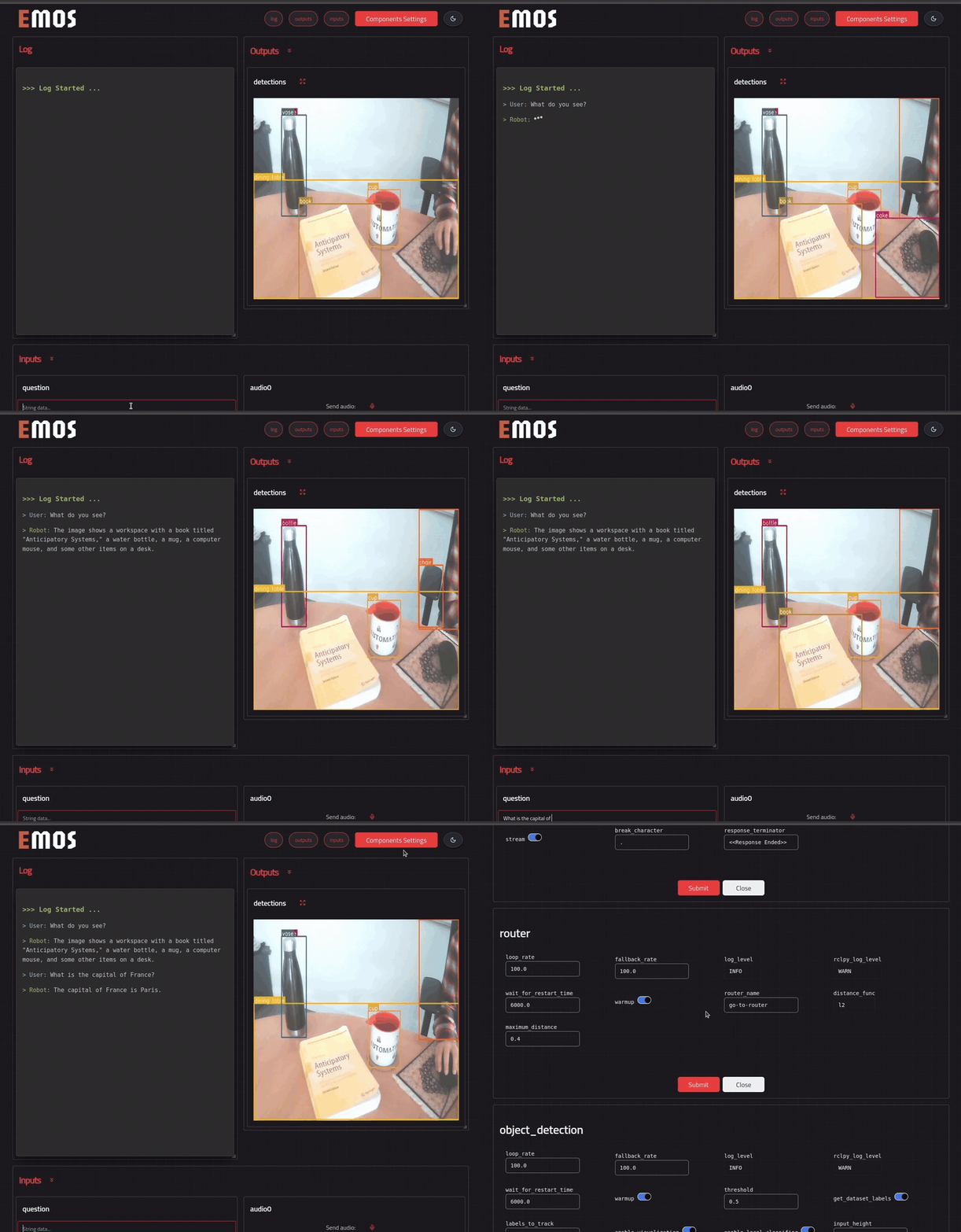
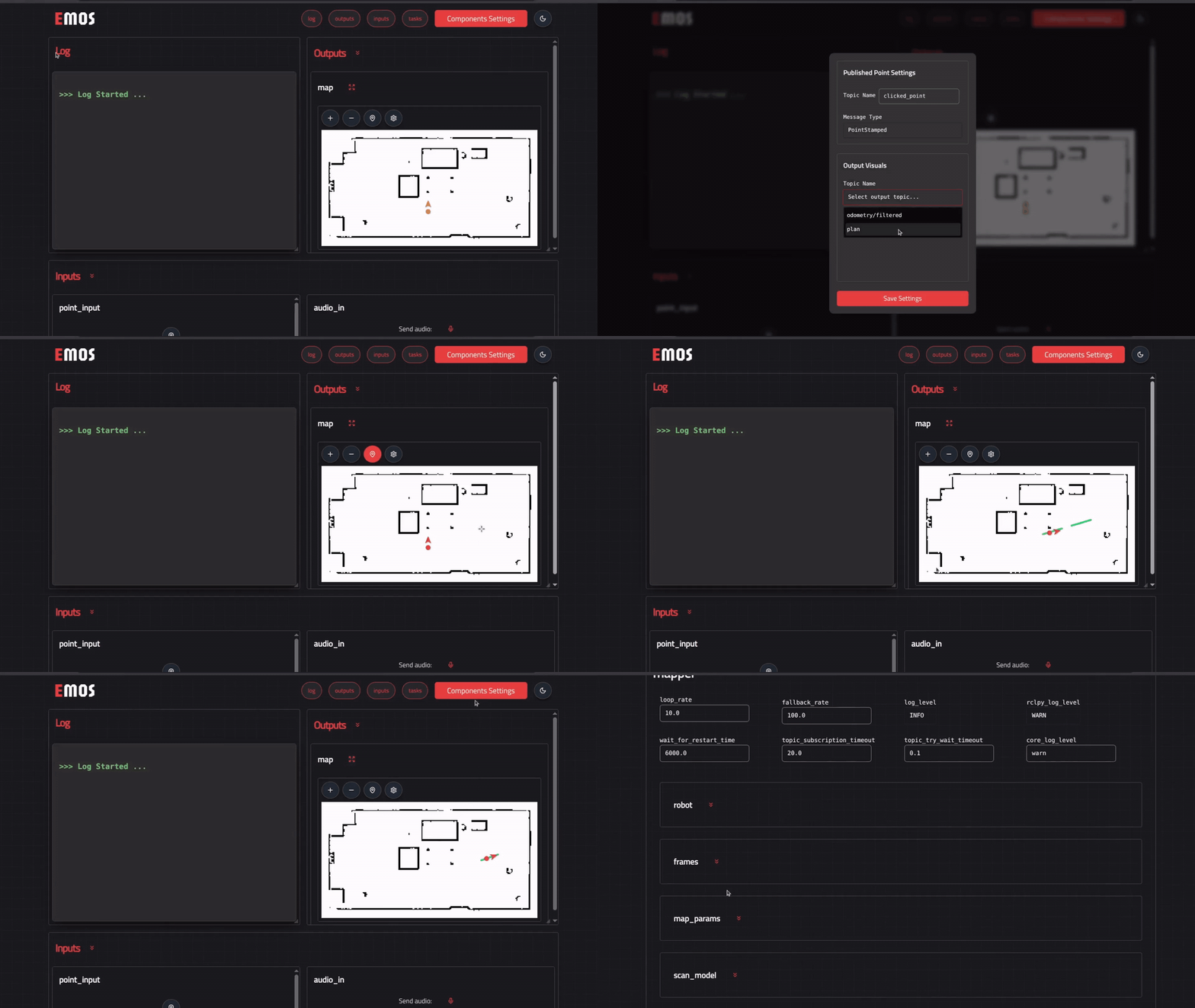
The Dynamic Web UI feature takes system visibility and control to the next level. Built with FastHTML and MonsterUI, it is designed to automatically generate a fully dynamic, extensible web interface for any Sugarcoat recipe, completely eliminating the need for manual front-end development.
Automatic UI Generation in Action
See how the Web UI effortlessly generates interfaces for different types of Sugarcoat recipes:
- Example 1: General Q&A MLLM Recipe A fully functional interface generated for an MLLM agent recipe from EmbodiedAgents, automatically providing controls for settings and real-time text I/O with the robot.
- Example 2: Point Navigation Recipe An example for an automatically generated UI for a point navigation system from Kompass. The UI automatically renders map data, and sends navigation goals to the robot.
What’s Inside?
- Automatic Settings UI: Interfaces for configuring the settings of all Components used in your recipe are generated on the fly.
- Auto I/O Visualization: Front-end controls and data visualizations for UI Inputs and Outputs are created automatically.
- WebSocket-Based Streaming: Features bidirectional, low-latency communication for streaming text, image, and audio messages.
- Responsive Layouts: Input and output elements are presented in clear, adaptable grid layouts.
- Extensible Design: Easily add support for new message types and custom visualizations through extensions.
Documentation
| Resource | URL |
|---|---|
| Usage Docs (EMOS) | emos.automatikarobotics.com |
| Developer Docs | sugarcoat.automatikarobotics.com |
| API Reference | sugarcoat.automatikarobotics.com/apidocs |
Installation
Sugarcoat is available for ROS versions Humble.
Using your Package Manager (Recommended)
On Ubuntu, for example:
sudo apt install ros-$ROS_DISTRO-automatika-ros-sugar
Building from Source
```bash
File truncated at 100 lines see the full file
CONTRIBUTING
Repository Summary
| Checkout URI | https://github.com/automatika-robotics/ros-sugar.git |
| VCS Type | git |
| VCS Version | main |
| Last Updated | 2026-09-13 |
| Dev Status | DEVELOPED |
| Released | RELEASED |
| Contributing |
Help Wanted (-)
Good First Issues (-) Pull Requests to Review (-) |
Packages
| Name | Version |
|---|---|
| automatika_ros_sugar | 0.8.1 |
README
Part of the [EMOS](https://github.com/automatika-robotics/emos) ecosystem [](https://opensource.org/licenses/MIT) [](https://www.python.org/downloads/) [](https://docs.ros.org/en/humble/index.html) [](https://discord.gg/B9ZU6qjzND) **The orchestration layer for event-driven ROS 2 systems** [**EMOS Documentation**](https://emos.automatikarobotics.com) | [**Developer Docs**](https://sugarcoat.automatikarobotics.com) | [**Discord**](https://discord.gg/B9ZU6qjzND)
What is Sugarcoat?
Sugarcoat is the orchestration layer of the EMOS (Embodied Operating System) ecosystem by Automatika Robotics. It is a meta-framework that replaces fragmented ROS2 development with a unified workflow, providing a high-level Python API to build robust lifecycle-managed components and orchestrate them into cohesive, self-healing systems using an event-driven architecture.
For full documentation, tutorials, and recipes, visit emos.automatikarobotics.com.
Key Features & Core Pillars
| Feature | Description |
|---|---|
| Smart Components | Every component is a managed lifecycle node (Configure, Activate, Deactivate) out of the box. It features type-safe configurations via attrs and declarative auto-wiring for inputs/outputs. |
| Active Resilience |
Built-in “Immune System” for ROS2 nodes. Components actively report their Health Status (Algorithm, Component, or System failures) and automatically trigger distributed Fallbacks to self-heal without crashing. |
| Event-Driven Behavior | Define global Events (e.g., Event(battery < 10.0)) and Actions in pure, readable Python. These act as triggers that monitor ROS2 topics natively and execute instantly regardless of current system state. |
| Centralized Orchestration | A powerful Launcher acts as a pythonic alternative to ros2 launch. It supports multi-threaded or multi-process execution, actively supervising component lifecycles at runtime. |
| Universal Applications | Robot Plugins act as a translation layer. This allows you to write generic, portable automation logic (recipes) that run on any robot without code changes. |
| Dynamic Web UI | Auto-generates a fully functional web frontend for every topic, parameter, and event instantly. |
Dynamic Web UI for Sugarcoat Recipes
The Dynamic Web UI feature takes system visibility and control to the next level. Built with FastHTML and MonsterUI, it is designed to automatically generate a fully dynamic, extensible web interface for any Sugarcoat recipe, completely eliminating the need for manual front-end development.
Automatic UI Generation in Action
See how the Web UI effortlessly generates interfaces for different types of Sugarcoat recipes:
- Example 1: General Q&A MLLM Recipe A fully functional interface generated for an MLLM agent recipe from EmbodiedAgents, automatically providing controls for settings and real-time text I/O with the robot.
- Example 2: Point Navigation Recipe An example for an automatically generated UI for a point navigation system from Kompass. The UI automatically renders map data, and sends navigation goals to the robot.
What’s Inside?
- Automatic Settings UI: Interfaces for configuring the settings of all Components used in your recipe are generated on the fly.
- Auto I/O Visualization: Front-end controls and data visualizations for UI Inputs and Outputs are created automatically.
- WebSocket-Based Streaming: Features bidirectional, low-latency communication for streaming text, image, and audio messages.
- Responsive Layouts: Input and output elements are presented in clear, adaptable grid layouts.
- Extensible Design: Easily add support for new message types and custom visualizations through extensions.
Documentation
| Resource | URL |
|---|---|
| Usage Docs (EMOS) | emos.automatikarobotics.com |
| Developer Docs | sugarcoat.automatikarobotics.com |
| API Reference | sugarcoat.automatikarobotics.com/apidocs |
Installation
Sugarcoat is available for ROS versions Humble.
Using your Package Manager (Recommended)
On Ubuntu, for example:
sudo apt install ros-$ROS_DISTRO-automatika-ros-sugar
Building from Source
```bash
File truncated at 100 lines see the full file
CONTRIBUTING
Repository Summary
| Checkout URI | https://github.com/automatika-robotics/ros-sugar.git |
| VCS Type | git |
| VCS Version | main |
| Last Updated | 2026-09-13 |
| Dev Status | DEVELOPED |
| Released | RELEASED |
| Contributing |
Help Wanted (-)
Good First Issues (-) Pull Requests to Review (-) |
Packages
| Name | Version |
|---|---|
| automatika_ros_sugar | 0.8.1 |
README
Part of the [EMOS](https://github.com/automatika-robotics/emos) ecosystem [](https://opensource.org/licenses/MIT) [](https://www.python.org/downloads/) [](https://docs.ros.org/en/humble/index.html) [](https://discord.gg/B9ZU6qjzND) **The orchestration layer for event-driven ROS 2 systems** [**EMOS Documentation**](https://emos.automatikarobotics.com) | [**Developer Docs**](https://sugarcoat.automatikarobotics.com) | [**Discord**](https://discord.gg/B9ZU6qjzND)
What is Sugarcoat?
Sugarcoat is the orchestration layer of the EMOS (Embodied Operating System) ecosystem by Automatika Robotics. It is a meta-framework that replaces fragmented ROS2 development with a unified workflow, providing a high-level Python API to build robust lifecycle-managed components and orchestrate them into cohesive, self-healing systems using an event-driven architecture.
For full documentation, tutorials, and recipes, visit emos.automatikarobotics.com.
Key Features & Core Pillars
| Feature | Description |
|---|---|
| Smart Components | Every component is a managed lifecycle node (Configure, Activate, Deactivate) out of the box. It features type-safe configurations via attrs and declarative auto-wiring for inputs/outputs. |
| Active Resilience |
Built-in “Immune System” for ROS2 nodes. Components actively report their Health Status (Algorithm, Component, or System failures) and automatically trigger distributed Fallbacks to self-heal without crashing. |
| Event-Driven Behavior | Define global Events (e.g., Event(battery < 10.0)) and Actions in pure, readable Python. These act as triggers that monitor ROS2 topics natively and execute instantly regardless of current system state. |
| Centralized Orchestration | A powerful Launcher acts as a pythonic alternative to ros2 launch. It supports multi-threaded or multi-process execution, actively supervising component lifecycles at runtime. |
| Universal Applications | Robot Plugins act as a translation layer. This allows you to write generic, portable automation logic (recipes) that run on any robot without code changes. |
| Dynamic Web UI | Auto-generates a fully functional web frontend for every topic, parameter, and event instantly. |
Dynamic Web UI for Sugarcoat Recipes
The Dynamic Web UI feature takes system visibility and control to the next level. Built with FastHTML and MonsterUI, it is designed to automatically generate a fully dynamic, extensible web interface for any Sugarcoat recipe, completely eliminating the need for manual front-end development.
Automatic UI Generation in Action
See how the Web UI effortlessly generates interfaces for different types of Sugarcoat recipes:
- Example 1: General Q&A MLLM Recipe A fully functional interface generated for an MLLM agent recipe from EmbodiedAgents, automatically providing controls for settings and real-time text I/O with the robot.
- Example 2: Point Navigation Recipe An example for an automatically generated UI for a point navigation system from Kompass. The UI automatically renders map data, and sends navigation goals to the robot.
What’s Inside?
- Automatic Settings UI: Interfaces for configuring the settings of all Components used in your recipe are generated on the fly.
- Auto I/O Visualization: Front-end controls and data visualizations for UI Inputs and Outputs are created automatically.
- WebSocket-Based Streaming: Features bidirectional, low-latency communication for streaming text, image, and audio messages.
- Responsive Layouts: Input and output elements are presented in clear, adaptable grid layouts.
- Extensible Design: Easily add support for new message types and custom visualizations through extensions.
Documentation
| Resource | URL |
|---|---|
| Usage Docs (EMOS) | emos.automatikarobotics.com |
| Developer Docs | sugarcoat.automatikarobotics.com |
| API Reference | sugarcoat.automatikarobotics.com/apidocs |
Installation
Sugarcoat is available for ROS versions Humble.
Using your Package Manager (Recommended)
On Ubuntu, for example:
sudo apt install ros-$ROS_DISTRO-automatika-ros-sugar
Building from Source
```bash
File truncated at 100 lines see the full file
CONTRIBUTING
Repository Summary
| Checkout URI | https://github.com/automatika-robotics/ros-sugar.git |
| VCS Type | git |
| VCS Version | main |
| Last Updated | 2026-09-13 |
| Dev Status | DEVELOPED |
| Released | RELEASED |
| Contributing |
Help Wanted (-)
Good First Issues (-) Pull Requests to Review (-) |
Packages
| Name | Version |
|---|---|
| automatika_ros_sugar | 0.8.1 |
README
Part of the [EMOS](https://github.com/automatika-robotics/emos) ecosystem [](https://opensource.org/licenses/MIT) [](https://www.python.org/downloads/) [](https://docs.ros.org/en/humble/index.html) [](https://discord.gg/B9ZU6qjzND) **The orchestration layer for event-driven ROS 2 systems** [**EMOS Documentation**](https://emos.automatikarobotics.com) | [**Developer Docs**](https://sugarcoat.automatikarobotics.com) | [**Discord**](https://discord.gg/B9ZU6qjzND)
What is Sugarcoat?
Sugarcoat is the orchestration layer of the EMOS (Embodied Operating System) ecosystem by Automatika Robotics. It is a meta-framework that replaces fragmented ROS2 development with a unified workflow, providing a high-level Python API to build robust lifecycle-managed components and orchestrate them into cohesive, self-healing systems using an event-driven architecture.
For full documentation, tutorials, and recipes, visit emos.automatikarobotics.com.
Key Features & Core Pillars
| Feature | Description |
|---|---|
| Smart Components | Every component is a managed lifecycle node (Configure, Activate, Deactivate) out of the box. It features type-safe configurations via attrs and declarative auto-wiring for inputs/outputs. |
| Active Resilience |
Built-in “Immune System” for ROS2 nodes. Components actively report their Health Status (Algorithm, Component, or System failures) and automatically trigger distributed Fallbacks to self-heal without crashing. |
| Event-Driven Behavior | Define global Events (e.g., Event(battery < 10.0)) and Actions in pure, readable Python. These act as triggers that monitor ROS2 topics natively and execute instantly regardless of current system state. |
| Centralized Orchestration | A powerful Launcher acts as a pythonic alternative to ros2 launch. It supports multi-threaded or multi-process execution, actively supervising component lifecycles at runtime. |
| Universal Applications | Robot Plugins act as a translation layer. This allows you to write generic, portable automation logic (recipes) that run on any robot without code changes. |
| Dynamic Web UI | Auto-generates a fully functional web frontend for every topic, parameter, and event instantly. |
Dynamic Web UI for Sugarcoat Recipes
The Dynamic Web UI feature takes system visibility and control to the next level. Built with FastHTML and MonsterUI, it is designed to automatically generate a fully dynamic, extensible web interface for any Sugarcoat recipe, completely eliminating the need for manual front-end development.
Automatic UI Generation in Action
See how the Web UI effortlessly generates interfaces for different types of Sugarcoat recipes:
- Example 1: General Q&A MLLM Recipe A fully functional interface generated for an MLLM agent recipe from EmbodiedAgents, automatically providing controls for settings and real-time text I/O with the robot.
- Example 2: Point Navigation Recipe An example for an automatically generated UI for a point navigation system from Kompass. The UI automatically renders map data, and sends navigation goals to the robot.
What’s Inside?
- Automatic Settings UI: Interfaces for configuring the settings of all Components used in your recipe are generated on the fly.
- Auto I/O Visualization: Front-end controls and data visualizations for UI Inputs and Outputs are created automatically.
- WebSocket-Based Streaming: Features bidirectional, low-latency communication for streaming text, image, and audio messages.
- Responsive Layouts: Input and output elements are presented in clear, adaptable grid layouts.
- Extensible Design: Easily add support for new message types and custom visualizations through extensions.
Documentation
| Resource | URL |
|---|---|
| Usage Docs (EMOS) | emos.automatikarobotics.com |
| Developer Docs | sugarcoat.automatikarobotics.com |
| API Reference | sugarcoat.automatikarobotics.com/apidocs |
Installation
Sugarcoat is available for ROS versions Humble.
Using your Package Manager (Recommended)
On Ubuntu, for example:
sudo apt install ros-$ROS_DISTRO-automatika-ros-sugar
Building from Source
```bash
File truncated at 100 lines see the full file
CONTRIBUTING
Repository Summary
| Checkout URI | https://github.com/automatika-robotics/ros-sugar.git |
| VCS Type | git |
| VCS Version | main |
| Last Updated | 2026-09-13 |
| Dev Status | DEVELOPED |
| Released | RELEASED |
| Contributing |
Help Wanted (-)
Good First Issues (-) Pull Requests to Review (-) |
Packages
| Name | Version |
|---|---|
| automatika_ros_sugar | 0.8.1 |
README
Part of the [EMOS](https://github.com/automatika-robotics/emos) ecosystem [](https://opensource.org/licenses/MIT) [](https://www.python.org/downloads/) [](https://docs.ros.org/en/humble/index.html) [](https://discord.gg/B9ZU6qjzND) **The orchestration layer for event-driven ROS 2 systems** [**EMOS Documentation**](https://emos.automatikarobotics.com) | [**Developer Docs**](https://sugarcoat.automatikarobotics.com) | [**Discord**](https://discord.gg/B9ZU6qjzND)
What is Sugarcoat?
Sugarcoat is the orchestration layer of the EMOS (Embodied Operating System) ecosystem by Automatika Robotics. It is a meta-framework that replaces fragmented ROS2 development with a unified workflow, providing a high-level Python API to build robust lifecycle-managed components and orchestrate them into cohesive, self-healing systems using an event-driven architecture.
For full documentation, tutorials, and recipes, visit emos.automatikarobotics.com.
Key Features & Core Pillars
| Feature | Description |
|---|---|
| Smart Components | Every component is a managed lifecycle node (Configure, Activate, Deactivate) out of the box. It features type-safe configurations via attrs and declarative auto-wiring for inputs/outputs. |
| Active Resilience |
Built-in “Immune System” for ROS2 nodes. Components actively report their Health Status (Algorithm, Component, or System failures) and automatically trigger distributed Fallbacks to self-heal without crashing. |
| Event-Driven Behavior | Define global Events (e.g., Event(battery < 10.0)) and Actions in pure, readable Python. These act as triggers that monitor ROS2 topics natively and execute instantly regardless of current system state. |
| Centralized Orchestration | A powerful Launcher acts as a pythonic alternative to ros2 launch. It supports multi-threaded or multi-process execution, actively supervising component lifecycles at runtime. |
| Universal Applications | Robot Plugins act as a translation layer. This allows you to write generic, portable automation logic (recipes) that run on any robot without code changes. |
| Dynamic Web UI | Auto-generates a fully functional web frontend for every topic, parameter, and event instantly. |
Dynamic Web UI for Sugarcoat Recipes
The Dynamic Web UI feature takes system visibility and control to the next level. Built with FastHTML and MonsterUI, it is designed to automatically generate a fully dynamic, extensible web interface for any Sugarcoat recipe, completely eliminating the need for manual front-end development.
Automatic UI Generation in Action
See how the Web UI effortlessly generates interfaces for different types of Sugarcoat recipes:
- Example 1: General Q&A MLLM Recipe A fully functional interface generated for an MLLM agent recipe from EmbodiedAgents, automatically providing controls for settings and real-time text I/O with the robot.
- Example 2: Point Navigation Recipe An example for an automatically generated UI for a point navigation system from Kompass. The UI automatically renders map data, and sends navigation goals to the robot.
What’s Inside?
- Automatic Settings UI: Interfaces for configuring the settings of all Components used in your recipe are generated on the fly.
- Auto I/O Visualization: Front-end controls and data visualizations for UI Inputs and Outputs are created automatically.
- WebSocket-Based Streaming: Features bidirectional, low-latency communication for streaming text, image, and audio messages.
- Responsive Layouts: Input and output elements are presented in clear, adaptable grid layouts.
- Extensible Design: Easily add support for new message types and custom visualizations through extensions.
Documentation
| Resource | URL |
|---|---|
| Usage Docs (EMOS) | emos.automatikarobotics.com |
| Developer Docs | sugarcoat.automatikarobotics.com |
| API Reference | sugarcoat.automatikarobotics.com/apidocs |
Installation
Sugarcoat is available for ROS versions Humble.
Using your Package Manager (Recommended)
On Ubuntu, for example:
sudo apt install ros-$ROS_DISTRO-automatika-ros-sugar
Building from Source
```bash
File truncated at 100 lines see the full file
CONTRIBUTING
Repository Summary
| Checkout URI | https://github.com/automatika-robotics/ros-sugar.git |
| VCS Type | git |
| VCS Version | main |
| Last Updated | 2026-09-13 |
| Dev Status | DEVELOPED |
| Released | RELEASED |
| Contributing |
Help Wanted (-)
Good First Issues (-) Pull Requests to Review (-) |
Packages
| Name | Version |
|---|---|
| automatika_ros_sugar | 0.8.1 |
README
Part of the [EMOS](https://github.com/automatika-robotics/emos) ecosystem [](https://opensource.org/licenses/MIT) [](https://www.python.org/downloads/) [](https://docs.ros.org/en/humble/index.html) [](https://discord.gg/B9ZU6qjzND) **The orchestration layer for event-driven ROS 2 systems** [**EMOS Documentation**](https://emos.automatikarobotics.com) | [**Developer Docs**](https://sugarcoat.automatikarobotics.com) | [**Discord**](https://discord.gg/B9ZU6qjzND)
What is Sugarcoat?
Sugarcoat is the orchestration layer of the EMOS (Embodied Operating System) ecosystem by Automatika Robotics. It is a meta-framework that replaces fragmented ROS2 development with a unified workflow, providing a high-level Python API to build robust lifecycle-managed components and orchestrate them into cohesive, self-healing systems using an event-driven architecture.
For full documentation, tutorials, and recipes, visit emos.automatikarobotics.com.
Key Features & Core Pillars
| Feature | Description |
|---|---|
| Smart Components | Every component is a managed lifecycle node (Configure, Activate, Deactivate) out of the box. It features type-safe configurations via attrs and declarative auto-wiring for inputs/outputs. |
| Active Resilience |
Built-in “Immune System” for ROS2 nodes. Components actively report their Health Status (Algorithm, Component, or System failures) and automatically trigger distributed Fallbacks to self-heal without crashing. |
| Event-Driven Behavior | Define global Events (e.g., Event(battery < 10.0)) and Actions in pure, readable Python. These act as triggers that monitor ROS2 topics natively and execute instantly regardless of current system state. |
| Centralized Orchestration | A powerful Launcher acts as a pythonic alternative to ros2 launch. It supports multi-threaded or multi-process execution, actively supervising component lifecycles at runtime. |
| Universal Applications | Robot Plugins act as a translation layer. This allows you to write generic, portable automation logic (recipes) that run on any robot without code changes. |
| Dynamic Web UI | Auto-generates a fully functional web frontend for every topic, parameter, and event instantly. |
Dynamic Web UI for Sugarcoat Recipes
The Dynamic Web UI feature takes system visibility and control to the next level. Built with FastHTML and MonsterUI, it is designed to automatically generate a fully dynamic, extensible web interface for any Sugarcoat recipe, completely eliminating the need for manual front-end development.
Automatic UI Generation in Action
See how the Web UI effortlessly generates interfaces for different types of Sugarcoat recipes:
- Example 1: General Q&A MLLM Recipe A fully functional interface generated for an MLLM agent recipe from EmbodiedAgents, automatically providing controls for settings and real-time text I/O with the robot.
- Example 2: Point Navigation Recipe An example for an automatically generated UI for a point navigation system from Kompass. The UI automatically renders map data, and sends navigation goals to the robot.
What’s Inside?
- Automatic Settings UI: Interfaces for configuring the settings of all Components used in your recipe are generated on the fly.
- Auto I/O Visualization: Front-end controls and data visualizations for UI Inputs and Outputs are created automatically.
- WebSocket-Based Streaming: Features bidirectional, low-latency communication for streaming text, image, and audio messages.
- Responsive Layouts: Input and output elements are presented in clear, adaptable grid layouts.
- Extensible Design: Easily add support for new message types and custom visualizations through extensions.
Documentation
| Resource | URL |
|---|---|
| Usage Docs (EMOS) | emos.automatikarobotics.com |
| Developer Docs | sugarcoat.automatikarobotics.com |
| API Reference | sugarcoat.automatikarobotics.com/apidocs |
Installation
Sugarcoat is available for ROS versions Humble.
Using your Package Manager (Recommended)
On Ubuntu, for example:
sudo apt install ros-$ROS_DISTRO-automatika-ros-sugar
Building from Source
```bash
File truncated at 100 lines see the full file
CONTRIBUTING
Repository Summary
| Checkout URI | https://github.com/automatika-robotics/ros-sugar.git |
| VCS Type | git |
| VCS Version | main |
| Last Updated | 2026-09-13 |
| Dev Status | DEVELOPED |
| Released | RELEASED |
| Contributing |
Help Wanted (-)
Good First Issues (-) Pull Requests to Review (-) |
Packages
| Name | Version |
|---|---|
| automatika_ros_sugar | 0.8.1 |
README
Part of the [EMOS](https://github.com/automatika-robotics/emos) ecosystem [](https://opensource.org/licenses/MIT) [](https://www.python.org/downloads/) [](https://docs.ros.org/en/humble/index.html) [](https://discord.gg/B9ZU6qjzND) **The orchestration layer for event-driven ROS 2 systems** [**EMOS Documentation**](https://emos.automatikarobotics.com) | [**Developer Docs**](https://sugarcoat.automatikarobotics.com) | [**Discord**](https://discord.gg/B9ZU6qjzND)
What is Sugarcoat?
Sugarcoat is the orchestration layer of the EMOS (Embodied Operating System) ecosystem by Automatika Robotics. It is a meta-framework that replaces fragmented ROS2 development with a unified workflow, providing a high-level Python API to build robust lifecycle-managed components and orchestrate them into cohesive, self-healing systems using an event-driven architecture.
For full documentation, tutorials, and recipes, visit emos.automatikarobotics.com.
Key Features & Core Pillars
| Feature | Description |
|---|---|
| Smart Components | Every component is a managed lifecycle node (Configure, Activate, Deactivate) out of the box. It features type-safe configurations via attrs and declarative auto-wiring for inputs/outputs. |
| Active Resilience |
Built-in “Immune System” for ROS2 nodes. Components actively report their Health Status (Algorithm, Component, or System failures) and automatically trigger distributed Fallbacks to self-heal without crashing. |
| Event-Driven Behavior | Define global Events (e.g., Event(battery < 10.0)) and Actions in pure, readable Python. These act as triggers that monitor ROS2 topics natively and execute instantly regardless of current system state. |
| Centralized Orchestration | A powerful Launcher acts as a pythonic alternative to ros2 launch. It supports multi-threaded or multi-process execution, actively supervising component lifecycles at runtime. |
| Universal Applications | Robot Plugins act as a translation layer. This allows you to write generic, portable automation logic (recipes) that run on any robot without code changes. |
| Dynamic Web UI | Auto-generates a fully functional web frontend for every topic, parameter, and event instantly. |
Dynamic Web UI for Sugarcoat Recipes
The Dynamic Web UI feature takes system visibility and control to the next level. Built with FastHTML and MonsterUI, it is designed to automatically generate a fully dynamic, extensible web interface for any Sugarcoat recipe, completely eliminating the need for manual front-end development.
Automatic UI Generation in Action
See how the Web UI effortlessly generates interfaces for different types of Sugarcoat recipes:
- Example 1: General Q&A MLLM Recipe A fully functional interface generated for an MLLM agent recipe from EmbodiedAgents, automatically providing controls for settings and real-time text I/O with the robot.
- Example 2: Point Navigation Recipe An example for an automatically generated UI for a point navigation system from Kompass. The UI automatically renders map data, and sends navigation goals to the robot.
What’s Inside?
- Automatic Settings UI: Interfaces for configuring the settings of all Components used in your recipe are generated on the fly.
- Auto I/O Visualization: Front-end controls and data visualizations for UI Inputs and Outputs are created automatically.
- WebSocket-Based Streaming: Features bidirectional, low-latency communication for streaming text, image, and audio messages.
- Responsive Layouts: Input and output elements are presented in clear, adaptable grid layouts.
- Extensible Design: Easily add support for new message types and custom visualizations through extensions.
Documentation
| Resource | URL |
|---|---|
| Usage Docs (EMOS) | emos.automatikarobotics.com |
| Developer Docs | sugarcoat.automatikarobotics.com |
| API Reference | sugarcoat.automatikarobotics.com/apidocs |
Installation
Sugarcoat is available for ROS versions Humble.
Using your Package Manager (Recommended)
On Ubuntu, for example:
sudo apt install ros-$ROS_DISTRO-automatika-ros-sugar
Building from Source
```bash
File truncated at 100 lines see the full file
CONTRIBUTING
Repository Summary
| Checkout URI | https://github.com/automatika-robotics/ros-sugar.git |
| VCS Type | git |
| VCS Version | main |
| Last Updated | 2026-09-13 |
| Dev Status | DEVELOPED |
| Released | RELEASED |
| Contributing |
Help Wanted (-)
Good First Issues (-) Pull Requests to Review (-) |
Packages
| Name | Version |
|---|---|
| automatika_ros_sugar | 0.8.1 |
README
Part of the [EMOS](https://github.com/automatika-robotics/emos) ecosystem [](https://opensource.org/licenses/MIT) [](https://www.python.org/downloads/) [](https://docs.ros.org/en/humble/index.html) [](https://discord.gg/B9ZU6qjzND) **The orchestration layer for event-driven ROS 2 systems** [**EMOS Documentation**](https://emos.automatikarobotics.com) | [**Developer Docs**](https://sugarcoat.automatikarobotics.com) | [**Discord**](https://discord.gg/B9ZU6qjzND)
What is Sugarcoat?
Sugarcoat is the orchestration layer of the EMOS (Embodied Operating System) ecosystem by Automatika Robotics. It is a meta-framework that replaces fragmented ROS2 development with a unified workflow, providing a high-level Python API to build robust lifecycle-managed components and orchestrate them into cohesive, self-healing systems using an event-driven architecture.
For full documentation, tutorials, and recipes, visit emos.automatikarobotics.com.
Key Features & Core Pillars
| Feature | Description |
|---|---|
| Smart Components | Every component is a managed lifecycle node (Configure, Activate, Deactivate) out of the box. It features type-safe configurations via attrs and declarative auto-wiring for inputs/outputs. |
| Active Resilience |
Built-in “Immune System” for ROS2 nodes. Components actively report their Health Status (Algorithm, Component, or System failures) and automatically trigger distributed Fallbacks to self-heal without crashing. |
| Event-Driven Behavior | Define global Events (e.g., Event(battery < 10.0)) and Actions in pure, readable Python. These act as triggers that monitor ROS2 topics natively and execute instantly regardless of current system state. |
| Centralized Orchestration | A powerful Launcher acts as a pythonic alternative to ros2 launch. It supports multi-threaded or multi-process execution, actively supervising component lifecycles at runtime. |
| Universal Applications | Robot Plugins act as a translation layer. This allows you to write generic, portable automation logic (recipes) that run on any robot without code changes. |
| Dynamic Web UI | Auto-generates a fully functional web frontend for every topic, parameter, and event instantly. |
Dynamic Web UI for Sugarcoat Recipes
The Dynamic Web UI feature takes system visibility and control to the next level. Built with FastHTML and MonsterUI, it is designed to automatically generate a fully dynamic, extensible web interface for any Sugarcoat recipe, completely eliminating the need for manual front-end development.
Automatic UI Generation in Action
See how the Web UI effortlessly generates interfaces for different types of Sugarcoat recipes:
- Example 1: General Q&A MLLM Recipe A fully functional interface generated for an MLLM agent recipe from EmbodiedAgents, automatically providing controls for settings and real-time text I/O with the robot.
- Example 2: Point Navigation Recipe An example for an automatically generated UI for a point navigation system from Kompass. The UI automatically renders map data, and sends navigation goals to the robot.
What’s Inside?
- Automatic Settings UI: Interfaces for configuring the settings of all Components used in your recipe are generated on the fly.
- Auto I/O Visualization: Front-end controls and data visualizations for UI Inputs and Outputs are created automatically.
- WebSocket-Based Streaming: Features bidirectional, low-latency communication for streaming text, image, and audio messages.
- Responsive Layouts: Input and output elements are presented in clear, adaptable grid layouts.
- Extensible Design: Easily add support for new message types and custom visualizations through extensions.
Documentation
| Resource | URL |
|---|---|
| Usage Docs (EMOS) | emos.automatikarobotics.com |
| Developer Docs | sugarcoat.automatikarobotics.com |
| API Reference | sugarcoat.automatikarobotics.com/apidocs |
Installation
Sugarcoat is available for ROS versions Humble.
Using your Package Manager (Recommended)
On Ubuntu, for example:
sudo apt install ros-$ROS_DISTRO-automatika-ros-sugar
Building from Source
```bash
File truncated at 100 lines see the full file
CONTRIBUTING
Repository Summary
| Checkout URI | https://github.com/automatika-robotics/ros-sugar.git |
| VCS Type | git |
| VCS Version | main |
| Last Updated | 2026-09-13 |
| Dev Status | DEVELOPED |
| Released | RELEASED |
| Contributing |
Help Wanted (-)
Good First Issues (-) Pull Requests to Review (-) |
Packages
| Name | Version |
|---|---|
| automatika_ros_sugar | 0.8.1 |
README
Part of the [EMOS](https://github.com/automatika-robotics/emos) ecosystem [](https://opensource.org/licenses/MIT) [](https://www.python.org/downloads/) [](https://docs.ros.org/en/humble/index.html) [](https://discord.gg/B9ZU6qjzND) **The orchestration layer for event-driven ROS 2 systems** [**EMOS Documentation**](https://emos.automatikarobotics.com) | [**Developer Docs**](https://sugarcoat.automatikarobotics.com) | [**Discord**](https://discord.gg/B9ZU6qjzND)
What is Sugarcoat?
Sugarcoat is the orchestration layer of the EMOS (Embodied Operating System) ecosystem by Automatika Robotics. It is a meta-framework that replaces fragmented ROS2 development with a unified workflow, providing a high-level Python API to build robust lifecycle-managed components and orchestrate them into cohesive, self-healing systems using an event-driven architecture.
For full documentation, tutorials, and recipes, visit emos.automatikarobotics.com.
Key Features & Core Pillars
| Feature | Description |
|---|---|
| Smart Components | Every component is a managed lifecycle node (Configure, Activate, Deactivate) out of the box. It features type-safe configurations via attrs and declarative auto-wiring for inputs/outputs. |
| Active Resilience |
Built-in “Immune System” for ROS2 nodes. Components actively report their Health Status (Algorithm, Component, or System failures) and automatically trigger distributed Fallbacks to self-heal without crashing. |
| Event-Driven Behavior | Define global Events (e.g., Event(battery < 10.0)) and Actions in pure, readable Python. These act as triggers that monitor ROS2 topics natively and execute instantly regardless of current system state. |
| Centralized Orchestration | A powerful Launcher acts as a pythonic alternative to ros2 launch. It supports multi-threaded or multi-process execution, actively supervising component lifecycles at runtime. |
| Universal Applications | Robot Plugins act as a translation layer. This allows you to write generic, portable automation logic (recipes) that run on any robot without code changes. |
| Dynamic Web UI | Auto-generates a fully functional web frontend for every topic, parameter, and event instantly. |
Dynamic Web UI for Sugarcoat Recipes
The Dynamic Web UI feature takes system visibility and control to the next level. Built with FastHTML and MonsterUI, it is designed to automatically generate a fully dynamic, extensible web interface for any Sugarcoat recipe, completely eliminating the need for manual front-end development.
Automatic UI Generation in Action
See how the Web UI effortlessly generates interfaces for different types of Sugarcoat recipes:
- Example 1: General Q&A MLLM Recipe A fully functional interface generated for an MLLM agent recipe from EmbodiedAgents, automatically providing controls for settings and real-time text I/O with the robot.
- Example 2: Point Navigation Recipe An example for an automatically generated UI for a point navigation system from Kompass. The UI automatically renders map data, and sends navigation goals to the robot.
What’s Inside?
- Automatic Settings UI: Interfaces for configuring the settings of all Components used in your recipe are generated on the fly.
- Auto I/O Visualization: Front-end controls and data visualizations for UI Inputs and Outputs are created automatically.
- WebSocket-Based Streaming: Features bidirectional, low-latency communication for streaming text, image, and audio messages.
- Responsive Layouts: Input and output elements are presented in clear, adaptable grid layouts.
- Extensible Design: Easily add support for new message types and custom visualizations through extensions.
Documentation
| Resource | URL |
|---|---|
| Usage Docs (EMOS) | emos.automatikarobotics.com |
| Developer Docs | sugarcoat.automatikarobotics.com |
| API Reference | sugarcoat.automatikarobotics.com/apidocs |
Installation
Sugarcoat is available for ROS versions Humble.
Using your Package Manager (Recommended)
On Ubuntu, for example:
sudo apt install ros-$ROS_DISTRO-automatika-ros-sugar
Building from Source
```bash
File truncated at 100 lines see the full file
CONTRIBUTING
Repository Summary
| Checkout URI | https://github.com/automatika-robotics/ros-sugar.git |
| VCS Type | git |
| VCS Version | main |
| Last Updated | 2026-09-13 |
| Dev Status | DEVELOPED |
| Released | RELEASED |
| Contributing |
Help Wanted (-)
Good First Issues (-) Pull Requests to Review (-) |
Packages
| Name | Version |
|---|---|
| automatika_ros_sugar | 0.8.1 |
README
Part of the [EMOS](https://github.com/automatika-robotics/emos) ecosystem [](https://opensource.org/licenses/MIT) [](https://www.python.org/downloads/) [](https://docs.ros.org/en/humble/index.html) [](https://discord.gg/B9ZU6qjzND) **The orchestration layer for event-driven ROS 2 systems** [**EMOS Documentation**](https://emos.automatikarobotics.com) | [**Developer Docs**](https://sugarcoat.automatikarobotics.com) | [**Discord**](https://discord.gg/B9ZU6qjzND)
What is Sugarcoat?
Sugarcoat is the orchestration layer of the EMOS (Embodied Operating System) ecosystem by Automatika Robotics. It is a meta-framework that replaces fragmented ROS2 development with a unified workflow, providing a high-level Python API to build robust lifecycle-managed components and orchestrate them into cohesive, self-healing systems using an event-driven architecture.
For full documentation, tutorials, and recipes, visit emos.automatikarobotics.com.
Key Features & Core Pillars
| Feature | Description |
|---|---|
| Smart Components | Every component is a managed lifecycle node (Configure, Activate, Deactivate) out of the box. It features type-safe configurations via attrs and declarative auto-wiring for inputs/outputs. |
| Active Resilience |
Built-in “Immune System” for ROS2 nodes. Components actively report their Health Status (Algorithm, Component, or System failures) and automatically trigger distributed Fallbacks to self-heal without crashing. |
| Event-Driven Behavior | Define global Events (e.g., Event(battery < 10.0)) and Actions in pure, readable Python. These act as triggers that monitor ROS2 topics natively and execute instantly regardless of current system state. |
| Centralized Orchestration | A powerful Launcher acts as a pythonic alternative to ros2 launch. It supports multi-threaded or multi-process execution, actively supervising component lifecycles at runtime. |
| Universal Applications | Robot Plugins act as a translation layer. This allows you to write generic, portable automation logic (recipes) that run on any robot without code changes. |
| Dynamic Web UI | Auto-generates a fully functional web frontend for every topic, parameter, and event instantly. |
Dynamic Web UI for Sugarcoat Recipes
The Dynamic Web UI feature takes system visibility and control to the next level. Built with FastHTML and MonsterUI, it is designed to automatically generate a fully dynamic, extensible web interface for any Sugarcoat recipe, completely eliminating the need for manual front-end development.
Automatic UI Generation in Action
See how the Web UI effortlessly generates interfaces for different types of Sugarcoat recipes:
- Example 1: General Q&A MLLM Recipe A fully functional interface generated for an MLLM agent recipe from EmbodiedAgents, automatically providing controls for settings and real-time text I/O with the robot.
- Example 2: Point Navigation Recipe An example for an automatically generated UI for a point navigation system from Kompass. The UI automatically renders map data, and sends navigation goals to the robot.
What’s Inside?
- Automatic Settings UI: Interfaces for configuring the settings of all Components used in your recipe are generated on the fly.
- Auto I/O Visualization: Front-end controls and data visualizations for UI Inputs and Outputs are created automatically.
- WebSocket-Based Streaming: Features bidirectional, low-latency communication for streaming text, image, and audio messages.
- Responsive Layouts: Input and output elements are presented in clear, adaptable grid layouts.
- Extensible Design: Easily add support for new message types and custom visualizations through extensions.
Documentation
| Resource | URL |
|---|---|
| Usage Docs (EMOS) | emos.automatikarobotics.com |
| Developer Docs | sugarcoat.automatikarobotics.com |
| API Reference | sugarcoat.automatikarobotics.com/apidocs |
Installation
Sugarcoat is available for ROS versions Humble.
Using your Package Manager (Recommended)
On Ubuntu, for example:
sudo apt install ros-$ROS_DISTRO-automatika-ros-sugar
Building from Source
```bash
File truncated at 100 lines see the full file
CONTRIBUTING
Repository Summary
| Checkout URI | https://github.com/automatika-robotics/ros-sugar.git |
| VCS Type | git |
| VCS Version | main |
| Last Updated | 2026-09-13 |
| Dev Status | DEVELOPED |
| Released | RELEASED |
| Contributing |
Help Wanted (-)
Good First Issues (-) Pull Requests to Review (-) |
Packages
| Name | Version |
|---|---|
| automatika_ros_sugar | 0.8.1 |
README
Part of the [EMOS](https://github.com/automatika-robotics/emos) ecosystem [](https://opensource.org/licenses/MIT) [](https://www.python.org/downloads/) [](https://docs.ros.org/en/humble/index.html) [](https://discord.gg/B9ZU6qjzND) **The orchestration layer for event-driven ROS 2 systems** [**EMOS Documentation**](https://emos.automatikarobotics.com) | [**Developer Docs**](https://sugarcoat.automatikarobotics.com) | [**Discord**](https://discord.gg/B9ZU6qjzND)
What is Sugarcoat?
Sugarcoat is the orchestration layer of the EMOS (Embodied Operating System) ecosystem by Automatika Robotics. It is a meta-framework that replaces fragmented ROS2 development with a unified workflow, providing a high-level Python API to build robust lifecycle-managed components and orchestrate them into cohesive, self-healing systems using an event-driven architecture.
For full documentation, tutorials, and recipes, visit emos.automatikarobotics.com.
Key Features & Core Pillars
| Feature | Description |
|---|---|
| Smart Components | Every component is a managed lifecycle node (Configure, Activate, Deactivate) out of the box. It features type-safe configurations via attrs and declarative auto-wiring for inputs/outputs. |
| Active Resilience |
Built-in “Immune System” for ROS2 nodes. Components actively report their Health Status (Algorithm, Component, or System failures) and automatically trigger distributed Fallbacks to self-heal without crashing. |
| Event-Driven Behavior | Define global Events (e.g., Event(battery < 10.0)) and Actions in pure, readable Python. These act as triggers that monitor ROS2 topics natively and execute instantly regardless of current system state. |
| Centralized Orchestration | A powerful Launcher acts as a pythonic alternative to ros2 launch. It supports multi-threaded or multi-process execution, actively supervising component lifecycles at runtime. |
| Universal Applications | Robot Plugins act as a translation layer. This allows you to write generic, portable automation logic (recipes) that run on any robot without code changes. |
| Dynamic Web UI | Auto-generates a fully functional web frontend for every topic, parameter, and event instantly. |
Dynamic Web UI for Sugarcoat Recipes
The Dynamic Web UI feature takes system visibility and control to the next level. Built with FastHTML and MonsterUI, it is designed to automatically generate a fully dynamic, extensible web interface for any Sugarcoat recipe, completely eliminating the need for manual front-end development.
Automatic UI Generation in Action
See how the Web UI effortlessly generates interfaces for different types of Sugarcoat recipes:
- Example 1: General Q&A MLLM Recipe A fully functional interface generated for an MLLM agent recipe from EmbodiedAgents, automatically providing controls for settings and real-time text I/O with the robot.
- Example 2: Point Navigation Recipe An example for an automatically generated UI for a point navigation system from Kompass. The UI automatically renders map data, and sends navigation goals to the robot.
What’s Inside?
- Automatic Settings UI: Interfaces for configuring the settings of all Components used in your recipe are generated on the fly.
- Auto I/O Visualization: Front-end controls and data visualizations for UI Inputs and Outputs are created automatically.
- WebSocket-Based Streaming: Features bidirectional, low-latency communication for streaming text, image, and audio messages.
- Responsive Layouts: Input and output elements are presented in clear, adaptable grid layouts.
- Extensible Design: Easily add support for new message types and custom visualizations through extensions.
Documentation
| Resource | URL |
|---|---|
| Usage Docs (EMOS) | emos.automatikarobotics.com |
| Developer Docs | sugarcoat.automatikarobotics.com |
| API Reference | sugarcoat.automatikarobotics.com/apidocs |
Installation
Sugarcoat is available for ROS versions Humble.
Using your Package Manager (Recommended)
On Ubuntu, for example:
sudo apt install ros-$ROS_DISTRO-automatika-ros-sugar
Building from Source
```bash
File truncated at 100 lines see the full file
CONTRIBUTING
Repository Summary
| Checkout URI | https://github.com/automatika-robotics/ros-sugar.git |
| VCS Type | git |
| VCS Version | main |
| Last Updated | 2026-09-13 |
| Dev Status | DEVELOPED |
| Released | RELEASED |
| Contributing |
Help Wanted (-)
Good First Issues (-) Pull Requests to Review (-) |
Packages
| Name | Version |
|---|---|
| automatika_ros_sugar | 0.8.1 |
README
Part of the [EMOS](https://github.com/automatika-robotics/emos) ecosystem [](https://opensource.org/licenses/MIT) [](https://www.python.org/downloads/) [](https://docs.ros.org/en/humble/index.html) [](https://discord.gg/B9ZU6qjzND) **The orchestration layer for event-driven ROS 2 systems** [**EMOS Documentation**](https://emos.automatikarobotics.com) | [**Developer Docs**](https://sugarcoat.automatikarobotics.com) | [**Discord**](https://discord.gg/B9ZU6qjzND)
What is Sugarcoat?
Sugarcoat is the orchestration layer of the EMOS (Embodied Operating System) ecosystem by Automatika Robotics. It is a meta-framework that replaces fragmented ROS2 development with a unified workflow, providing a high-level Python API to build robust lifecycle-managed components and orchestrate them into cohesive, self-healing systems using an event-driven architecture.
For full documentation, tutorials, and recipes, visit emos.automatikarobotics.com.
Key Features & Core Pillars
| Feature | Description |
|---|---|
| Smart Components | Every component is a managed lifecycle node (Configure, Activate, Deactivate) out of the box. It features type-safe configurations via attrs and declarative auto-wiring for inputs/outputs. |
| Active Resilience |
Built-in “Immune System” for ROS2 nodes. Components actively report their Health Status (Algorithm, Component, or System failures) and automatically trigger distributed Fallbacks to self-heal without crashing. |
| Event-Driven Behavior | Define global Events (e.g., Event(battery < 10.0)) and Actions in pure, readable Python. These act as triggers that monitor ROS2 topics natively and execute instantly regardless of current system state. |
| Centralized Orchestration | A powerful Launcher acts as a pythonic alternative to ros2 launch. It supports multi-threaded or multi-process execution, actively supervising component lifecycles at runtime. |
| Universal Applications | Robot Plugins act as a translation layer. This allows you to write generic, portable automation logic (recipes) that run on any robot without code changes. |
| Dynamic Web UI | Auto-generates a fully functional web frontend for every topic, parameter, and event instantly. |
Dynamic Web UI for Sugarcoat Recipes
The Dynamic Web UI feature takes system visibility and control to the next level. Built with FastHTML and MonsterUI, it is designed to automatically generate a fully dynamic, extensible web interface for any Sugarcoat recipe, completely eliminating the need for manual front-end development.
Automatic UI Generation in Action
See how the Web UI effortlessly generates interfaces for different types of Sugarcoat recipes:
- Example 1: General Q&A MLLM Recipe A fully functional interface generated for an MLLM agent recipe from EmbodiedAgents, automatically providing controls for settings and real-time text I/O with the robot.
- Example 2: Point Navigation Recipe An example for an automatically generated UI for a point navigation system from Kompass. The UI automatically renders map data, and sends navigation goals to the robot.
What’s Inside?
- Automatic Settings UI: Interfaces for configuring the settings of all Components used in your recipe are generated on the fly.
- Auto I/O Visualization: Front-end controls and data visualizations for UI Inputs and Outputs are created automatically.
- WebSocket-Based Streaming: Features bidirectional, low-latency communication for streaming text, image, and audio messages.
- Responsive Layouts: Input and output elements are presented in clear, adaptable grid layouts.
- Extensible Design: Easily add support for new message types and custom visualizations through extensions.
Documentation
| Resource | URL |
|---|---|
| Usage Docs (EMOS) | emos.automatikarobotics.com |
| Developer Docs | sugarcoat.automatikarobotics.com |
| API Reference | sugarcoat.automatikarobotics.com/apidocs |
Installation
Sugarcoat is available for ROS versions Humble.
Using your Package Manager (Recommended)
On Ubuntu, for example:
sudo apt install ros-$ROS_DISTRO-automatika-ros-sugar
Building from Source
```bash
File truncated at 100 lines see the full file
CONTRIBUTING
Repository Summary
| Checkout URI | https://github.com/automatika-robotics/ros-sugar.git |
| VCS Type | git |
| VCS Version | main |
| Last Updated | 2026-09-13 |
| Dev Status | DEVELOPED |
| Released | RELEASED |
| Contributing |
Help Wanted (-)
Good First Issues (-) Pull Requests to Review (-) |
Packages
| Name | Version |
|---|---|
| automatika_ros_sugar | 0.8.1 |
README
Part of the [EMOS](https://github.com/automatika-robotics/emos) ecosystem [](https://opensource.org/licenses/MIT) [](https://www.python.org/downloads/) [](https://docs.ros.org/en/humble/index.html) [](https://discord.gg/B9ZU6qjzND) **The orchestration layer for event-driven ROS 2 systems** [**EMOS Documentation**](https://emos.automatikarobotics.com) | [**Developer Docs**](https://sugarcoat.automatikarobotics.com) | [**Discord**](https://discord.gg/B9ZU6qjzND)
What is Sugarcoat?
Sugarcoat is the orchestration layer of the EMOS (Embodied Operating System) ecosystem by Automatika Robotics. It is a meta-framework that replaces fragmented ROS2 development with a unified workflow, providing a high-level Python API to build robust lifecycle-managed components and orchestrate them into cohesive, self-healing systems using an event-driven architecture.
For full documentation, tutorials, and recipes, visit emos.automatikarobotics.com.
Key Features & Core Pillars
| Feature | Description |
|---|---|
| Smart Components | Every component is a managed lifecycle node (Configure, Activate, Deactivate) out of the box. It features type-safe configurations via attrs and declarative auto-wiring for inputs/outputs. |
| Active Resilience |
Built-in “Immune System” for ROS2 nodes. Components actively report their Health Status (Algorithm, Component, or System failures) and automatically trigger distributed Fallbacks to self-heal without crashing. |
| Event-Driven Behavior | Define global Events (e.g., Event(battery < 10.0)) and Actions in pure, readable Python. These act as triggers that monitor ROS2 topics natively and execute instantly regardless of current system state. |
| Centralized Orchestration | A powerful Launcher acts as a pythonic alternative to ros2 launch. It supports multi-threaded or multi-process execution, actively supervising component lifecycles at runtime. |
| Universal Applications | Robot Plugins act as a translation layer. This allows you to write generic, portable automation logic (recipes) that run on any robot without code changes. |
| Dynamic Web UI | Auto-generates a fully functional web frontend for every topic, parameter, and event instantly. |
Dynamic Web UI for Sugarcoat Recipes
The Dynamic Web UI feature takes system visibility and control to the next level. Built with FastHTML and MonsterUI, it is designed to automatically generate a fully dynamic, extensible web interface for any Sugarcoat recipe, completely eliminating the need for manual front-end development.
Automatic UI Generation in Action
See how the Web UI effortlessly generates interfaces for different types of Sugarcoat recipes:
- Example 1: General Q&A MLLM Recipe A fully functional interface generated for an MLLM agent recipe from EmbodiedAgents, automatically providing controls for settings and real-time text I/O with the robot.
- Example 2: Point Navigation Recipe An example for an automatically generated UI for a point navigation system from Kompass. The UI automatically renders map data, and sends navigation goals to the robot.
What’s Inside?
- Automatic Settings UI: Interfaces for configuring the settings of all Components used in your recipe are generated on the fly.
- Auto I/O Visualization: Front-end controls and data visualizations for UI Inputs and Outputs are created automatically.
- WebSocket-Based Streaming: Features bidirectional, low-latency communication for streaming text, image, and audio messages.
- Responsive Layouts: Input and output elements are presented in clear, adaptable grid layouts.
- Extensible Design: Easily add support for new message types and custom visualizations through extensions.
Documentation
| Resource | URL |
|---|---|
| Usage Docs (EMOS) | emos.automatikarobotics.com |
| Developer Docs | sugarcoat.automatikarobotics.com |
| API Reference | sugarcoat.automatikarobotics.com/apidocs |
Installation
Sugarcoat is available for ROS versions Humble.
Using your Package Manager (Recommended)
On Ubuntu, for example:
sudo apt install ros-$ROS_DISTRO-automatika-ros-sugar
Building from Source
```bash
File truncated at 100 lines see the full file
CONTRIBUTING
Repository Summary
| Checkout URI | https://github.com/automatika-robotics/ros-sugar.git |
| VCS Type | git |
| VCS Version | main |
| Last Updated | 2026-09-13 |
| Dev Status | DEVELOPED |
| Released | RELEASED |
| Contributing |
Help Wanted (-)
Good First Issues (-) Pull Requests to Review (-) |
Packages
| Name | Version |
|---|---|
| automatika_ros_sugar | 0.8.1 |
README
Part of the [EMOS](https://github.com/automatika-robotics/emos) ecosystem [](https://opensource.org/licenses/MIT) [](https://www.python.org/downloads/) [](https://docs.ros.org/en/humble/index.html) [](https://discord.gg/B9ZU6qjzND) **The orchestration layer for event-driven ROS 2 systems** [**EMOS Documentation**](https://emos.automatikarobotics.com) | [**Developer Docs**](https://sugarcoat.automatikarobotics.com) | [**Discord**](https://discord.gg/B9ZU6qjzND)
What is Sugarcoat?
Sugarcoat is the orchestration layer of the EMOS (Embodied Operating System) ecosystem by Automatika Robotics. It is a meta-framework that replaces fragmented ROS2 development with a unified workflow, providing a high-level Python API to build robust lifecycle-managed components and orchestrate them into cohesive, self-healing systems using an event-driven architecture.
For full documentation, tutorials, and recipes, visit emos.automatikarobotics.com.
Key Features & Core Pillars
| Feature | Description |
|---|---|
| Smart Components | Every component is a managed lifecycle node (Configure, Activate, Deactivate) out of the box. It features type-safe configurations via attrs and declarative auto-wiring for inputs/outputs. |
| Active Resilience |
Built-in “Immune System” for ROS2 nodes. Components actively report their Health Status (Algorithm, Component, or System failures) and automatically trigger distributed Fallbacks to self-heal without crashing. |
| Event-Driven Behavior | Define global Events (e.g., Event(battery < 10.0)) and Actions in pure, readable Python. These act as triggers that monitor ROS2 topics natively and execute instantly regardless of current system state. |
| Centralized Orchestration | A powerful Launcher acts as a pythonic alternative to ros2 launch. It supports multi-threaded or multi-process execution, actively supervising component lifecycles at runtime. |
| Universal Applications | Robot Plugins act as a translation layer. This allows you to write generic, portable automation logic (recipes) that run on any robot without code changes. |
| Dynamic Web UI | Auto-generates a fully functional web frontend for every topic, parameter, and event instantly. |
Dynamic Web UI for Sugarcoat Recipes
The Dynamic Web UI feature takes system visibility and control to the next level. Built with FastHTML and MonsterUI, it is designed to automatically generate a fully dynamic, extensible web interface for any Sugarcoat recipe, completely eliminating the need for manual front-end development.
Automatic UI Generation in Action
See how the Web UI effortlessly generates interfaces for different types of Sugarcoat recipes:
- Example 1: General Q&A MLLM Recipe A fully functional interface generated for an MLLM agent recipe from EmbodiedAgents, automatically providing controls for settings and real-time text I/O with the robot.
- Example 2: Point Navigation Recipe An example for an automatically generated UI for a point navigation system from Kompass. The UI automatically renders map data, and sends navigation goals to the robot.
What’s Inside?
- Automatic Settings UI: Interfaces for configuring the settings of all Components used in your recipe are generated on the fly.
- Auto I/O Visualization: Front-end controls and data visualizations for UI Inputs and Outputs are created automatically.
- WebSocket-Based Streaming: Features bidirectional, low-latency communication for streaming text, image, and audio messages.
- Responsive Layouts: Input and output elements are presented in clear, adaptable grid layouts.
- Extensible Design: Easily add support for new message types and custom visualizations through extensions.
Documentation
| Resource | URL |
|---|---|
| Usage Docs (EMOS) | emos.automatikarobotics.com |
| Developer Docs | sugarcoat.automatikarobotics.com |
| API Reference | sugarcoat.automatikarobotics.com/apidocs |
Installation
Sugarcoat is available for ROS versions Humble.
Using your Package Manager (Recommended)
On Ubuntu, for example:
sudo apt install ros-$ROS_DISTRO-automatika-ros-sugar
Building from Source
```bash
File truncated at 100 lines see the full file
CONTRIBUTING
Repository Summary
| Checkout URI | https://github.com/automatika-robotics/ros-sugar.git |
| VCS Type | git |
| VCS Version | main |
| Last Updated | 2026-09-13 |
| Dev Status | DEVELOPED |
| Released | RELEASED |
| Contributing |
Help Wanted (-)
Good First Issues (-) Pull Requests to Review (-) |
Packages
| Name | Version |
|---|---|
| automatika_ros_sugar | 0.8.1 |
README
Part of the [EMOS](https://github.com/automatika-robotics/emos) ecosystem [](https://opensource.org/licenses/MIT) [](https://www.python.org/downloads/) [](https://docs.ros.org/en/humble/index.html) [](https://discord.gg/B9ZU6qjzND) **The orchestration layer for event-driven ROS 2 systems** [**EMOS Documentation**](https://emos.automatikarobotics.com) | [**Developer Docs**](https://sugarcoat.automatikarobotics.com) | [**Discord**](https://discord.gg/B9ZU6qjzND)
What is Sugarcoat?
Sugarcoat is the orchestration layer of the EMOS (Embodied Operating System) ecosystem by Automatika Robotics. It is a meta-framework that replaces fragmented ROS2 development with a unified workflow, providing a high-level Python API to build robust lifecycle-managed components and orchestrate them into cohesive, self-healing systems using an event-driven architecture.
For full documentation, tutorials, and recipes, visit emos.automatikarobotics.com.
Key Features & Core Pillars
| Feature | Description |
|---|---|
| Smart Components | Every component is a managed lifecycle node (Configure, Activate, Deactivate) out of the box. It features type-safe configurations via attrs and declarative auto-wiring for inputs/outputs. |
| Active Resilience |
Built-in “Immune System” for ROS2 nodes. Components actively report their Health Status (Algorithm, Component, or System failures) and automatically trigger distributed Fallbacks to self-heal without crashing. |
| Event-Driven Behavior | Define global Events (e.g., Event(battery < 10.0)) and Actions in pure, readable Python. These act as triggers that monitor ROS2 topics natively and execute instantly regardless of current system state. |
| Centralized Orchestration | A powerful Launcher acts as a pythonic alternative to ros2 launch. It supports multi-threaded or multi-process execution, actively supervising component lifecycles at runtime. |
| Universal Applications | Robot Plugins act as a translation layer. This allows you to write generic, portable automation logic (recipes) that run on any robot without code changes. |
| Dynamic Web UI | Auto-generates a fully functional web frontend for every topic, parameter, and event instantly. |
Dynamic Web UI for Sugarcoat Recipes
The Dynamic Web UI feature takes system visibility and control to the next level. Built with FastHTML and MonsterUI, it is designed to automatically generate a fully dynamic, extensible web interface for any Sugarcoat recipe, completely eliminating the need for manual front-end development.
Automatic UI Generation in Action
See how the Web UI effortlessly generates interfaces for different types of Sugarcoat recipes:
- Example 1: General Q&A MLLM Recipe A fully functional interface generated for an MLLM agent recipe from EmbodiedAgents, automatically providing controls for settings and real-time text I/O with the robot.
- Example 2: Point Navigation Recipe An example for an automatically generated UI for a point navigation system from Kompass. The UI automatically renders map data, and sends navigation goals to the robot.
What’s Inside?
- Automatic Settings UI: Interfaces for configuring the settings of all Components used in your recipe are generated on the fly.
- Auto I/O Visualization: Front-end controls and data visualizations for UI Inputs and Outputs are created automatically.
- WebSocket-Based Streaming: Features bidirectional, low-latency communication for streaming text, image, and audio messages.
- Responsive Layouts: Input and output elements are presented in clear, adaptable grid layouts.
- Extensible Design: Easily add support for new message types and custom visualizations through extensions.
Documentation
| Resource | URL |
|---|---|
| Usage Docs (EMOS) | emos.automatikarobotics.com |
| Developer Docs | sugarcoat.automatikarobotics.com |
| API Reference | sugarcoat.automatikarobotics.com/apidocs |
Installation
Sugarcoat is available for ROS versions Humble.
Using your Package Manager (Recommended)
On Ubuntu, for example:
sudo apt install ros-$ROS_DISTRO-automatika-ros-sugar
Building from Source
```bash
File truncated at 100 lines see the full file
CONTRIBUTING
Repository Summary
| Checkout URI | https://github.com/automatika-robotics/ros-sugar.git |
| VCS Type | git |
| VCS Version | main |
| Last Updated | 2026-09-13 |
| Dev Status | DEVELOPED |
| Released | RELEASED |
| Contributing |
Help Wanted (-)
Good First Issues (-) Pull Requests to Review (-) |
Packages
| Name | Version |
|---|---|
| automatika_ros_sugar | 0.8.1 |
README
Part of the [EMOS](https://github.com/automatika-robotics/emos) ecosystem [](https://opensource.org/licenses/MIT) [](https://www.python.org/downloads/) [](https://docs.ros.org/en/humble/index.html) [](https://discord.gg/B9ZU6qjzND) **The orchestration layer for event-driven ROS 2 systems** [**EMOS Documentation**](https://emos.automatikarobotics.com) | [**Developer Docs**](https://sugarcoat.automatikarobotics.com) | [**Discord**](https://discord.gg/B9ZU6qjzND)
What is Sugarcoat?
Sugarcoat is the orchestration layer of the EMOS (Embodied Operating System) ecosystem by Automatika Robotics. It is a meta-framework that replaces fragmented ROS2 development with a unified workflow, providing a high-level Python API to build robust lifecycle-managed components and orchestrate them into cohesive, self-healing systems using an event-driven architecture.
For full documentation, tutorials, and recipes, visit emos.automatikarobotics.com.
Key Features & Core Pillars
| Feature | Description |
|---|---|
| Smart Components | Every component is a managed lifecycle node (Configure, Activate, Deactivate) out of the box. It features type-safe configurations via attrs and declarative auto-wiring for inputs/outputs. |
| Active Resilience |
Built-in “Immune System” for ROS2 nodes. Components actively report their Health Status (Algorithm, Component, or System failures) and automatically trigger distributed Fallbacks to self-heal without crashing. |
| Event-Driven Behavior | Define global Events (e.g., Event(battery < 10.0)) and Actions in pure, readable Python. These act as triggers that monitor ROS2 topics natively and execute instantly regardless of current system state. |
| Centralized Orchestration | A powerful Launcher acts as a pythonic alternative to ros2 launch. It supports multi-threaded or multi-process execution, actively supervising component lifecycles at runtime. |
| Universal Applications | Robot Plugins act as a translation layer. This allows you to write generic, portable automation logic (recipes) that run on any robot without code changes. |
| Dynamic Web UI | Auto-generates a fully functional web frontend for every topic, parameter, and event instantly. |
Dynamic Web UI for Sugarcoat Recipes
The Dynamic Web UI feature takes system visibility and control to the next level. Built with FastHTML and MonsterUI, it is designed to automatically generate a fully dynamic, extensible web interface for any Sugarcoat recipe, completely eliminating the need for manual front-end development.
Automatic UI Generation in Action
See how the Web UI effortlessly generates interfaces for different types of Sugarcoat recipes:
- Example 1: General Q&A MLLM Recipe A fully functional interface generated for an MLLM agent recipe from EmbodiedAgents, automatically providing controls for settings and real-time text I/O with the robot.
- Example 2: Point Navigation Recipe An example for an automatically generated UI for a point navigation system from Kompass. The UI automatically renders map data, and sends navigation goals to the robot.
What’s Inside?
- Automatic Settings UI: Interfaces for configuring the settings of all Components used in your recipe are generated on the fly.
- Auto I/O Visualization: Front-end controls and data visualizations for UI Inputs and Outputs are created automatically.
- WebSocket-Based Streaming: Features bidirectional, low-latency communication for streaming text, image, and audio messages.
- Responsive Layouts: Input and output elements are presented in clear, adaptable grid layouts.
- Extensible Design: Easily add support for new message types and custom visualizations through extensions.
Documentation
| Resource | URL |
|---|---|
| Usage Docs (EMOS) | emos.automatikarobotics.com |
| Developer Docs | sugarcoat.automatikarobotics.com |
| API Reference | sugarcoat.automatikarobotics.com/apidocs |
Installation
Sugarcoat is available for ROS versions Humble.
Using your Package Manager (Recommended)
On Ubuntu, for example:
sudo apt install ros-$ROS_DISTRO-automatika-ros-sugar
Building from Source
```bash
File truncated at 100 lines see the full file
CONTRIBUTING
Repository Summary
| Checkout URI | https://github.com/automatika-robotics/ros-sugar.git |
| VCS Type | git |
| VCS Version | main |
| Last Updated | 2026-09-13 |
| Dev Status | DEVELOPED |
| Released | RELEASED |
| Contributing |
Help Wanted (-)
Good First Issues (-) Pull Requests to Review (-) |
Packages
| Name | Version |
|---|---|
| automatika_ros_sugar | 0.8.1 |
README
Part of the [EMOS](https://github.com/automatika-robotics/emos) ecosystem [](https://opensource.org/licenses/MIT) [](https://www.python.org/downloads/) [](https://docs.ros.org/en/humble/index.html) [](https://discord.gg/B9ZU6qjzND) **The orchestration layer for event-driven ROS 2 systems** [**EMOS Documentation**](https://emos.automatikarobotics.com) | [**Developer Docs**](https://sugarcoat.automatikarobotics.com) | [**Discord**](https://discord.gg/B9ZU6qjzND)
What is Sugarcoat?
Sugarcoat is the orchestration layer of the EMOS (Embodied Operating System) ecosystem by Automatika Robotics. It is a meta-framework that replaces fragmented ROS2 development with a unified workflow, providing a high-level Python API to build robust lifecycle-managed components and orchestrate them into cohesive, self-healing systems using an event-driven architecture.
For full documentation, tutorials, and recipes, visit emos.automatikarobotics.com.
Key Features & Core Pillars
| Feature | Description |
|---|---|
| Smart Components | Every component is a managed lifecycle node (Configure, Activate, Deactivate) out of the box. It features type-safe configurations via attrs and declarative auto-wiring for inputs/outputs. |
| Active Resilience |
Built-in “Immune System” for ROS2 nodes. Components actively report their Health Status (Algorithm, Component, or System failures) and automatically trigger distributed Fallbacks to self-heal without crashing. |
| Event-Driven Behavior | Define global Events (e.g., Event(battery < 10.0)) and Actions in pure, readable Python. These act as triggers that monitor ROS2 topics natively and execute instantly regardless of current system state. |
| Centralized Orchestration | A powerful Launcher acts as a pythonic alternative to ros2 launch. It supports multi-threaded or multi-process execution, actively supervising component lifecycles at runtime. |
| Universal Applications | Robot Plugins act as a translation layer. This allows you to write generic, portable automation logic (recipes) that run on any robot without code changes. |
| Dynamic Web UI | Auto-generates a fully functional web frontend for every topic, parameter, and event instantly. |
Dynamic Web UI for Sugarcoat Recipes
The Dynamic Web UI feature takes system visibility and control to the next level. Built with FastHTML and MonsterUI, it is designed to automatically generate a fully dynamic, extensible web interface for any Sugarcoat recipe, completely eliminating the need for manual front-end development.
Automatic UI Generation in Action
See how the Web UI effortlessly generates interfaces for different types of Sugarcoat recipes:
- Example 1: General Q&A MLLM Recipe A fully functional interface generated for an MLLM agent recipe from EmbodiedAgents, automatically providing controls for settings and real-time text I/O with the robot.
- Example 2: Point Navigation Recipe An example for an automatically generated UI for a point navigation system from Kompass. The UI automatically renders map data, and sends navigation goals to the robot.
What’s Inside?
- Automatic Settings UI: Interfaces for configuring the settings of all Components used in your recipe are generated on the fly.
- Auto I/O Visualization: Front-end controls and data visualizations for UI Inputs and Outputs are created automatically.
- WebSocket-Based Streaming: Features bidirectional, low-latency communication for streaming text, image, and audio messages.
- Responsive Layouts: Input and output elements are presented in clear, adaptable grid layouts.
- Extensible Design: Easily add support for new message types and custom visualizations through extensions.
Documentation
| Resource | URL |
|---|---|
| Usage Docs (EMOS) | emos.automatikarobotics.com |
| Developer Docs | sugarcoat.automatikarobotics.com |
| API Reference | sugarcoat.automatikarobotics.com/apidocs |
Installation
Sugarcoat is available for ROS versions Humble.
Using your Package Manager (Recommended)
On Ubuntu, for example:
sudo apt install ros-$ROS_DISTRO-automatika-ros-sugar
Building from Source
```bash
File truncated at 100 lines see the full file
CONTRIBUTING
Repository Summary
| Checkout URI | https://github.com/automatika-robotics/ros-sugar.git |
| VCS Type | git |
| VCS Version | main |
| Last Updated | 2026-09-13 |
| Dev Status | DEVELOPED |
| Released | RELEASED |
| Contributing |
Help Wanted (-)
Good First Issues (-) Pull Requests to Review (-) |
Packages
| Name | Version |
|---|---|
| automatika_ros_sugar | 0.8.1 |
README
Part of the [EMOS](https://github.com/automatika-robotics/emos) ecosystem [](https://opensource.org/licenses/MIT) [](https://www.python.org/downloads/) [](https://docs.ros.org/en/humble/index.html) [](https://discord.gg/B9ZU6qjzND) **The orchestration layer for event-driven ROS 2 systems** [**EMOS Documentation**](https://emos.automatikarobotics.com) | [**Developer Docs**](https://sugarcoat.automatikarobotics.com) | [**Discord**](https://discord.gg/B9ZU6qjzND)
What is Sugarcoat?
Sugarcoat is the orchestration layer of the EMOS (Embodied Operating System) ecosystem by Automatika Robotics. It is a meta-framework that replaces fragmented ROS2 development with a unified workflow, providing a high-level Python API to build robust lifecycle-managed components and orchestrate them into cohesive, self-healing systems using an event-driven architecture.
For full documentation, tutorials, and recipes, visit emos.automatikarobotics.com.
Key Features & Core Pillars
| Feature | Description |
|---|---|
| Smart Components | Every component is a managed lifecycle node (Configure, Activate, Deactivate) out of the box. It features type-safe configurations via attrs and declarative auto-wiring for inputs/outputs. |
| Active Resilience |
Built-in “Immune System” for ROS2 nodes. Components actively report their Health Status (Algorithm, Component, or System failures) and automatically trigger distributed Fallbacks to self-heal without crashing. |
| Event-Driven Behavior | Define global Events (e.g., Event(battery < 10.0)) and Actions in pure, readable Python. These act as triggers that monitor ROS2 topics natively and execute instantly regardless of current system state. |
| Centralized Orchestration | A powerful Launcher acts as a pythonic alternative to ros2 launch. It supports multi-threaded or multi-process execution, actively supervising component lifecycles at runtime. |
| Universal Applications | Robot Plugins act as a translation layer. This allows you to write generic, portable automation logic (recipes) that run on any robot without code changes. |
| Dynamic Web UI | Auto-generates a fully functional web frontend for every topic, parameter, and event instantly. |
Dynamic Web UI for Sugarcoat Recipes
The Dynamic Web UI feature takes system visibility and control to the next level. Built with FastHTML and MonsterUI, it is designed to automatically generate a fully dynamic, extensible web interface for any Sugarcoat recipe, completely eliminating the need for manual front-end development.
Automatic UI Generation in Action
See how the Web UI effortlessly generates interfaces for different types of Sugarcoat recipes:
- Example 1: General Q&A MLLM Recipe A fully functional interface generated for an MLLM agent recipe from EmbodiedAgents, automatically providing controls for settings and real-time text I/O with the robot.
- Example 2: Point Navigation Recipe An example for an automatically generated UI for a point navigation system from Kompass. The UI automatically renders map data, and sends navigation goals to the robot.
What’s Inside?
- Automatic Settings UI: Interfaces for configuring the settings of all Components used in your recipe are generated on the fly.
- Auto I/O Visualization: Front-end controls and data visualizations for UI Inputs and Outputs are created automatically.
- WebSocket-Based Streaming: Features bidirectional, low-latency communication for streaming text, image, and audio messages.
- Responsive Layouts: Input and output elements are presented in clear, adaptable grid layouts.
- Extensible Design: Easily add support for new message types and custom visualizations through extensions.
Documentation
| Resource | URL |
|---|---|
| Usage Docs (EMOS) | emos.automatikarobotics.com |
| Developer Docs | sugarcoat.automatikarobotics.com |
| API Reference | sugarcoat.automatikarobotics.com/apidocs |
Installation
Sugarcoat is available for ROS versions Humble.
Using your Package Manager (Recommended)
On Ubuntu, for example:
sudo apt install ros-$ROS_DISTRO-automatika-ros-sugar
Building from Source
```bash
File truncated at 100 lines see the full file
CONTRIBUTING
Repository Summary
| Checkout URI | https://github.com/automatika-robotics/ros-sugar.git |
| VCS Type | git |
| VCS Version | main |
| Last Updated | 2026-09-13 |
| Dev Status | DEVELOPED |
| Released | RELEASED |
| Contributing |
Help Wanted (-)
Good First Issues (-) Pull Requests to Review (-) |
Packages
| Name | Version |
|---|---|
| automatika_ros_sugar | 0.8.1 |
README
Part of the [EMOS](https://github.com/automatika-robotics/emos) ecosystem [](https://opensource.org/licenses/MIT) [](https://www.python.org/downloads/) [](https://docs.ros.org/en/humble/index.html) [](https://discord.gg/B9ZU6qjzND) **The orchestration layer for event-driven ROS 2 systems** [**EMOS Documentation**](https://emos.automatikarobotics.com) | [**Developer Docs**](https://sugarcoat.automatikarobotics.com) | [**Discord**](https://discord.gg/B9ZU6qjzND)
What is Sugarcoat?
Sugarcoat is the orchestration layer of the EMOS (Embodied Operating System) ecosystem by Automatika Robotics. It is a meta-framework that replaces fragmented ROS2 development with a unified workflow, providing a high-level Python API to build robust lifecycle-managed components and orchestrate them into cohesive, self-healing systems using an event-driven architecture.
For full documentation, tutorials, and recipes, visit emos.automatikarobotics.com.
Key Features & Core Pillars
| Feature | Description |
|---|---|
| Smart Components | Every component is a managed lifecycle node (Configure, Activate, Deactivate) out of the box. It features type-safe configurations via attrs and declarative auto-wiring for inputs/outputs. |
| Active Resilience |
Built-in “Immune System” for ROS2 nodes. Components actively report their Health Status (Algorithm, Component, or System failures) and automatically trigger distributed Fallbacks to self-heal without crashing. |
| Event-Driven Behavior | Define global Events (e.g., Event(battery < 10.0)) and Actions in pure, readable Python. These act as triggers that monitor ROS2 topics natively and execute instantly regardless of current system state. |
| Centralized Orchestration | A powerful Launcher acts as a pythonic alternative to ros2 launch. It supports multi-threaded or multi-process execution, actively supervising component lifecycles at runtime. |
| Universal Applications | Robot Plugins act as a translation layer. This allows you to write generic, portable automation logic (recipes) that run on any robot without code changes. |
| Dynamic Web UI | Auto-generates a fully functional web frontend for every topic, parameter, and event instantly. |
Dynamic Web UI for Sugarcoat Recipes
The Dynamic Web UI feature takes system visibility and control to the next level. Built with FastHTML and MonsterUI, it is designed to automatically generate a fully dynamic, extensible web interface for any Sugarcoat recipe, completely eliminating the need for manual front-end development.
Automatic UI Generation in Action
See how the Web UI effortlessly generates interfaces for different types of Sugarcoat recipes:
- Example 1: General Q&A MLLM Recipe A fully functional interface generated for an MLLM agent recipe from EmbodiedAgents, automatically providing controls for settings and real-time text I/O with the robot.
- Example 2: Point Navigation Recipe An example for an automatically generated UI for a point navigation system from Kompass. The UI automatically renders map data, and sends navigation goals to the robot.
What’s Inside?
- Automatic Settings UI: Interfaces for configuring the settings of all Components used in your recipe are generated on the fly.
- Auto I/O Visualization: Front-end controls and data visualizations for UI Inputs and Outputs are created automatically.
- WebSocket-Based Streaming: Features bidirectional, low-latency communication for streaming text, image, and audio messages.
- Responsive Layouts: Input and output elements are presented in clear, adaptable grid layouts.
- Extensible Design: Easily add support for new message types and custom visualizations through extensions.
Documentation
| Resource | URL |
|---|---|
| Usage Docs (EMOS) | emos.automatikarobotics.com |
| Developer Docs | sugarcoat.automatikarobotics.com |
| API Reference | sugarcoat.automatikarobotics.com/apidocs |
Installation
Sugarcoat is available for ROS versions Humble.
Using your Package Manager (Recommended)
On Ubuntu, for example:
sudo apt install ros-$ROS_DISTRO-automatika-ros-sugar
Building from Source
```bash
File truncated at 100 lines see the full file
CONTRIBUTING
Repository Summary
| Checkout URI | https://github.com/automatika-robotics/ros-sugar.git |
| VCS Type | git |
| VCS Version | main |
| Last Updated | 2026-09-13 |
| Dev Status | DEVELOPED |
| Released | RELEASED |
| Contributing |
Help Wanted (-)
Good First Issues (-) Pull Requests to Review (-) |
Packages
| Name | Version |
|---|---|
| automatika_ros_sugar | 0.8.1 |
README
Part of the [EMOS](https://github.com/automatika-robotics/emos) ecosystem [](https://opensource.org/licenses/MIT) [](https://www.python.org/downloads/) [](https://docs.ros.org/en/humble/index.html) [](https://discord.gg/B9ZU6qjzND) **The orchestration layer for event-driven ROS 2 systems** [**EMOS Documentation**](https://emos.automatikarobotics.com) | [**Developer Docs**](https://sugarcoat.automatikarobotics.com) | [**Discord**](https://discord.gg/B9ZU6qjzND)
What is Sugarcoat?
Sugarcoat is the orchestration layer of the EMOS (Embodied Operating System) ecosystem by Automatika Robotics. It is a meta-framework that replaces fragmented ROS2 development with a unified workflow, providing a high-level Python API to build robust lifecycle-managed components and orchestrate them into cohesive, self-healing systems using an event-driven architecture.
For full documentation, tutorials, and recipes, visit emos.automatikarobotics.com.
Key Features & Core Pillars
| Feature | Description |
|---|---|
| Smart Components | Every component is a managed lifecycle node (Configure, Activate, Deactivate) out of the box. It features type-safe configurations via attrs and declarative auto-wiring for inputs/outputs. |
| Active Resilience |
Built-in “Immune System” for ROS2 nodes. Components actively report their Health Status (Algorithm, Component, or System failures) and automatically trigger distributed Fallbacks to self-heal without crashing. |
| Event-Driven Behavior | Define global Events (e.g., Event(battery < 10.0)) and Actions in pure, readable Python. These act as triggers that monitor ROS2 topics natively and execute instantly regardless of current system state. |
| Centralized Orchestration | A powerful Launcher acts as a pythonic alternative to ros2 launch. It supports multi-threaded or multi-process execution, actively supervising component lifecycles at runtime. |
| Universal Applications | Robot Plugins act as a translation layer. This allows you to write generic, portable automation logic (recipes) that run on any robot without code changes. |
| Dynamic Web UI | Auto-generates a fully functional web frontend for every topic, parameter, and event instantly. |
Dynamic Web UI for Sugarcoat Recipes
The Dynamic Web UI feature takes system visibility and control to the next level. Built with FastHTML and MonsterUI, it is designed to automatically generate a fully dynamic, extensible web interface for any Sugarcoat recipe, completely eliminating the need for manual front-end development.
Automatic UI Generation in Action
See how the Web UI effortlessly generates interfaces for different types of Sugarcoat recipes:
- Example 1: General Q&A MLLM Recipe A fully functional interface generated for an MLLM agent recipe from EmbodiedAgents, automatically providing controls for settings and real-time text I/O with the robot.
- Example 2: Point Navigation Recipe An example for an automatically generated UI for a point navigation system from Kompass. The UI automatically renders map data, and sends navigation goals to the robot.
What’s Inside?
- Automatic Settings UI: Interfaces for configuring the settings of all Components used in your recipe are generated on the fly.
- Auto I/O Visualization: Front-end controls and data visualizations for UI Inputs and Outputs are created automatically.
- WebSocket-Based Streaming: Features bidirectional, low-latency communication for streaming text, image, and audio messages.
- Responsive Layouts: Input and output elements are presented in clear, adaptable grid layouts.
- Extensible Design: Easily add support for new message types and custom visualizations through extensions.
Documentation
| Resource | URL |
|---|---|
| Usage Docs (EMOS) | emos.automatikarobotics.com |
| Developer Docs | sugarcoat.automatikarobotics.com |
| API Reference | sugarcoat.automatikarobotics.com/apidocs |
Installation
Sugarcoat is available for ROS versions Humble.
Using your Package Manager (Recommended)
On Ubuntu, for example:
sudo apt install ros-$ROS_DISTRO-automatika-ros-sugar
Building from Source
```bash
File truncated at 100 lines see the full file